Performance Marketing Company vs Traditional Ad Agency

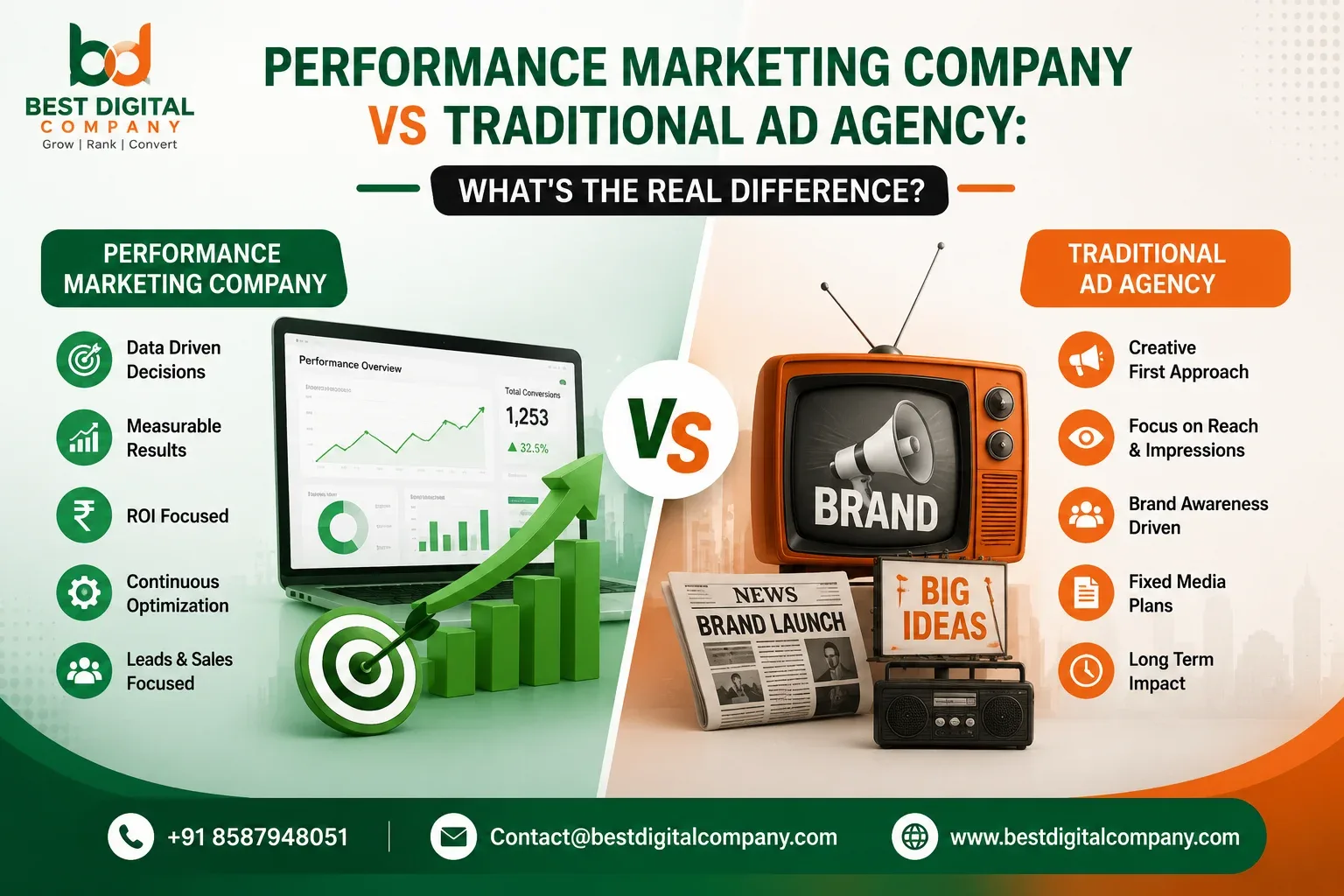
Performance Marketing Company vs Traditional Ad Agency: What is the Real Difference?

If you have sat through a pitch meeting recently, you have probably heard both phrases thrown around like they mean the same thing. “We are a full-service agency.” “We are performance-driven.” “We focus on ROI.” Somewhere in that word salad, most business owners quietly nod along and hope the invoice at the end of the month will explain what they actually bought.

It won’t.

The confusion is understandable. Traditional ad agencies and a performance marketing company both promise to grow your brand, both build campaigns, and both send you decks full of charts. But the way they get paid, the way they measure success, and the way they treat your budget are fundamentally different. One is built around a philosophy of “creative first, measure later.” The other is built around a philosophy of “measure everything, then create around what works.” Confusing the two can cost you months of budget and a marketing plan that looks good in a boardroom but does nothing for your bank account.

This article breaks down exactly how these two models differ, where each one genuinely shines, and how to figure out which approach actually fits the stage your business is at right now.

What a Performance Marketing Company Actually Does

A performance marketing company builds every campaign around a measurable action: a lead form filled, a product purchased, a call placed, an app installed. Nothing gets a green light unless it can be tracked back to a number. If a social post, a landing page, or an ad creative isn’t contributing to that number, it gets changed or dropped, usually within days rather than months.

This is a very different mindset from “brand awareness” campaigns, where success is judged by impressions, reach, or how many people saw the ad. A performance-focused team treats visibility as a means to an end, not the end itself. The question is never “did people see this?” It’s “did people act on this, and can we afford to keep doing it at scale?”

In practice, this usually means combining a few disciplines under one roof:

  • Paid advertising across Google, Meta, and other platforms, managed with tight budget controls and daily optimization
  • Landing page testing to see which version actually converts visitors into leads or customers
  • Search visibility work so that organic traffic supports paid spend instead of competing against it
  • Analytics and attribution to trace every rupee spent back to a result

If any of that sounds familiar, it is because it overlaps heavily with services like pay per click management and search engine optimization except the performance model ties them together under one shared scoreboard: revenue, not vanity metrics.

What a Traditional Ad Agency Actually Does

A traditional ad agency has a different starting point. The work usually begins with a brand strategy session, mood boards, a creative concept, and a media plan built around reach and frequency. The goal is to build recognition and emotional association with a brand over time, the kind of work you see in television commercials, billboards, and large-scale brand campaigns.

There is real craft in this. A good traditional agency can shape how a brand sounds, looks, and feels across every touchpoint. Automobile launches, FMCG brands, and large consumer campaigns still rely heavily on this model because the goal isn’t an immediate click, it’s staying power in a customer’s memory.

The tradeoff is measurement. Reach, impressions, and brand recall studies are far harder to tie directly to sales. A traditional campaign might genuinely be working, shaping perception and consideration, while looking “flat” on a spreadsheet for months. That’s fine for a company with a large budget and a long runway. It’s much riskier for a business that needs leads or sales this quarter, not brand equity in three years.

Performance Marketing Company vs Traditional Ad Agency: The Core Differences

Let is put the two side by side, because the differences show up in almost every part of how the work actually happens.

How Success Gets Measured

A performance marketing company reports on cost per lead, cost per acquisition, conversion rate, and return on ad spend. A traditional ad agency reports on reach, impressions, brand recall, and share of voice. Neither number is “fake,” but they answer completely different questions. One tells you whether the campaign made money. The other tells you whether people noticed.

How Budgets Are Handled

Performance budgets are usually flexible and reallocated weekly, sometimes daily, based on what’s converting. If a Google Ads keyword group is outperforming a Meta campaign, budget shifts there almost immediately. Traditional ad agency budgets tend to be locked into a media plan for a full quarter or campaign cycle, because television slots, print placements, and large creative productions don’t allow for that kind of daily flexibility.

How Pricing Works

This is one of the biggest practical differences. Traditional agencies commonly charge a retainer or a percentage of ad spend, regardless of the direct outcome. A performance marketing company is far more likely to tie at least part of its fee to results, whether that’s cost per lead targets or agreed conversion benchmarks. This alone changes the incentive structure of the entire relationship.

Speed of Optimization

A performance team might test five ad variations in a week and kill the two that underperform by day three. A traditional agency, working within a bigger creative and production cycle, usually can’t move that fast, and honestly, isn’t trying to. Big brand campaigns need consistency, not constant tweaking.

The Skills Involved

Traditional agencies lean heavily on creative directors, copywriters, and media planners. Performance marketing companies lean on paid media specialists, conversion rate optimizers, and analysts who live inside dashboards. Some businesses actually need both, which is why understanding what a google ads expert does day to day versus what a full agency team handles can help you decide who to bring in first.

Why This Distinction Matters More in 2026

A few years ago, this line was blurrier because most agencies claimed to do everything. But tighter marketing budgets, more advanced tracking tools, and increased pressure to show real business impact have pushed the industry to specialize. Business owners today are asking sharper questions before signing contracts: what did last month’s spend actually generate, and can you prove it.

That shift favors performance-based models because they were built for exactly this kind of scrutiny. A performance marketing company lives and dies by dashboards that show, in real time, whether spend is translating into leads or sales. There’s nowhere to hide behind a nicely produced brand video if the conversion numbers aren’t there.

This doesn’t mean brand-building is dead. It means most small and mid-sized businesses, especially those without a multi-year runway, are better served starting with performance-driven work and adding brand campaigns once there’s steady revenue to protect.

Where a Traditional Ad Agency Still Makes Sense

It would be misleading to say the traditional model is obsolete, because it is not. There are situations where it is genuinely the smarter choice:

  • Large product launches that need mass awareness before any purchase intent even exists
  • Established brands protecting market position rather than chasing immediate conversions
  • Categories with long sales cycles, like real estate or enterprise software, where a single ad rarely leads to an instant sale
  • Businesses with the budget and patience to invest in recall and reputation over a longer horizon

If your business fits one of these, blending brand-building with performance tactics, rather than picking only one, often produces the best long-term outcome.

Where a Performance Marketing Company Wins

On the other hand, a performance-first approach tends to be the better fit when:

  • You need leads or sales within weeks, not quarters
  • Your budget is limited and every rupee needs to be justified
  • You are a local business, e-commerce store, or service provider competing on visibility and conversions rather than mass brand recognition
  • You want clear reporting that ties spend directly to outcomes rather than abstract reach numbers

This is also where the overlap with a company’s broader digital presence matters. Paid campaigns rarely perform in isolation. A performance marketing company usually pairs paid ads with organic visibility work, active social media marketing, and a website that’s actually built to convert the traffic being paid for. Sending expensive clicks to a slow, cluttered, or outdated site is one of the fastest ways to waste an ad budget, which is why website development and design often ends up being part of the same conversation, not a separate project handled months later.

A Practical Example

Picture two businesses running the exact same monthly ad budget.

Business A hires a traditional ad agency. They get a polished campaign concept, a media plan spread across a few platforms, and monthly reporting focused on impressions and reach. Three months in, brand awareness has genuinely improved, but leads are inconsistent, and nobody can say with certainty which specific ad or platform is driving actual inquiries.

Business B hires a performance marketing company. Within the first two weeks, three ad variations are tested, the underperforming ones are paused, and budget is shifted toward the landing page generating the most form fills. By month two, the cost per lead has dropped, and the reporting shows exactly which keyword, ad, and platform combination is producing the best return.

Neither business made a wrong choice in principle, they just had different goals. But if Business B actually needed sales this quarter, the performance approach clearly served that need faster and more transparently.

Red Flags to Watch For, Regardless of Which Model You Choose

Whether you’re evaluating a traditional agency or a performance marketing company, a few warning signs apply across the board. Vague reporting that only shows impressions when you asked about leads. Long-term contracts with no clear exit or review point. A refusal to explain exactly how your budget is being spent across platforms. These issues aren’t unique to one model, they’re signs of a vendor relationship that isn’t built on transparency. If any of this sounds familiar from past experience, it is worth reading through common warning signs when evaluating a pay-per-click partner before signing another contract.

How to Choose the Right Fit for Your Business

Instead of asking “which one is better,” a more useful question is: what does my business actually need right now?

If you need measurable leads, tighter cost control, and fast optimization, a performance marketing company is almost certainly the better starting point. If you’re building a long-term brand with a bigger budget and a longer timeline, blending brand strategy with performance tactics tends to work better than choosing purely one lane.

The businesses that get the most value usually don’t treat this as a permanent, one-time decision either. They start with performance-focused work to build a stable base of leads and revenue, then layer in brand-building campaigns once there’s enough consistent income to support a longer-term investment.

Final Thoughts

The difference between a performance marketing company and a traditional ad agency isn’t just terminology, it’s a difference in philosophy, pricing, speed, and accountability. One is built to prove its worth in numbers you can check weekly. The other is built to shape how your brand is remembered over time. Neither approach is automatically wrong, but picking the one that matches your business stage, budget, and timeline will save you months of second-guessing and a lot of unclear invoices.

If you’re trying to figure out which model fits your business, or you want a team that can move between performance-driven campaigns and long-term brand growth as your needs change, it helps to talk through your specific goals with a team that works across search engine optimization, paid media, social platforms, and website performance, rather than one narrow specialty.


Frequently Asked Questions

What exactly is a performance marketing company?

It’s an agency or team that builds campaigns around measurable actions, like leads, sales, or app installs, rather than general brand visibility. Every rupee spent is expected to tie back to a trackable result.

Is a performance marketing company cheaper than a traditional ad agency?

Not necessarily cheaper, but usually more efficient with budget in the short term, since underperforming campaigns get cut quickly instead of running for a full quarter regardless of results.

Can a traditional ad agency also do performance marketing?

Some can, if they have dedicated paid media and analytics teams. But many traditional agencies are structured around creative and media planning, not real-time optimization, so it’s worth asking directly how they handle tracking and reporting before assuming they can.

How fast can I expect results from a performance marketing company?

Early signals, like click-through rates and initial lead volume, often show up within the first two to three weeks. Meaningful, stable results usually take six to eight weeks as campaigns are tested and refined.

Do small businesses need a traditional ad agency at all?

Most small and mid-sized businesses are better served starting with performance-driven work, since it delivers measurable leads faster on a limited budget. Brand-building campaigns tend to make more sense once there’s steady revenue to protect.

What should I ask before hiring either type of agency?

Ask exactly how success will be measured, how often budgets are reviewed, what reporting looks like, and whether there’s a minimum contract lock-in. Clear answers to these questions usually separate a trustworthy partner from a vague one.
Pay Per Click Company Red Flags

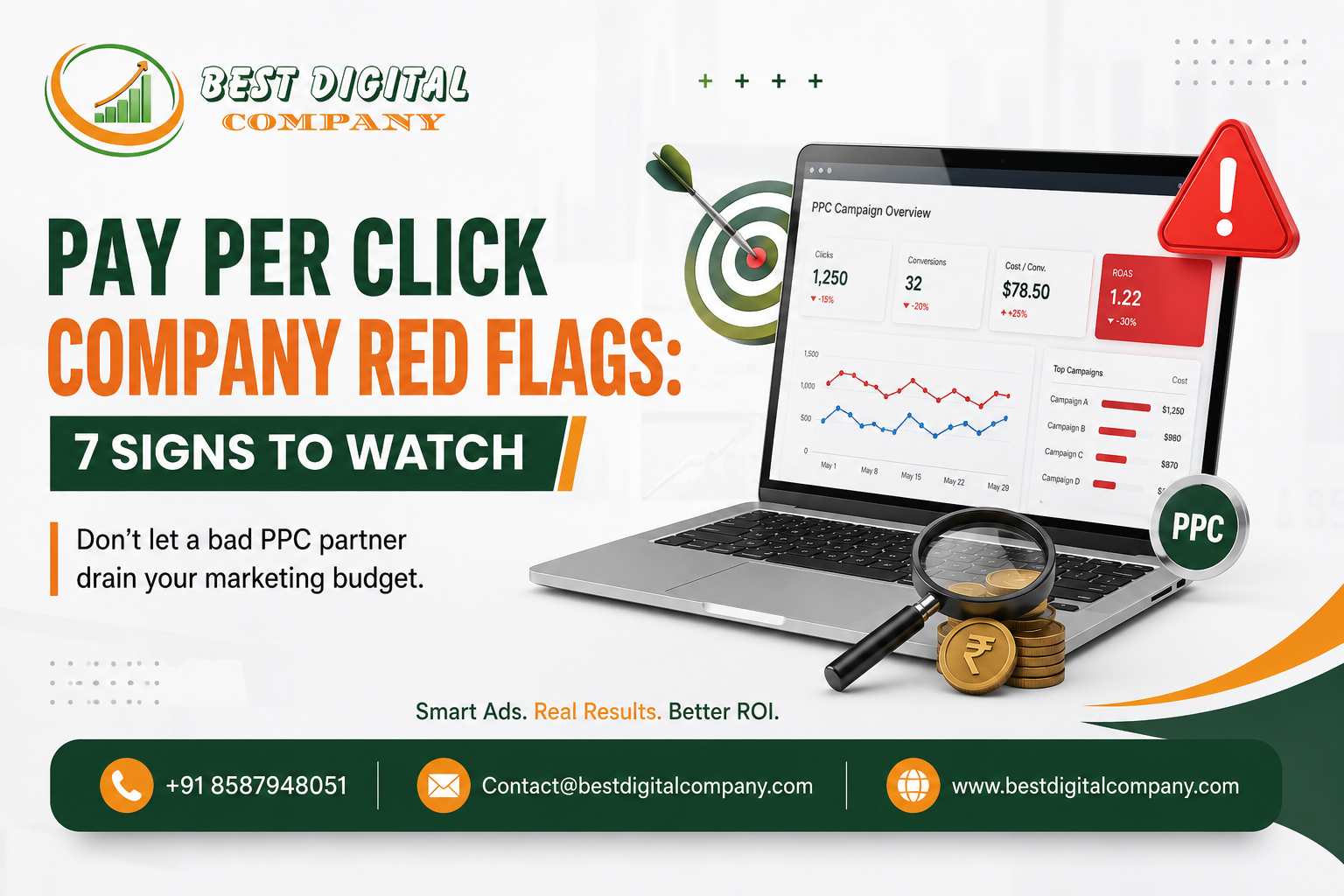
Pay Per Click Company Red Flags: 7 Signs You are Wasting Ad Spend

If you have ever logged into your Google Ads dashboard on a Monday morning and felt a small knot in your stomach before the numbers even load, you already know what this article is about. You are spending money every single day, the clicks are coming in, and yet the phone is not ringing the way it should. Somewhere between the invoice you paid and the leads you expected, something is leaking.

More often than not, that leak has a name: the pay per click company you hired to protect your budget is the one quietly draining it. Not always out of dishonesty. Sometimes it is simple neglect, a junior team member juggling too many accounts, or an agency that never had a real strategy beyond turning campaigns on and hoping for the best.

This guide walks through seven warning signs that tell you your ad spend is not being managed the way it should be, why each one matters more than it sounds, and what a business owner can realistically do about it. If you manage paid advertising in-house, work with a freelancer, or have signed a retainer with a full-service agency, these signs apply to you.

Why Choosing the Right Pay Per Click Company Matters More Than the Discount

Paid advertising is one of the few marketing channels where you can see results within days instead of months. That speed is exactly why it is so easy to get burned. A poorly managed campaign does not fail quietly over a year, like weak content might. It fails loudly, in real time, with your card getting charged the entire way down.

A capable pay per click company treats your budget like it is their own money. They obsess over cost per lead, they test relentlessly, and they tell you the truth even when the truth is “this campaign is not working yet, here is why.” The moment any of that discipline disappears, the red flags below start to show up.

Red Flag #1: You Don’t Have Access to Your Own Ad Account

This is the single biggest warning sign, and it is also the easiest one to check right now. Open your Google Ads or Meta Ads account settings and look at who owns it. If the account was created under the agency’s own login and you were never added as an admin, you do not actually own your advertising history, your audience data, or your account’s performance record.

Here is why that matters: if you ever decide to leave, you leave with nothing. Every conversion tracked, every audience built from remarketing, every quality score earned over months of optimisation stays locked inside an account you cannot access. Some agencies do this innocently, out of convenience. Others do it deliberately, because it makes clients harder to walk away from.

A trustworthy partner will always set up the account under your business’s ownership and add themselves as a manager, not the other way around. If you are unsure how this should look, our ownPay Per Click team walks every client through account ownership before a single rupee is spent on ads.

Red Flag #2: Reports Are Full of Vanity Metrics, Not Business Outcomes

Clicks. Impressions. Reach. These numbers look impressive in a monthly report, and they are also the easiest numbers to inflate without actually growing your business. A campaign can generate thousands of clicks and still produce zero paying customers if the targeting is broad, the keywords are irrelevant, or the offer does not match search intent.

Ask yourself a simple question the next time a report lands in your inbox: does this document tell me how many leads or sales came from this spend, and at what cost? If the answer is buried, missing, or replaced with phrases like “great engagement” and “strong visibility,” that is a sign the agency is measuring the wrong things, or hiding the right ones.

A reliable pay per click company will always tie reporting back to cost per lead, cost per acquisition, and return on ad spend, because those are the numbers that actually decide whether your business grows or shrinks.

Red Flag #3: Every Client Gets the Same Cookie-Cutter Campaign Structure

Paid advertising has a strategy problem that shows up often: agencies build one campaign template and reuse it across every client, regardless of industry, competition, or customer journey. A real estate business, a dental clinic, and an e-commerce store do not convert the same way, and running identical ad structures for all three is a guaranteed way to waste budget on at least two of them.

Signs of this include generic keyword lists that were clearly copied from a template, ad copy that reads like it could belong to any business in any city, and a complete absence of industry-specific research before launch. This is closely related to how search visibility gets built as well; if you have ever compared how Search Engine Optimization and paid campaigns should work together, you already know that both need to reflect how your specific customers actually search, not a generic assumption of how “most people” search.

We covered a related comparison in an earlier piece on our blog, PPC Services Explained: What a Performance Marketing Agency Really Does Every Month, which breaks down what genuinely customised account management should look like month over month.

Red Flag #4: Nobody Is Talking About Your Landing Pages

A pay per click company that only focuses on the ad and ignores where the click actually lands is only doing half the job. You can have the most relevant keyword, the sharpest ad copy, and a perfect quality score, and still lose the sale if the person clicks through to a slow, confusing, or outdated page.

If your agency has never asked about your landing page load speed, mobile experience, or the clarity of your call-to-action, that is a gap worth questioning. Conversion rate optimisation is not a separate service that happens somewhere else; it is part of the same job as managing the ad spend, because the ad and the page are two halves of the same transaction.

This is also where good Website Development work quietly protects your ad budget. A page that loads in under three seconds and clearly states what you are offering will always outperform a beautiful but bloated page, no matter how well the campaign underneath it is built.

Red Flag #5: You’re Locked Into a Long Contract With No Exit Clause

Long-term contracts are not automatically a bad sign; consistency does matter in paid advertising, and campaigns often need two to three months to gather enough data to optimise properly. The red flag is a contract with no performance benchmarks, no review points, and no reasonable way out if the results genuinely are not there after a fair testing period.

Ask directly: what happens if this is not working after ninety days? A confident agency will have an answer ready, because they expect their own work to hold up to scrutiny. An agency that gets defensive, vague, or suddenly brings up “the market” or “the algorithm” as an excuse before you have even asked a hard question is telling you something important about how they plan to handle future conversations.

Red Flag #6: Negative Keywords and Wasted Clicks Are Never Discussed

This one is technical, but it has an outsized impact on your budget. Negative keywords are the terms you tell the platform not to show your ads for, and they are one of the fastest ways to stop paying for clicks that were never going to convert. A clothing brand selling premium jackets, for example, needs to exclude searches like “free,” “cheap,” or “jacket repair near me,” or their budget quietly bleeds out on browsers who were never buyers.

If a monthly review has never once mentioned search term reports, wasted spend, or negative keyword lists, there is a good chance nobody has looked closely at where your clicks are actually coming from. This is basic account hygiene, and its absence over several months usually points to a set-it-and-forget-it approach rather than active management.

Red Flag #7: Communication Feels One-Sided and Reactive

The final sign is less about numbers and more about how the relationship feels. Do you have to chase your account manager for updates? Are calls rescheduled repeatedly? Does every question get answered days later, if at all? Paid advertising moves fast, and a partner who is not proactively flagging both wins and problems is not actually managing your account in real time.

A pay per click company worth keeping will reach out when something changes, whether that is a cost increase, a new competitor bidding on your keywords, or an opportunity worth testing. Silence, especially when your money is being spent daily, is rarely a good sign.

What Good Pay Per Click Management Actually Looks Like

None of this is meant to make paid advertising sound like a minefield. When it is managed properly, it remains one of the most direct ways to generate qualified leads on demand. The difference between a campaign that wastes money and one that fuels growth usually comes down to a handful of habits: transparent account access, honest reporting tied to business outcomes, ongoing keyword and negative keyword management, attention to landing pages, and communication that does not require chasing.

If you are also weighing whether to bring this in-house, hire a freelancer, or work with a dedicated team, our earlier guide on How to Choose the Best PPC Company for Your Business in 2026 goes deeper into that specific decision and the trade-offs involved with each option.

It is also worth remembering that paid campaigns rarely work in isolation. Businesses that pair paid advertising with organic visibility and active social presence tend to see lower costs over time, because branded search traffic and social proof both make paid clicks convert better. If your current setup only touches paid ads and nothing else, it may be worth exploring how Social Media Marketing can support the same campaigns you are already running. Similarly, businesses often ask us how paid strategy compares against organic-first approaches, a topic we unpacked in SEO Agency vs SEO Company: Is There Really a Difference?, since the two channels tend to work best together rather than as substitutes.

A Quick Checklist Before You Sign With Any Pay Per Click Company

Before your next renewal or your first contract, run through this short list:

  • Do you have full admin access to your own ad accounts?
  • Does the monthly report show cost per lead and return on ad spend, not just clicks?
  • Has the agency researched your industry specifically, or reused a generic template?
  • Is your landing page part of the conversation, or only the ad itself?
  • Is there a clear plan if results are not there after a fair testing window?
  • Are negative keywords and wasted spend reviewed regularly?
  • Do you get updates without having to ask first?

If you answered no to two or more of these, it is worth having a direct conversation with your current provider, or exploring options that are built around transparency from day one. Reasonable providers will also offer clear, tiered options rather than one flat number; our PPC Packages page breaks down what is typically included at each level, so there are no surprises later.

Frequently Asked Questions

How do I know if my pay per click company is overcharging me for management fees?

 Compare the management fee against the total ad spend it covers. Most transparent providers charge a percentage of spend or a flat monthly fee that is disclosed upfront, along with a breakdown of what is included, such as campaign setup, ongoing optimisation, and reporting. If the fee structure has never been explained clearly, ask for it in writing.

What is a reasonable amount of time to give a new campaign before judging results?

Most search campaigns need at least four to six weeks to gather enough data for the platform’s algorithm to optimise properly, and eight to twelve weeks to show a clearer trend in cost per lead. Judging a campaign after the first week almost always leads to premature and inaccurate conclusions.

Should I ever manage pay per click campaigns myself instead of hiring an agency?

It depends on your time, budget, and how quickly you need results. Managing campaigns in-house can work for small, simple accounts, but it requires ongoing learning as platform rules change frequently. For larger budgets or multiple channels, a dedicated team usually recovers its own cost through better targeting and reduced wasted spend.

What is the difference between a pay per click company and a full-service digital marketing agency?

A dedicated pay per click company typically focuses only on paid advertising across platforms like Google Ads and Meta Ads. A full-service agency usually bundles paid ads with services such as search engine optimisation, social media management, and web development, which can help when channels need to work together rather than in isolation.

Can switching agencies hurt my existing campaign performance?

There can be a short adjustment period while a new team reviews historical data and adjusts strategy, but this is usually far less damaging than continuing with an underperforming account. Ask any new provider how they handle the transition, including migrating conversion tracking and historical audience data, before you make the switch.

Final Thought

Wasted ad spend rarely announces itself with a single dramatic mistake. It shows up slowly, through small gaps that add up over months: an account you cannot access, a report that never quite answers your questions, a landing page nobody optimised, a conversation that always feels one step behind. Spotting these seven signs early gives you the chance to fix the relationship or find a partner who treats your budget with the seriousness it deserves.

If you would like a second opinion on your current campaigns, our team is happy to review your account structure and reporting at no cost, and tell you plainly whether your spend is working as hard as it should be.