Best Free SEO Tools for Small Businesses in 2026

Best Free SEO Tools for Small Businesses in 2026

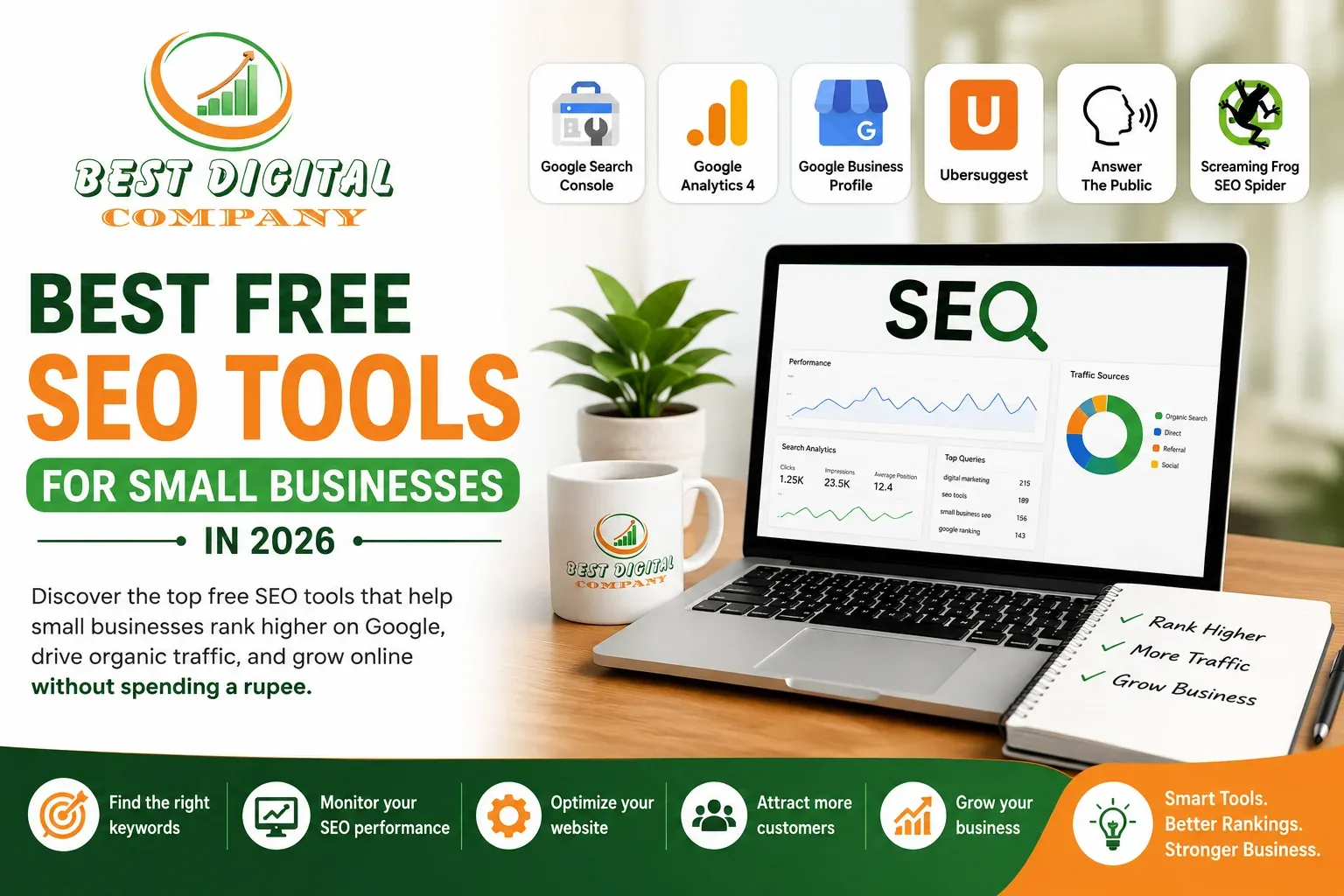
Discover the top free SEO tools that help small businesses rank higher on Google, drive organic traffic, and grow online without spending a rupee.

Running a small business is already a full-time job. Between managing customers, handling operations, and keeping your finances in check, it can feel impossible to also think about showing up on Google. But here’s the truth, if people can’t find you online, you’re leaving serious money on the table.

The good news? You don’t need a massive marketing budget to compete. There are powerful, free SEO tools available today that can give your small business the same visibility advantages that big brands enjoy. You just need to know which ones are actually worth your time.

At Best Digital Company, we’ve helped dozens of small and medium-sized businesses in Delhi and across India build strong organic search presences often starting with these exact free tools. In this guide, we’re breaking down the best free SEO tools for small businesses, what they do, and exactly how to use them.


Why SEO Matters for Small Businesses

Before we dive into the tools, let’s address the elephant in the room, why does SEO even matter for a small, local business?

Think about your own behaviour. When you need a plumber, a bakery, or a digital marketing agency, where do you go first? Google. Your potential customers do the same. Studies consistently show that over 90% of online experiences begin with a search engine, and the first page of Google captures nearly 95% of all clicks.

If you’re not showing up on page one, you’re practically invisible. SEO fixes that and free tools make it accessible to businesses at every level.

Let’s get into the tools.


1. Google Search Console – Your SEO Command Centre

What It Is

Google Search Console (GSC) is a free tool directly from Google that shows you exactly how your website performs in Google Search. If you only set up one tool from this entire list, make it this one.

What It Does for Small Businesses

  • Shows which search queries are driving traffic to your site
  • Identifies which pages are getting impressions but low clicks (a huge opportunity)
  • Flags technical errors like broken pages, crawl issues, and mobile usability problems
  • Lets you submit your sitemap so Google indexes your pages faster
  • Tracks your average ranking position for different keywords

Pro Tip

In the Performance tab, look for keywords where your site appears in positions 8–20. These are your low-hanging fruit. With a little content optimisation, you can push those to page one and dramatically increase your traffic  without creating brand-new content.


2. Google Analytics 4 – Understand Your Visitors

SEO isn’t just about getting visitors ,it’s about getting the right visitors. Google Analytics 4 (GA4) tells you what those visitors do once they land on your site.

What You’ll Learn

  • Which pages visitors spend the most time on (these are your best-performing pages)
  • Where your traffic comes from organic search, social media, direct, referrals
  • Which pages have high bounce rates (visitors leave immediately something needs fixing)
  • User demographics and interests, helping you create better-targeted content
  • Conversion tracking ,are visitors actually taking action (calling, buying, enquiring)?

When used together, Google Search Console and GA4 give you a nearly complete picture of your SEO health all for free.


3. Google Business Profile – The Local SEO Game-Changer

If your business serves a local area -0 a shop, a clinic, a restaurant, a service provider — Google Business Profile (GBP) is arguably the most important free SEO asset you have. This is what makes your business show up in the Google Maps section and the local “3-pack” that appears at the top of local searches.

How to Maximise It

  • Fill out every single field, business name, address, phone, hours, website, categories
  • Upload high-quality photos of your premises, team, and products/services
  • Actively collect and respond to Google reviews (this directly impacts your local ranking)
  • Post regular updates, offers, and events using the Posts feature
  • Use the Q&A section to answer common customer questions before they even ask

For small businesses in Delhi and other Indian cities, an optimised Google Business Profile can be the difference between a phone that rings and one that doesn’t.


4. Ubersuggest – Keyword Research Without the Price Tag

Keyword research is the foundation of all SEO. If you’re creating content without knowing what your potential customers are actually searching for, you’re writing into the void. Ubersuggest, created by digital marketing expert Neil Patel, offers a solid free tier for keyword research.

Key Features (Free Tier)

  • Keyword suggestions with monthly search volume and competition scores
  • Content ideas based on what’s already ranking for your target keyword
  • Backlink data showing who links to your competitors
  • Site audit tool to spot on-page SEO issues
  • Competitor analysis see what’s working for businesses like yours

Start by typing in your main business keyword (e.g., “digital marketing Delhi” or “bakery Lajpat Nagar”) and explore the related keywords it suggests. Look for keywords with decent search volume but low SEO difficulty those are the ones you can realistically rank for.


5. AnswerThePublic – Discover What Your Customers Are Asking

One of the most underrated free SEO tools for small businesses is AnswerThePublic. Enter a keyword and it generates a visual map of all the questions, prepositions, and comparisons people type into search engines related to that topic.

This is gold for content creation. Instead of guessing what to write about, you’re answering questions your customers are already asking Google. Each question becomes a potential blog post, FAQ section, or service page.

For example, if you’re a digital marketing agency, you might discover questions like:

  • “How much does SEO cost for a small business?”
  • “Is social media marketing worth it for local businesses?”
  • “What is the difference between SEO and PPC?”

Each one of those is a blog post waiting to be written content that captures real search intent and drives qualified leads to your site.


6. Yoast SEO – On-Page Optimisation Made Simple (WordPress Users)

If your website runs on WordPress (and many small business sites do), Yoast SEO is an essential free plugin. It removes the guesswork from on-page optimisation by giving you real-time feedback as you write.

What Yoast Does

  • Guides you to write an optimised SEO title and meta description for every page
  • Analyses your content’s readability and keyword usage
  • Automatically generates XML sitemaps to help Google crawl your site
  • Adds structured data (schema markup) to help your site appear in rich snippets
  • Alerts you to thin content, missing alt text, and other on-page issues

Think of Yoast as a junior SEO assistant that sits in your WordPress dashboard and tells you what to fix before you hit publish.


7. Screaming Frog SEO Spider (Free Version) – Technical SEO Audit

Technical SEO is the backbone of your website’s performance in search. Even the best content won’t rank if your site has broken links, missing meta tags, duplicate pages, or slow load times. Screaming Frog’s free version crawls up to 500 URLs and identifies exactly these kinds of issues.

What to Look For

  • Pages returning 404 errors (broken pages hurt both users and rankings)
  • Missing or duplicate title tags and meta descriptions
  • Images without alt text (accessibility and SEO issue)
  • Pages that redirect incorrectly (redirect chains)
  • Thin content pages with very little text

Run a crawl once a month to catch issues before they tank your rankings. For sites under 500 pages, the free version is all you’ll need.


8. Google PageSpeed Insights – Speed Up Your Site

Page speed is a confirmed Google ranking factor, and it also directly affects your conversion rate. Research shows that if a page takes longer than 3 seconds to load, more than half of visitors will leave. Google PageSpeed Insights is a free tool that analyses your website’s loading speed and tells you exactly what to fix.

It breaks down issues into categories like image compression, unused JavaScript, and render-blocking resources and for most issues, it tells you specifically how to fix them. This is especially important in India, where many users browse on mobile data connections.

Aim for a score above 70 on mobile. Anything under 50 is a red flag that’s likely hurting your rankings and your user experience.


9. MozBar – Quick On-Page Analysis in Your Browser

MozBar is a free Chrome extension that adds an SEO toolbar to every page you visit. As you browse your own site or your competitors’ sites, it shows you critical SEO data at a glance.

  • Domain Authority (DA) – a score indicating how strong a website’s backlink profile is
  • Page Authority – the strength of a specific page
  • On-page elements like title tags, meta descriptions, and header structure
  • Link metrics – see how many links a page has and where they go
  • Keyword highlighting on any search results page

MozBar is great for competitive research before you create content or target a keyword, check the Domain Authority of the pages currently ranking to understand how competitive the space is.


10. Ahrefs Webmaster Tools – Free Backlink & Keyword Data for Your Site

Ahrefs is one of the most powerful SEO tools in the world and while the full version is expensive, their free Webmaster Tools product gives small business owners something incredibly valuable: complete backlink and keyword data for their own website.

What You Get for Free (Verified Site Only)

  • Full backlink profile – see every site linking to you
  • Organic keywords – every keyword your site ranks for in Google
  • Site health score with prioritised technical issues to fix
  • Broken backlinks – find and reclaim links pointing to deleted pages
  • Top pages by organic traffic and ranking position

You simply verify your website (the same process as Google Search Console), and Ahrefs gives you a level of insight that used to cost hundreds of dollars a month. For any small business serious about SEO, this is a must-use.


How to Use These Tools Together: A Simple Monthly SEO Routine

You don’t need to use all ten tools every day. Here’s a simple monthly routine that covers all the bases:

  • Week 1 – Content: Use AnswerThePublic and Ubersuggest to find keywords and content ideas. Write one optimised blog post or update an existing page.
  • Week 2 – Technical: Run a Screaming Frog crawl. Fix any broken links or missing meta tags. Check Google PageSpeed Insights and action the top recommendations.
  • Week 3 – Performance: Log into Google Search Console. Review which pages got impressions without clicks. Update those pages to better match search intent.
  • Week 4 – Local & Links: Update your Google Business Profile with a new post or photos. Check Ahrefs Webmaster Tools for any new backlinks and respond to Google reviews.

That’s roughly 2-3 hours a month. Consistent effort with free tools will outperform inconsistent use of expensive tools every single time.


Frequently Asked Questions

Can free SEO tools really help my small business rank on Google?

Yes ,absolutely. Google Search Console, Google Business Profile, and Ahrefs Webmaster Tools are all free and are used by professional SEO agencies (including ours) every single day. The paid tools mainly offer more data on competitor sites; for your own site, free tools cover the essentials extremely well.

How long does it take to see results from SEO?

SEO is a long-term investment. Most businesses start seeing meaningful improvements within 3 -6 months of consistent effort. Local SEO (through Google Business Profile) can show results faster, sometimes within weeks of optimisation.

Do I need all 10 of these tools?

Not all at once. Start with Google Search Console, Google Analytics 4, and Google Business Profile, these three alone will give you a solid foundation. Add the others progressively as you get comfortable.

What is the most important free SEO tool for a local business?

Google Business Profile, without question. If your business serves a local area, an optimised GBP listing is the fastest way to appear in relevant local searches and on Google Maps.


Final Thoughts – Start Today, Grow Tomorrow

SEO doesn’t have to be expensive or complicated. With the ten free tools covered in this guide, you have everything you need to build a solid organic search presence, understand your audience, and outrank your competitors even on a tight budget.

The key is consistency. Pick two or three tools, get comfortable with them, and build from there. Small, regular improvements compound over time into significant results.

And if you’d like expert help implementing these strategies or if you want to accelerate your growth with a tailored SEO campaign our team at Best Digital Company is here to help. We’ve been helping businesses across Delhi and India grow their online presence through smart, ethical SEO strategies that deliver real, measurable results.


Ready to Grow Your Business Online? Get a free SEO audit from Best Digital Company — Delhi’s trusted digital marketing experts.

🌐 Website: https://bestdigitalcompany.com 📞 Phone: +91 8587948051 📧 Email: Contact@bestdigitalcompany.com
AI Is Transforming Digital Marketing

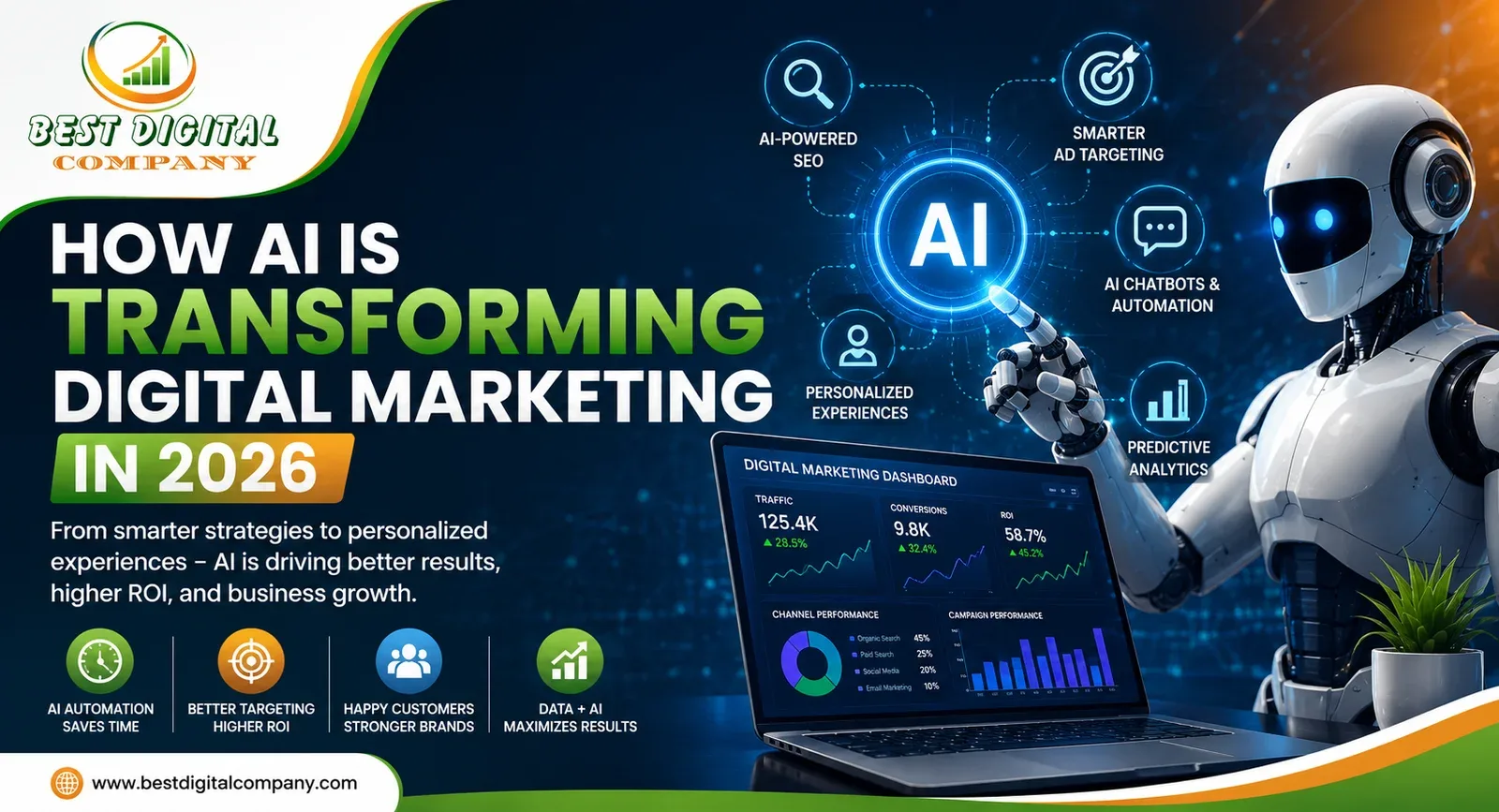
How AI Is Transforming Digital Marketing in 2026

Artificial Intelligence is no longer a futuristic concept in digital marketing. It is the engine driving modern campaigns, strategies, and customer experiences. In 2026, businesses that embrace AI-powered marketing aren’t just ahead of the curve; they are redefining it entirely.

From how we discover products online to the ads we see on social media, AI is silently but powerfully reshaping every touchpoint of the customer journey. At Best Digital Company Delhi’s leading digital marketing agency. we have witnessed this transformation first-hand, helping hundreds of brands leverage AI to generate more traffic, leads, and revenue.

In this comprehensive guide, we break down the most significant ways AI is transforming digital marketing in 2026, and how your business can harness these innovations to stay competitive in an increasingly intelligent marketplace.

Key Stats at a Glance:

  • 80% of marketing teams now use AI tools regularly
  • Businesses using AI personalization see 3.5× higher conversion rates
  • AI optimization reduces ad spend waste by up to 60%
  • The global AI marketing industry is projected to reach ₹4.5 lakh crore by 2027

1. AI-Powered SEO: Smarter Rankings, Faster Results

Search Engine Optimization has always been data-intensive, but AI has transformed it from a manual process into a dynamic, intelligent system. In 2026, AI tools analyze thousands of ranking signals simultaneously, predict algorithm shifts, and recommend content changes in real time.

What AI does for SEO:

  • Automated keyword research based on user intent, not just search volume
  • Content gap analysis to identify topics your competitors rank for but you don’t
  • On-page optimization suggestions driven by Natural Language Processing (NLP)
  • Technical SEO audits that detect crawl issues, Core Web Vital failures, and schema gaps
  • Predictive SERP analysis to forecast which content will rank for emerging queries

Google’s AI-powered Search Generative Experience (SGE) has fundamentally changed how results appear. Businesses that optimize for AI-featured snippets and conversational search queries are capturing significantly more visibility than those using traditional SEO approaches.

Pro Tip: Optimizing for “answer-first” content, where you directly answer the user’s query in the first 50–80 words dramatically increases your chances of appearing in AI-generated search summaries and featured snippets.


2. Hyper-Personalization at Scale

One-size-fits-all marketing is extinct. In 2026, AI enables brands to deliver individualized experiences to millions of users simultaneously ,a capability that was simply impossible before machine learning.

AI analyzes behavioral data, purchase history, browsing patterns, device usage, and even sentiment signals to build a dynamic profile of each user. This allows marketers to serve the right message, on the right channel, at precisely the right moment.

AI personalization in action:

Product Recommendations: AI engines suggest products based on real-time browsing behavior, dramatically boosting average order value  the same technology that powers Amazon and Flipkart’s recommendation systems.

Dynamic Email Campaigns: AI personalizes email subject lines, content blocks, and send times for each individual recipient, improving open rates by up to 41%.

Website Personalization: Landing pages dynamically adapt their content, CTAs, and offers based on who is visiting new vs. returning, location, referral source, and more.

Indian businesses especially in e-commerce, edtech, and fintech are rapidly adopting AI personalization platforms to compete with global players and meet increasingly sophisticated consumer expectations.


3. AI-Assisted Content Creation & Strategy

Content marketing has been supercharged by generative AI. Tools powered by large language models can now produce first drafts, suggest headline variations, generate social media captions, and even write long-form articles all at unprecedented speed.

However, the most successful brands in 2026 are not replacing human writers with AI ,they are using AI as a powerful assistant to accelerate ideation, research, and production while maintaining authentic brand voice and expert insight.

“The brands winning with AI content in 2026 are those who use it to do more human marketing, not less freeing their teams to focus on creativity, strategy, and storytelling.”

AI content applications in 2026:

  • Blog post outlines, introductions, and meta descriptions generated in seconds
  • Video scripts and podcast episode structures created from a single brief
  • Multilingual content creation for regional Indian markets (Hindi, Tamil, Bengali, and more)
  • AI image generation for social media posts and ad creatives
  • Automated content repurposing turning one blog into 10 social posts instantly

4. Smarter PPC Advertising & Ad Optimization

Pay-Per-Click advertising has been completely reimagined by AI. Google’s Performance Max campaigns and Meta’s Advantage+ suite now use deep learning to automatically test ad combinations, allocate budget across channels, and identify the highest-converting audience segments often outperforming manually managed campaigns by a significant margin.

Automated Bidding: AI adjusts bids in real time based on auction signals, device, time, location, and user intent maximizing conversions within your budget.

Creative Testing at Scale: AI simultaneously tests hundreds of ad copy and image combinations, identifying winning creatives far faster than manual A/B testing ever could.

Audience Intelligence: Predictive audience modeling finds users most likely to convert even before they’ve shown explicit purchase intent signals.

For businesses in Delhi and across India, AI-powered PPC means more conversions at a lower cost-per-acquisition directly impacting your marketing ROI and revenue growth.


5. Conversational AI & Chatbots

The chatbot of 2026 is nothing like the frustrating, scripted bots of the past. Powered by sophisticated large language models, today’s AI assistants can hold nuanced conversations, understand complex queries, recommend products, process returns, and even close sales — available 24/7 without human intervention.

Businesses deploying AI chatbots are seeing dramatic improvements in customer satisfaction scores and lead generation. For digital marketing specifically, chatbots now serve as powerful conversion tools engaging website visitors, qualifying leads, and guiding users through purchase decisions in real time.

Key chatbot applications:

  • WhatsApp AI assistants handling customer queries for Indian businesses around the clock
  • Website chatbots that capture leads, schedule appointments, and answer FAQs instantly
  • AI voice assistants integrating with Google Assistant and Alexa for commerce queries
  • Multilingual chatbots serving customers in their preferred regional languages

6. AI in Social Media Marketing

Social media platforms have embedded AI so deeply into their algorithms that understanding AI is now a prerequisite for effective social media marketing. In 2026, AI determines what content gets seen, by whom, and when making strategic alignment with these systems essential.

Key AI applications for social media:

  • Optimal posting time prediction based on your specific audience’s activity patterns
  • Sentiment analysis of comments and mentions for real-time brand monitoring
  • AI-powered hashtag and caption recommendations to maximize organic reach
  • Influencer identification finding creators whose audience best matches your target demographic
  • Automated social media reporting and competitive benchmarking

India-Specific Insight: With over 700 million social media users in India, AI-powered social listening and regional content localization are becoming critical differentiators for brands looking to capture diverse, multilingual audiences across Instagram, YouTube, and Moj.


7. Predictive Analytics & Data-Driven Decisions

Perhaps the most transformative application of AI in digital marketing is predictive analytics the ability to forecast future customer behavior, campaign outcomes, and market trends with remarkable accuracy.

Rather than analyzing what happened (descriptive analytics), AI now tells marketers what is likely to happen enabling proactive strategy adjustments before performance dips, rather than reactive fixes after the fact.

Customer Churn Prediction: Identify customers showing signs of disengagement before they leave and trigger targeted retention campaigns automatically.

Revenue Forecasting: AI models accurately project monthly and quarterly revenue, enabling smarter budget allocation and growth planning.

Attribution Modeling: AI multi-touch attribution accurately shows which channels are driving conversions eliminating guesswork from your marketing mix.


8. Challenges, Ethics & the Human Element

Despite its transformative power, AI in digital marketing is not without challenges. Responsible marketers must navigate data privacy regulations (like India’s DPDP Act), avoid algorithmic bias in targeting, and ensure transparency when AI-generated content is used in customer communications.

Key challenges to address:

  • Data privacy compliance collecting and using customer data ethically and legally
  • Maintaining authentic brand voice when using AI content generation tools
  • Avoiding over-automation that makes customer interactions feel impersonal
  • Ensuring AI models are trained on diverse, representative datasets

The most successful businesses treat AI as a powerful collaborator, not a replacement for human strategy and creativity. Expert marketers who understand AI tools while bringing human empathy, cultural context, and creative vision to campaigns will continue to outperform pure automation.

“AI handles the data, the speed, and the scale. Humans bring the strategy, the empathy, and the brand soul. The future belongs to teams that master both.”


Conclusion: Is Your Business AI-Ready?

AI is not a trend to watch from the sidelines in 2026, it is the fundamental infrastructure of competitive digital marketing. Whether you are a startup in Ghaziabad, a growing business in Delhi, or an enterprise brand targeting pan-India audiences, integrating AI into your digital marketing strategy is no longer optional.

At Best Digital Company, we specialize in building AI-powered digital marketing strategies that deliver measurable results more traffic, more leads, and more revenue. From advanced SEO and PPC campaigns to social media marketing and website development, we are your growth partner in the age of AI.


Frequently Asked Questions (FAQ)

How is AI used in digital marketing in 2026?

In 2026, AI is embedded across virtually every aspect of digital marketing. It powers SEO tools that analyze search intent and recommend content optimizations, advertising platforms that automatically test and optimize campaigns, personalization engines that tailor website content and emails to individual users, chatbots that handle customer queries 24/7, and analytics platforms that forecast future campaign performance. AI has moved from an experimental technology to core marketing infrastructure.

Can small businesses in India afford AI-powered digital marketing?

Absolutely. The AI marketing tool landscape in 2026 is far more accessible than it was even two years ago. Many platforms offer affordable monthly subscriptions, AI-powered email marketing, social media scheduling, basic chatbots, and SEO tools are available to small businesses for just a few thousand rupees per month. Working with a digital marketing agency like Best Digital Company also gives small businesses access to enterprise-level AI tools and expertise at manageable costs.

Will AI replace digital marketers and their jobs?

No, AI is augmenting marketers, not replacing them. What AI does exceptionally well is handle repetitive, data-intensive tasks: bid management, A/B testing at scale, data analysis, and content drafting. What it cannot replicate is genuine strategic thinking, creative brand storytelling, relationship building, cultural nuance, and ethical judgment. The most valuable digital marketers in 2026 are those who combine deep marketing expertise with proficiency in AI tools.

How does AI specifically improve SEO performance?

AI improves SEO in multiple ways: it automates keyword research at scale by analyzing search intent rather than just volume; it identifies content gaps compared to competitors; it uses Natural Language Processing (NLP) to optimize content for semantic relevance; it monitors and flags technical SEO issues automatically; and it helps businesses optimize for Google’s AI-powered search features like SGE (Search Generative Experience). The result is faster, more accurate, and more effective optimization than purely manual SEO.

What is the biggest AI trend in digital marketing right now?

The dominant trend in 2026 is AI-driven hyper-personalization delivering individually tailored content, product recommendations, and advertising experiences to each user based on their real-time behavioral data. Related to this is the rise of conversational AI through chatbots and voice assistants, and the integration of AI into search through Google’s SGE, which is fundamentally changing how businesses need to approach SEO and content strategy.

How do I get started with AI-powered digital marketing for my business?

The best starting point is a digital marketing audit to identify where AI can have the greatest impact for your specific business whether that’s SEO, paid advertising, email marketing, or customer service. From there, you can implement AI tools incrementally, beginning with platforms that offer the most immediate ROI for your industry and goals. Best Digital Company offers a free consultation to help businesses map their AI marketing roadmap. Contact us at +91 8587948051 or Contact@bestdigitalcompany.com.

Is AI marketing ethical? What about data privacy?

AI marketing is ethical when implemented responsibly. This means collecting customer data transparently with proper consent, complying with India’s Digital Personal Data Protection (DPDP) Act and other relevant regulations, avoiding discriminatory targeting practices, and being transparent with customers about AI-generated content when appropriate. Responsible AI marketing which puts customer trust at its center is not only ethical but also more effective in building long-term brand loyalty.