

Every day, thousands of hungry people open Google and type phrases like “best café near me” or “top restaurants in Delhi.” The restaurants that appear at the top of those results aren’t there by accident, they’ve invested in SEO. And if your restaurant isn’t showing up, you’re quietly handing those customers to your competitors.
This guide breaks down exactly how restaurants can improve their Google Maps rankings and Google Search visibility with practical, actionable steps you can start implementing today.
Why SEO Matters More Than Ever for Restaurants
Before a customer decides where to eat, most of them Google it. They check ratings, read reviews, browse photos, and compare options all before stepping out of the house. If your restaurant doesn’t appear in those results, it simply doesn’t exist in their decision-making process.
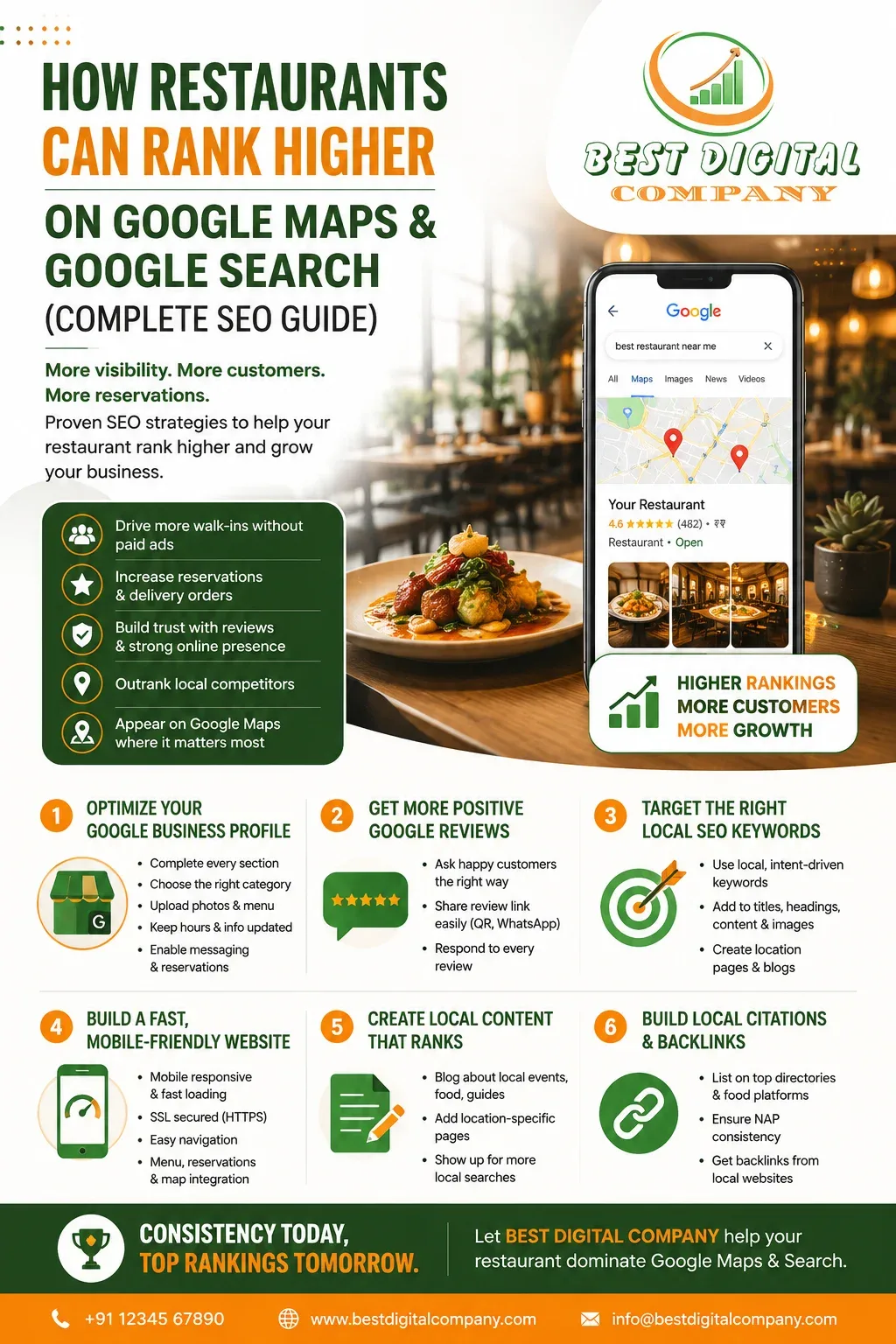
A well-executed restaurant SEO strategy helps you:
- Drive consistent walk-in traffic without depending on paid advertising
- Increase online reservations and food delivery orders
- Build credibility through reviews, ratings, and a polished online presence
- Outrank local competitors in your area
- Appear prominently on Google Maps – where most local food searches end
The best part? Unlike paid ads, SEO delivers compounding results over time. Invest once, reap the benefits for months and years.
1. Optimize Your Google Business Profile – Your Most Powerful Local SEO Asset
If you do nothing else on this list, do this. Your Google Business Profile (GBP) is the single most influential factor in how your restaurant ranks on Google Maps.
An incomplete or outdated profile signals neglect both to customers and to Google’s algorithm. A fully optimized profile, on the other hand, builds trust and pushes you higher in local search results.
Here’s what a fully optimized Google Business Profile looks like:
- Business Name: Use your exact restaurant name, no keyword stuffing
- Address & Phone Number: Must be accurate and consistent with every other platform
- Business Category: Choose the most specific and relevant category (e.g., “North Indian Restaurant” rather than just “Restaurant”)
- Photos: Upload high-resolution images of your dishes, interiors, ambience, and team regularly
- Menu: Add your full menu with prices directly to your profile
- Business Hours: Keep these updated, especially during holidays and special events
- Business Description: Write a natural, keyword-rich description that tells customers who you are and what makes you special
- Messaging & Reservations: Enable these features to reduce friction for potential customers
2. Get More Positive Google Reviews (And Respond to Every Single One)
Reviews are the currency of local SEO. Restaurants with more reviews and higher ratings consistently outrank those without them. But beyond rankings, reviews are what convert a searcher into a guest.
How to generate more Google reviews consistently:
- Ask at the right moment — when a customer compliments the food or thanks your staff, that’s your window
- Make it frictionless — share a direct Google review link via WhatsApp, SMS, or printed QR codes on the table
- Train your team — your front-of-house staff should know how to naturally invite happy guests to leave a review
- Respond to every review — thank positive reviewers warmly, and address negative ones professionally and constructively
Responding to reviews shows Google (and potential customers) that you’re engaged and take feedback seriously. It’s a small effort with a significant impact on both trust and rankings.
3. Target the Right Local SEO Keywords
Your restaurant’s website needs to speak the same language your customers are using when they search on Google. That means intentionally weaving local, intent-driven keywords throughout your content.
Examples of high-intent restaurant keywords:
- Best restaurant in Delhi
- Family restaurant near Connaught Place
- Top café in Ghaziabad
- Best North Indian food in Noida
- Fine dining restaurant in Delhi NCR
- Rooftop restaurant in South Delhi
- Budget-friendly restaurants near me
Where to use these keywords:
- Page titles and meta descriptions
- Website headings
- Body content on your homepage, about page, and menu page
- Blog posts and location pages
- Image alt text and file names
The key is to use keywords naturally, write for your customer first, and let the SEO follow. Stuffing keywords awkwardly into your content will hurt both readability and rankings.
4. Build a Fast, Mobile-Friendly Restaurant Website
Your Google Business Profile gets people interested. Your website seals the deal. A slow, cluttered, or hard-to-navigate website is a conversion killer and Google knows it.
Essential features of an SEO-ready restaurant website:
- Mobile responsiveness – over 70% of restaurant searches happen on smartphones
- Fast loading speed – aim for under 3 seconds; compress images and use quality hosting
- SSL certificate (HTTPS) – non-negotiable for both security and SEO
- Clear navigation – menu, reservations, contact, and location should be one click away
- Dedicated menu page – with searchable, text-based content (not just a PDF)
- Online reservation integration – reduce the steps between interest and booking
- Embedded Google Map on your contact page
- High-quality food photography – visuals are your digital storefront
A well-designed website doesn’t just rank better, it converts more visitors into paying customers.
5. Create Location-Specific Pages (Especially for Multi-Branch Restaurants)
If your restaurant serves multiple neighbourhoods, or if you have more than one location, dedicated location pages are a powerful SEO tool that most restaurants overlook.
Examples of location pages:
- Restaurant in Connaught Place, New Delhi
- Best Café in Sector 18, Noida
- Rooftop Dining in Cyber Hub, Gurgaon
Each page should include:
- Unique, location-specific content (not copy-pasted)
- Locally relevant keywords
- Branch-specific contact details and hours
- An embedded Google Map
- Customer reviews from that location
These pages help Google understand exactly where you operate and who you serve — boosting your visibility in hyper-local searches.
6. Publish Regular Blog Content to Capture More Search Traffic
Blogging is one of the most underutilized SEO tools in the restaurant industry. Every blog post you publish is another opportunity to rank for a relevant search term and bring new customers to your website.
High-performing blog ideas for restaurants:
- “Best Dishes to Try in Delhi This Monsoon Season”
- “5 Romantic Dinner Spots in Delhi NCR (That Aren’t Overpriced)”
- “Our New Summer Menu: What’s Fresh and What to Order First”
- “Planning a Corporate Lunch in Noida? Here’s Why We’re the Top Choice”
- “Healthy Eating Out: Our Lightest, Most Nutritious Dishes”
Fresh, relevant content signals to Google that your website is active and authoritative — two factors that directly influence rankings. Even one well-written blog post per month can make a meaningful difference over time.
7. Invest in Professional Food Photography
This one sits at the intersection of SEO and customer psychology. High-quality visuals increase time spent on your website, improve engagement on your Google Business Profile, and directly influence a customer’s decision to visit.
Visual content to prioritize:
- Hero shots of your signature dishes
- Lifestyle photos of your dining room ambience
- Behind-the-scenes glimpses of your kitchen and team
- Event and seasonal decoration photos
- Candid customer experience moments (with permission)
On the SEO side: optimize every image with descriptive file and relevant alt text. Images can rank independently on Google Images, another traffic source most restaurants ignore.
8. List Your Restaurant on Every Major Directory
Consistent citations across the web strengthen your local SEO authority. Make sure your business name, address, and phone number (NAP) are identical across every platform where you’re listed.
Key platforms for restaurant listings:
- Zomato
- Swiggy
- Justdial
- TripAdvisor
- Yelp
- MagicPin
- Dineout
- Facebook Business
Even a small discrepancy, like “St.” on one platform and “Street” on another can dilute your local SEO signals. Audit your listings periodically to keep everything consistent.
9. Use Social Media to Amplify Your SEO Efforts
Social media doesn’t directly affect Google rankings, but it plays a powerful supporting role. A strong social presence drives traffic to your website, increases brand searches, and builds the kind of authority that Google notices.
What to post and how often:
- Instagram & Facebook Reels — short, visually compelling food videos perform exceptionally well
- Customer testimonials — repost tagged photos and stories with permission
- Offers and events — time-sensitive posts create urgency and engagement
- Behind-the-scenes content — people connect with the humans behind the food
- Seasonal and festival specials — align your content calendar with occasions your customers care about
Aim for consistency over volume. Three well-crafted posts a week outperform daily posts that feel rushed or generic.
10. Monitor Your Performance and Keep Improving
SEO is not a one-time task it’s an ongoing process. Use free tools like Google Search Console and Google Business Profile Insights to track how customers find you, which keywords drive the most traffic, and where you can improve.
Set a monthly reminder to:
- Review your Google Business Profile for outdated information
- Check and respond to new reviews
- Publish a new blog post or update existing content
- Audit your website speed and mobile experience
- Track keyword rankings and organic traffic trends
The restaurants that stay on top of local search results are the ones that treat SEO as a habit, not a one-time fix.
Final Thoughts:
SEO Is the Most Reliable Way to Fill Your Tables
Paid ads stop working the moment you stop paying. SEO keeps delivering. A restaurant that ranks at the top of Google Maps for “best restaurant in [your area]” gets seen by every hungry person searching in that neighbourhood, day after day, without paying per click.
The strategies in this guide aren’t complex, but they do require consistency and attention to detail. Start with your Google Business Profile and reviews, build out your website and content, and layer in citations and social activity over time. The results compound.
If you want to accelerate the process and work with a team that specializes in restaurant SEO from Google Maps optimization to content strategy and technical SEO, we’re here to help.
Ready to Rank Higher and Attract More Customers?
Best Digital Company — Specialists in Restaurant SEO & Local Search Visibility
📞 +91 8587948051 ✉️ Contact@bestdigitalcompany.com
Let’s put your restaurant in front of the customers who are already searching for you.

Add a Comment