
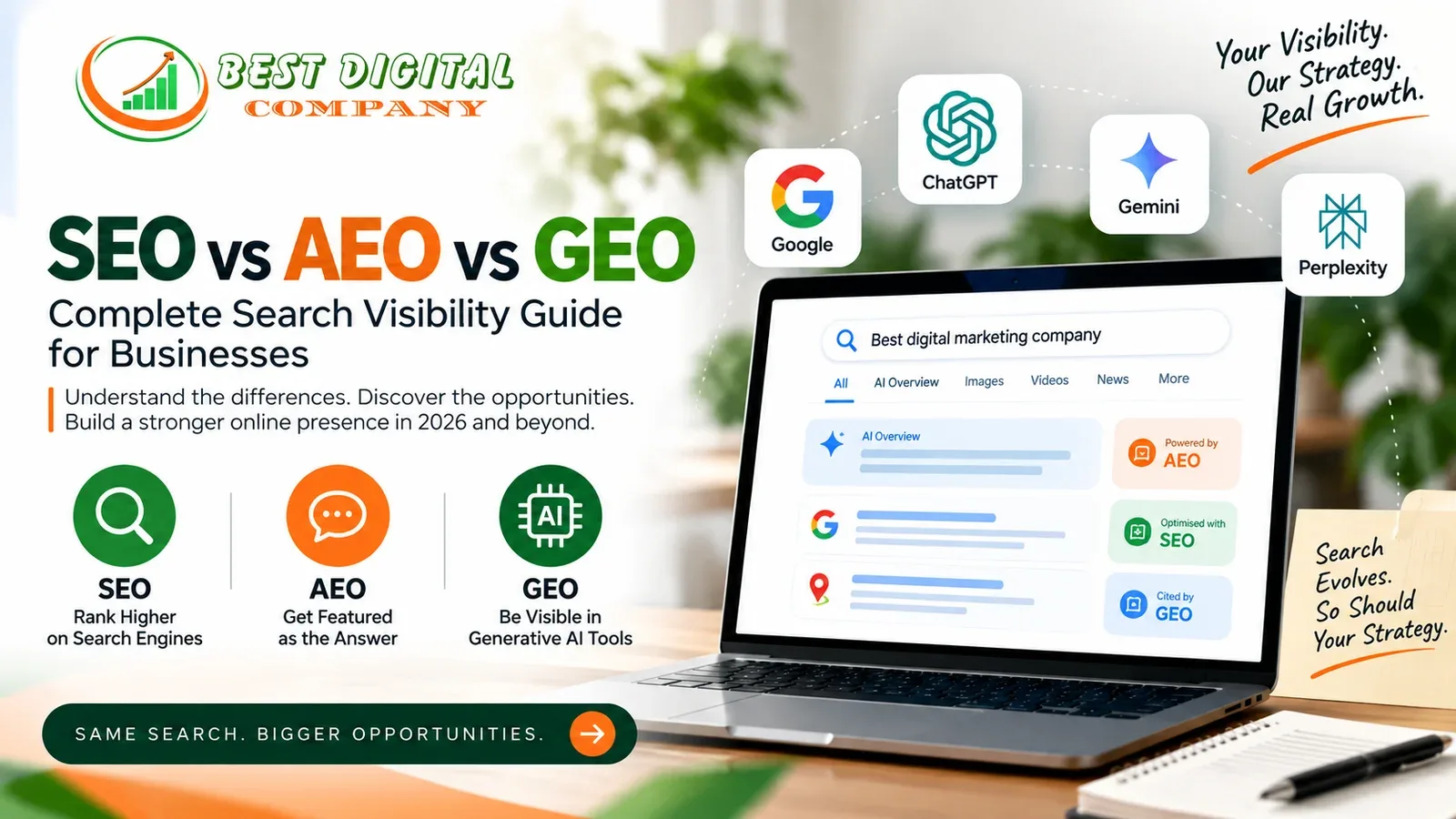
If you run a business and someone on your marketing team recently asked, “Should we still be worried about SEO, or do we need AEO and GEO now too?” — you’re not alone. Search has quietly split into three overlapping disciplines, and most business owners haven’t been told what changed or why it matters to their revenue.
For almost twenty years, being found online meant one thing: rank high on Google’s results page. Today, that’s only part of the picture. People still type keywords into Google, but they also ask ChatGPT for recommendations, get instant answers from Google’s AI Overviews without clicking anything, and rely on Gemini or Perplexity to compare options before they ever visit a website. Each of these behaviors is served by a different discipline — SEO, AEO, and GEO.
This guide breaks down what SEO, AEO, and GEO actually mean, how they’re different, where they overlap, and how a business should combine all three to stay visible in 2026 and beyond. Whether you’re a founder, a marketing manager, or someone simply trying to make sense of the terminology before hiring an agency, this is meant to be the one page you need to read.
What Is SEO (Search Engine Optimization)?
SEO, or Search Engine Optimization, is the practice of improving a website so that search engines like Google and Bing understand it, trust it, and rank it higher for relevant queries. It covers technical site health, keyword-focused content, backlinks, page speed, mobile usability, and dozens of smaller signals that together decide where a page lands when someone searches.
SEO has always been about earning organic visibility without paying for every click. A well-optimized website keeps generating traffic long after the work is done, which is why it remains the foundation of almost every digital growth plan. If you’re unfamiliar with how this works in practice, our detailed breakdown of Search Engine Optimization covers the technical, on-page, and off-page pieces that go into a real SEO strategy, and our SEO services in Delhi page shows how this is applied for local businesses specifically.
SEO typically includes:
- Keyword research – understanding what your audience is actually typing into search engines
- On-page optimization – titles, headers, internal links, content structure, and image alt text
- Technical SEO – site speed, mobile-friendliness, crawlability, and secure hosting
- Off-page SEO – backlinks and brand mentions that signal authority to search engines
- Local SEO – optimizing for “near me” searches and Google Business Profile visibility, something we cover in depth on our Local SEO in Delhi page
SEO isn’t going away. It’s still the backbone that AEO and GEO are built on top of — but it’s no longer the whole story.
What Is AEO (Answer Engine Optimization)?
AEO, or Answer Engine Optimization, is the practice of structuring content so it gets pulled directly into featured snippets, voice assistant answers, and the “answer box” style results that sit above traditional organic listings. Instead of optimizing purely to rank a page, AEO optimizes to become the answer itself.
Think about how often you ask a smart speaker a question, or how frequently a short answer box appears right at the top of Google before any website links show up. That box didn’t get there by accident — the content behind it was written in a format answer engines could easily lift: a direct question, followed by a clear, concise answer, often supported by a list or a short paragraph.
AEO leans heavily on:
- Direct, well-structured answers to specific questions, usually in the first sentence or two
- FAQ sections and schema markup that make it easy for algorithms to extract and display content
- Conversational phrasing that matches how people actually speak and ask questions, especially through voice search
- Clear headers that mirror real user questions
This is a discipline that’s still fairly new to most businesses, which is exactly why we put together a dedicated guide on what AEO is and how to get featured in AI search results. If your competitor’s content is showing up as the answer to a question and yours isn’t, AEO is usually the reason.
What Is GEO (Generative Engine Optimization)?
GEO, or Generative Engine Optimization, is the newest of the three, and it’s built specifically for how generative AI tools — ChatGPT, Gemini, Perplexity, Claude, and Google’s AI Overviews — pull together information to answer a question in a written, conversational response rather than a list of links.
Here’s the shift GEO responds to: when someone asks a generative AI tool “which digital marketing agency should I hire in Delhi,” the tool doesn’t hand back ten blue links. It reads across multiple sources, synthesizes an answer, and often names two or three businesses by name — sometimes without the user ever visiting a website at all. GEO is about making sure your business is one of the sources that gets cited, quoted, or recommended in that generated response.
GEO focuses on:
- Topical authority – covering a subject thoroughly enough that AI models recognize your site as a credible source
- Clear, factual, well-organized content – generative models favor content that’s easy to extract and summarize accurately
- Brand mentions across the web – AI tools weigh how often and how consistently your business is referenced elsewhere, not just on your own site
- Original data, expert opinions, and specificity – generic content is far less likely to be cited than content with real insight behind it
We’ve written a full comparison of GEO vs SEO and which one your business actually needs, along with a broader look at how AI search is changing SEO in 2026. Both are worth reading if you want to go deeper into how generative engines are reshaping discovery.
SEO vs AEO vs GEO: The Core Differences
It’s easier to understand these three disciplines side by side. Here’s how SEO, AEO, and GEO compare across the factors that matter most to a business owner deciding where to invest.
| Factor | SEO | AEO | GEO |
| Primary goal | Rank higher on traditional search results | Get selected as a direct answer or featured snippet | Get cited or recommended inside AI-generated responses |
| Platforms | Google, Bing organic listings | Featured snippets, voice assistants, answer boxes | ChatGPT, Gemini, Perplexity, AI Overviews |
| Content style | Keyword-optimized, comprehensive pages | Short, direct answers to specific questions | Well-structured, factual, citation-worthy content |
| Success metric | Rankings, organic traffic, click-through rate | Snippet ownership, voice search appearances | Brand mentions, citations, AI-driven referral traffic |
| User outcome | User clicks through to your website | User gets the answer instantly, may or may not click | User gets a recommendation and may never visit your site |
| Time horizon | Medium to long term, compounding | Medium term, dependent on content structure | Emerging, requires ongoing authority building |
The biggest mental shift for most businesses is this: SEO earns clicks, but AEO and GEO increasingly earn visibility without a click. Your business can be “found” and even trusted by a potential customer before they ever land on your website — which changes how you should measure success and how you should write your content in the first place.
Where SEO, AEO, and GEO Overlap
None of these three exist in isolation, and treating them as separate projects is one of the most common mistakes businesses make. In reality, they share a foundation:
- Quality content is non-negotiable across all three. Thin, generic pages don’t rank well in traditional search, don’t get pulled into answer boxes, and definitely don’t get cited by generative AI tools that are specifically trying to avoid low-value sources.
- Site structure and technical health matter everywhere. A slow, poorly organized website hurts SEO rankings, makes it harder for answer engines to parse your content, and gives AI crawlers a worse experience overall.
- Authority and trust signals carry weight in all three systems. Backlinks, consistent business information across the web, and genuine expertise influence how Google ranks you, how answer engines select you, and how generative models decide whether to cite you.
- Search intent still drives everything. Whether someone types a query into Google, asks a voice assistant, or prompts ChatGPT, they’re trying to solve the same underlying problem. Content that genuinely answers the question performs better across every channel.
This overlap is good news. It means a business doesn’t need three completely separate strategies — it needs one strong content and authority foundation, adapted slightly for how each system consumes and surfaces information.
Why Businesses Can’t Rely on SEO Alone Anymore
A few years ago, ranking on page one of Google was the finish line. That’s no longer true, and the data backs this up: a growing share of searches now end without a single click, because the user’s question gets answered directly on the results page or inside an AI chat window.
This has real consequences for businesses that have only ever invested in traditional SEO:
- Zero-click searches are rising. If your content isn’t structured to appear in an answer box, you may be losing visibility even when you technically rank well.
- AI Overviews are becoming the default experience. Google now shows AI-generated summaries for a large portion of informational queries, and businesses that don’t optimize for this are invisible in that summary regardless of their traditional ranking. We break this down further in our guide on making your business visible in AI Overviews and AI search results.
- Generative AI is becoming a discovery channel, not just a chatbot. People are starting to ask ChatGPT and Gemini for recommendations the way they used to ask a friend or search Google — and if your business isn’t part of the data these tools were trained on or actively crawl, you simply won’t come up.
- Voice search continues to grow, and voice results almost always come from a single, well-structured answer rather than a list of ranked pages.
None of this means SEO has lost its value. It means SEO is now the foundation that AEO and GEO are built on, rather than the entire strategy on its own. For a practical look at adapting your existing site, our guide on optimizing your website for ChatGPT, Gemini, and Google AI search walks through the specific changes that help.
How to Build a Search Visibility Strategy That Covers SEO, AEO, and GEO
Bringing all three together doesn’t require a complete overhaul of your marketing. It requires a shift in how content is planned, written, and structured. Here’s a practical approach.
1. Start with genuinely useful, well-researched content
Every discipline rewards content that actually helps the reader. Vague, keyword-stuffed pages written purely to rank no longer perform well anywhere — not on Google, not in answer boxes, and definitely not in AI-generated responses that are built to filter out low-quality sources. Write for a real person with a real question first, then optimize.
2. Structure content around questions, not just keywords
Instead of building a page around a single keyword phrase, build it around the actual questions your customers ask. Use clear H2 and H3 headers phrased as questions, followed by direct, concise answers. This single change improves your odds across SEO, AEO, and GEO simultaneously.
3. Add FAQ sections with structured markup
FAQ sections aren’t just good for user experience — they’re one of the most effective tools for both AEO and GEO because they present information in a format that’s easy for machines to extract, summarize, and cite accurately.
4. Build topical authority, not just isolated pages
Publishing one article about a topic rarely earns you a citation in an AI-generated answer. Publishing a genuinely thorough cluster of content around a subject — the way we’ve approached search visibility topics on our own blog — builds the kind of depth that both search engines and generative AI models recognize as expertise.
5. Strengthen your presence beyond your own website
Generative engines and answer engines pull signals from across the web, not just from your homepage. Consistent business information, credible mentions, reviews, and social proof all feed into how trustworthy your business appears. This is where Social Media Marketing plays a bigger role than most businesses realize — an active, consistent social presence reinforces the same authority signals that AEO and GEO depend on.
6. Keep technical SEO healthy
None of this matters if your site is slow, poorly structured, or difficult to crawl. A clean technical foundation — the kind covered under proper Website Development & Designing makes it easier for every type of search and AI system to access and understand your content.
7. Use paid visibility to fill the gaps while organic strategies mature
AEO and GEO take time to build, especially the authority component. In the meantime, a well-targetedPay Per Click campaign keeps your business visible and generating leads while your organic and AI-search presence grows in the background.
Common Mistakes Businesses Make With SEO, AEO, and GEO
- Treating them as competing strategies instead of complementary ones. You don’t choose SEO or AEO or GEO — you build one strong foundation that supports all three.
- Ignoring structure in favor of length. A 3,000-word article with no clear headers, no direct answers, and no logical flow will underperform a well-organized 1,200-word page in both answer engines and generative AI results.
- Forgetting to update existing content. Older pages written purely for traditional SEO often need restructuring — added FAQs, clearer headers, more direct answers — to compete in an AI-driven search environment.
- Assuming rankings alone equal visibility. A page can rank on the first page and still be invisible in an AI Overview or a ChatGPT response if it isn’t structured for extraction.
- Skipping measurement. Most businesses still only track clicks and rankings. Tracking brand mentions in AI tools, featured snippet ownership, and referral patterns from AI platforms is quickly becoming just as important.
Bringing It All Together
SEO, AEO, and GEO aren’t three separate battles for visibility — they’re three lenses on the same goal: being found, trusted, and chosen by the right people at the moment they’re looking for what you offer. SEO gets your website in front of search engines. AEO gets your content selected as the direct answer. GEO gets your business mentioned inside the AI-generated responses that a growing number of people now trust as their starting point for research and decisions.
Businesses that treat these as one connected strategy — built on genuinely useful content, solid technical foundations, and consistent authority across the web — are the ones who will stay visible no matter how people choose to search over the next few years.
If you’d like help auditing where your business currently stands across search engines and AI platforms, our team can walk you through a practical, prioritized plan. You can explore our full range of digital marketing services or get in touch with our team to start the conversation.
Frequently Asked Questions
What is the difference between SEO, AEO, and GEO?
SEO focuses on ranking your website higher on traditional search results through keywords, technical optimization, and backlinks. AEO focuses on getting your content selected as a direct answer in featured snippets and voice search. GEO focuses on getting your business cited or recommended inside AI-generated responses from tools like ChatGPT and Gemini.
Does a business need to choose between SEO, AEO, and GEO?
No. These three disciplines share the same foundation — quality content, technical health, and authority — and work best when combined into a single strategy rather than pursued separately.
Is SEO still worth investing in with the rise of AI search?
Yes. SEO remains the foundation that AEO and GEO are built on. Without solid on-page and technical SEO, it’s much harder for answer engines or generative AI tools to find, understand, and trust your content in the first place.
How long does it take to see results from AEO and GEO?
AEO can show results faster, sometimes within a few weeks, since it often involves restructuring existing content with clearer answers and FAQ sections. GEO typically takes longer because it depends on building broader topical authority and consistent mentions across the web, which compounds over several months.
Can small or local businesses benefit from AEO and GEO, or is this only for large companies?
Small and local businesses can benefit significantly, especially since many AI-driven searches are local in nature — such as “best digital marketing agency near me.” A focused strategy combining local SEO with clear, well-structured content often works well even on a limited budget.
How can I check if my business is showing up in AI search results?
Try asking tools like ChatGPT, Gemini, and Google’s AI Overviews the kinds of questions your customers would ask, and see whether your business appears in the response. If it doesn’t, that’s usually a sign your content needs better structure, more depth, or stronger authority signals across the web.

Add a Comment