

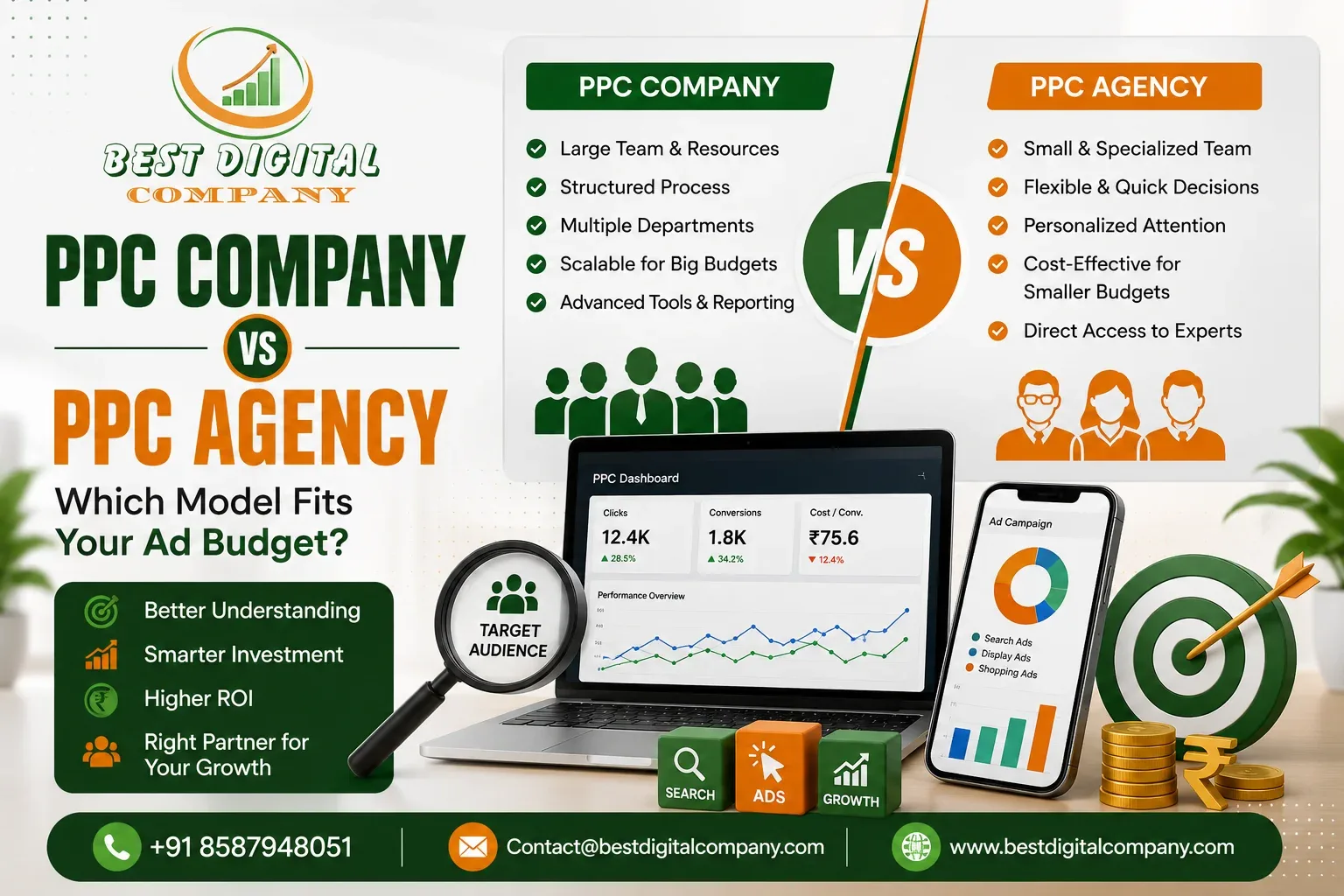
A few weeks ago, we sat across two proposals from a client who was comparing offers before committing to paid advertising. One provider called itself a PPC company. The other called itself a PPC agency. The pricing was different, the contracts read differently, and the client had no idea why two businesses doing what sounded like the exact same job were priced so far apart.
This mix-up is more common than most business owners realize. The terms “PPC company” and “PPC agency” get used almost interchangeably in marketing conversations, yet in practice they often describe two different ways of running paid ad campaigns different team structures, different pricing logic, and different minimum budgets to make the relationship worthwhile. Picking the wrong one for your current budget is how businesses end up either overpaying for infrastructure they don’t need yet, or underpaying for a level of hands-on strategy their ad spend actually requires.
This guide breaks down what genuinely separates a PPC company from a PPC agency, how each one prices its work, and how to match the right model to the budget you actually have not the budget you hope to have in a year.
“PPC Company” and “PPC Agency” – What the Terms Actually Mean
There’s no official rulebook that defines these two labels, which is exactly why so much confusion exists. But when you look past the branding, a pattern shows up consistently across the industry.
A PPC company usually refers to a larger, more process-driven organization. It typically runs paid campaigns as one service line among several SEO, web development, social media and has dedicated departments for each. You are usually assigned a named account manager who sits between you and the specialists actually touching your Google Ads or Meta Ads account.
A PPC agency, on the other hand, often leans smaller and more specialized. Some are boutique teams built entirely around paid advertising, with founders or senior strategists still directly involved in client accounts. There’s usually less internal hierarchy, which can mean faster decisions, but also a smaller bench if the team gets overloaded.
Neither structure is inherently better. They are simply built for different situations, and your ad budget is one of the clearest signals for which one you should be talking to first.
Inside a PPC Company – Team, Process, and Who Actually Touches Your Account
When you sign with a PPC company, you are usually buying into a defined process rather than a single expert’s judgment. That has real advantages once your budget crosses a certain size.
Most PPC companies structure client work in layers: an account manager who communicates with you, a strategist who plans the campaign, and specialists who handle execution across Search, Display, Shopping, or video. This layered setup means the business doesn’t grind to a halt if one team member is on leave or moves to a different project. There’s institutional memory in how campaigns are documented, reported, and handed off.
The tradeoff is that you’re often one account among many being run through a standardized playbook. Reporting formats, campaign structures, and check-in schedules tend to follow a template designed to scale across dozens of clients, not built from scratch around your specific business. For businesses with a straightforward product and a clear target audience, this rarely matters. For businesses with unusual sales cycles or niche audiences, it can feel like the process wasn’t really built with them in mind.
You can see how this kind of structured approach is usually packaged by browsing a typical PPC services offering, which is generally organized into tiers rather than fully custom scopes.
Inside a PPC Agency – Flexibility, Specialization, and Direct Access
A PPC agency tends to operate with fewer layers between you and the person actually managing your bids. In smaller, specialist agencies, it’s common to work directly with the strategist running your campaigns rather than routing every question through an account manager first.
This closeness can be a genuine advantage when your business needs fast decisions a sudden competitor move, a flash sale, a product launch that needs a campaign live within a day. Smaller agencies typically carry less internal process overhead, so changes can happen faster.
The flip side is capacity. A boutique PPC agency with a handful of specialists has a ceiling on how many accounts it can run well at once. If it takes on too many clients, response times slow down and campaigns get less attention, even though the pricing structure hasn’t changed. It’s worth asking directly how many active accounts a given specialist is currently managing before you sign anything a fair question that a confident agency should answer without hesitation.
PPC Company vs PPC Agency: Where the Cost Difference Actually Comes From
The pricing gap between these two models is not random. It comes down to overhead.
A PPC company carries the cost of account managers, dedicated reporting tools, larger office infrastructure, and multiple specialist departments. That overhead gets distributed across every client relationship, which usually means higher minimum retainers, but also more redundancy if something goes wrong internally.
A PPC agency, especially a leaner one, carries less overhead. Retainers can be lower, and some smaller agencies are willing to work with tighter monthly budgets that a bigger PPC company wouldn’t consider worth the account management time.
Both models typically charge in one of three ways: a flat monthly retainer regardless of ad spend, a percentage of your total ad spend (commonly somewhere between 10% and 20%), or a hybrid a smaller flat fee plus a percentage once spend crosses a certain threshold. None of these structures is automatically better. A flat fee protects you as your budget scales, since the management cost doesn’t grow with it. A percentage model can align incentives, since the provider only earns more by helping you spend more effectively, though it’s worth asking how they define “effectively” before agreeing to it.
Which Model Fits a Small or Just-Starting Ad Budget
If you’re working with a modest monthly ad budget enough to test one or two campaigns rather than run a full multi-platform strategy a leaner PPC agency is usually the more practical starting point.
Larger PPC companies often set minimum retainers that make sense only once your ad spend itself is substantial enough to justify the account management layer. A smaller agency, or even a specialist freelancer working within an agency structure, can typically build a focused campaign around a tighter budget without insisting on services you don’t need yet, like dedicated creative production or multi-platform reporting dashboards.
This stage is also where getting the fundamentals right matters more than scale. If you’re building your very first customer base through digital channels, it’s worth reading our guide on how small businesses can get their first 100 customers, since paid ads at this budget level work best when paired with a clear, realistic acquisition plan rather than treated as a standalone fix.
Which Model Fits a Growing Mid-Size Budget
As your monthly ad spend grows, the conversation usually shifts from “can we afford management” to “what are we getting for it.” This is the range where the difference between a PPC company and a PPC agency starts to matter the most, because both can now justify their pricing, but the value they deliver looks different.
A PPC company tends to shine here because your budget can now support proper testing across multiple campaign types Search, Shopping, Display, and remarketing run by specialists in each area rather than one generalist handling everything. A well-run PPC agency at this budget level can compete just as effectively, but it depends heavily on whether the team has genuinely grown its capacity or is simply stretched thinner across more clients.
At this stage, reporting quality also becomes a real differentiator, since you are now making budget decisions based on the numbers you’re being shown. If a provider’s reports leave you more confused than informed, that’s worth addressing early our piece on how to create an SEO report clients actually understand covers the same reporting principles that apply just as much to paid campaigns as they do to organic performance.
It’s also the point where your landing pages start carrying real weight. A growing budget sending traffic to a page that wasn’t built to convert is money left on the table, which is why many mid-size accounts eventually pair PPC with support from a web development team to fix conversion gaps rather than just increasing ad spend to compensate.
Which Model Fits a Large or Multi-Channel Ad Budget
Once your budget supports running campaigns across several platforms at once Google, Meta, LinkedIn, YouTube a full-service PPC company generally becomes the more sustainable choice, mainly because of what it takes to run that scope well.
Multi-channel advertising isn’t just “more of the same campaign” spread across platforms. Each channel has its own bidding logic, creative requirements, and audience behavior. A PPC company with dedicated specialists per platform can manage this without one person being stretched across skill sets they only partially know. A smaller PPC agency can still deliver at this level, but only if it has genuinely built out specialist coverage rather than asking one team to cover everything.
At this budget size, paid advertising also tends to work best when it’s coordinated with your broader organic strategy rather than run in isolation. Businesses investing seriously in search engine optimization and social media marketing alongside PPC typically see paid campaigns perform better, since brand familiarity built through organic channels tends to lower the cost of paid clicks over time.
Six Questions to Ask Before You Choose a PPC Company or PPC Agency
Regardless of which model you’re leaning toward, a short list of direct questions can save you months of wasted spend:
- Who exactly will manage my account day to day – a named specialist, or a rotating team member depending on availability?
- What is your minimum monthly retainer, and does it change if my ad spend grows?
- How many other active accounts is my specialist currently managing?
- Can I see a sample report before signing, not just a description of what reporting looks like?
- What happens if the first month underperforms — is there a review point built into the contract, or am I locked in regardless?
- Do you handle landing page recommendations, or only the ad side of the campaign?
A provider that answers these clearly and specifically, rather than in vague reassurances, is usually signaling that they run a real process whether they call themselves a company or an agency.
How Best Digital Company Supports Every Budget Level
We work with businesses across this entire range, from a first-time advertiser testing a single campaign to established brands running paid ads across multiple platforms alongside SEO and social. Rather than pushing every client toward the same package, we start by understanding what your current budget can realistically support and build the campaign structure around that, not the other way around.
If your budget is still modest, we will tell you honestly whether it makes more sense to start lean and scale, rather than signing you up for a retainer sized for a bigger spend than you currently have. If you are ready to run a full multi-channel strategy, our team covers Search, Shopping, Display, Meta, and LinkedIn advertising, backed by the same reporting clarity we bring to our SEO clients. You can see current retainer structures on our PPC packages page, or reach out through our contact page for a straightforward review of what your current budget could realistically achieve before you commit to either model.
Frequently Asked Questions
Is a PPC company always more expensive than a PPC agency?
Not always, but it’s common. PPC companies carry more internal structure account managers, larger teams, dedicated reporting systems and that overhead is usually reflected in higher minimum retainers. Smaller PPC agencies often have lower minimums, though pricing varies enough that it’s worth getting quotes from both before assuming either is automatically cheaper.
Can a PPC agency handle a large, multi-platform ad budget?
Yes, if the agency has genuinely built out specialists for each platform rather than stretching a small generalist team across everything. Ask directly how many people work on each channel before assuming a smaller agency can’t scale with you.
What’s the minimum ad budget needed to work with a PPC company?
This varies by provider, but many PPC companies set retainers that only make financial sense once your ad spend itself is substantial enough to justify dedicated account management. If your budget is still small, a leaner PPC agency is usually a more practical starting point.
Do PPC companies and PPC agencies charge in the same way?
Both typically use one of three models: a flat monthly retainer, a percentage of ad spend, or a hybrid of the two. The pricing model matters more than the label ask how a provider charges before comparing them purely on the word “company” or “agency.”
Should I start with a PPC agency and move to a PPC company later?
Many businesses do exactly this. It’s common to start with a smaller, more flexible agency while testing what works, then move to a larger PPC company once ad spend and reporting needs grow beyond what a lean team can comfortably manage.
How do I know if my current provider company or agency is worth the cost?
Look past the label and focus on outcomes: are you getting account-level visibility, clear reporting tied to leads or sales, and honest communication about what’s working versus what isn’t. A provider delivering all three is worth the retainer, regardless of whether it calls itself a company or an agency.
Not sure whether a PPC company or a PPC agency fits where your business is right now? Talk to Best Digital Company for a free, no-pressure review of your current ad budget and what it can realistically support.

Add a Comment