

If you have ever asked three different agencies for a website quote and gotten three wildly different numbers, you are not alone. One agency says ₹15,000. Another says ₹1,50,000. A third asks you to “hop on a call” before they will say anything at all. None of this is a scam, exactly, but it does mean the same two words “website development” can point to completely different scopes of work, depending on who you’re talking to.
This guide breaks down what website development services actually include by default, what typically gets billed as an extra, and how to read a quote without feeling like you need a computer science degree to understand it. We work with clinics, retailers, real estate firms, and D2C brands on exactly this kind of project every week, so this is not theory. It is the same breakdown we walk clients through on discovery calls.
What “Website Development Services” Actually Means
Before getting into pricing, it helps to separate two things people often lump together: design and development.
Design is how the site looks and how a visitor moves through it layout, colors, typography, the path from homepage to enquiry form. Development is the actual build: the code, the backend, the integrations that make the design functional rather than just a picture. A polished mockup that no one has coded yet isn’t a website. It’s a preview of one.
Most agencies offering website development services bundle both under one roof, and that’s usually the smarter setup. It removes the back-and-forth of a designer and a developer blaming each other when something breaks. But it’s worth asking directly which part of the process you’re paying for at each stage, because some freelancers only do one half and outsource the other, which adds a layer you do not see on the invoice.
The Core Deliverables Included in a Standard Package
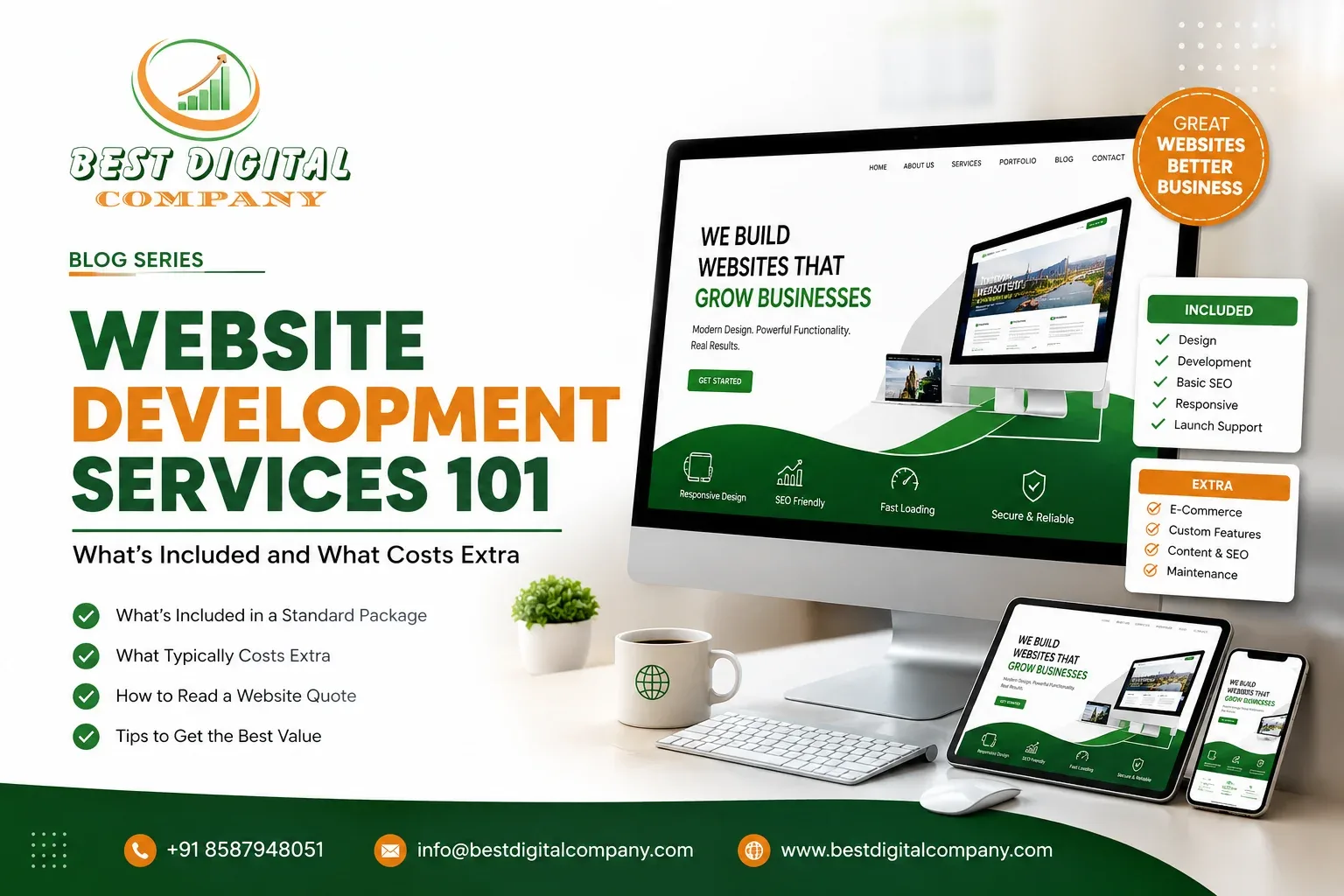
Every legitimate website development services package, regardless of price point, should include a baseline set of deliverables. Here’s what that baseline typically looks like for a standard 5-8 page business website:
Discovery and planning. A short session to understand your business, your audience, and what the site needs to do — generate leads, sell products, build credibility, or some mix of the three. This shapes everything that follows, including site structure and the technology stack.
Wireframes or a design mockup. A visual layout you approve before any code is written, so you’re reacting to a plan rather than a finished product you now have to unwind.
Responsive design. The site needs to work properly on a phone, not just look acceptable on one. Given how much traffic comes from mobile devices today, this isn’t optional anymore — it’s the baseline, not a premium add-on.
Core pages. Home, About, Services, Contact, and usually a handful of interior pages depending on your business. A clinic needs different pages than a real estate firm, and a decent developer will scope this around what you actually sell, not a generic template.
Basic on-page SEO setup. Page titles, meta descriptions, header structure, and a sitemap submitted to search engines. This is foundational SEO, not a full search engine optimization campaign more on that distinction below.
Contact forms and basic integrations. An enquiry form that actually emails you, click-to-call buttons, maybe a WhatsApp chat widget.
CMS access. If the site is built on WordPress or a similar content management system, you should be able to log in and edit text or swap images yourself without calling the developer every time.
A launch checklist. SSL certificate, browser and device testing, broken-link checks, and speed testing before the site goes live.
If a quote is missing more than one or two of these, it’s worth asking why either the price reflects that gap, or it’s an oversight that will surface as a support request later.
What Typically Costs Extra (and Why)
This is the part most quotes gloss over, and it’s usually where the final invoice ends up higher than the first number you were quoted. None of these are hidden fees in a shady sense. They are genuinely separate scopes of work that many businesses don’t need on day one, so agencies leave them out of the base price rather than padding every quote with services you might not want.
E-Commerce Functionality
A brochure site and an online store are not the same build. E-commerce website designing involves product catalogues, payment gateway integration, inventory sync so you don’t oversell stock, and a checkout flow that’s tested separately for mobile since that’s where most shopping traffic actually happens. Whether you build on Shopify, WooCommerce, or a custom cart changes the cost significantly, and that decision usually comes down to your catalogue size and how much control you want over the backend.
Custom Features and Integrations
Booking systems, membership portals, multi-language support, custom calculators, third-party CRM or ERP integration.These are all standard requests, but they’re also all outside a base website build. Each one adds development hours because it’s not a template feature; it has to be built and tested for your specific use case.
Content Writing and Photography
Plenty of quotes assume you’re supplying your own text and images. If you need someone to write the copy for eight pages or arrange a product photoshoot, that’s a separate line item almost everywhere, and it’s worth asking about upfront rather than discovering it mid-project.
Advanced SEO and Ongoing Optimization
Basic on-page setup gets your site technically ready for search engines. It does not mean you will rank. Competitive keyword targeting, content strategy, backlink building, and ongoing optimization are a continuous service, not a one-time setup task which is exactly why search engine optimization is usually sold as its own monthly engagement rather than bundled into a development invoice. If you’re comparing options, our piece on how to choose the right SEO company is a useful companion read before you sign anything.
Paid Advertising Setup
Some businesses want traffic immediately after launch rather than waiting for organic rankings to build. That’s where Pay Per Click campaigns come in Google Ads account setup, conversion tracking, and campaign management are a distinct skill set from building the site itself, and they’re billed separately.
Social Media Integration and Management
Feeds, share buttons, and pixel tracking for platforms like Instagram or Facebook are usually a quick add during development. Actually running your social media marketing content calendars, posting, community management is an entirely different, ongoing service.
Ongoing Maintenance and Support
Security patches, plugin updates, uptime monitoring, and content changes after launch. Some agencies bundle a few months of this into the base price and then bill monthly after; others treat it as an add-on from day one. Either way, ask specifically what happens the day after launch, because “we’ll support you” means different things to different agencies.
Redesigns of an Existing Site
If you already have a website and want it rebuilt rather than starting fresh, this is its own category with its own risk: a badly planned redesign can tank your search rankings overnight if URLs aren’t mapped and redirected properly. We’ve written a full breakdown of what to check before touching an existing site in our website redesign checklist, and it is worth reading even if you’re planning to hire someone else for the job.
How Pricing Actually Breaks Down
Because scope varies this much, a single flat number rarely tells you anything useful. Here’s a more honest way to think about it, based on the kind of ranges we see across the market:
- A basic 5-6 page business site, template-based or lightly customized, with standard integrations, sits at the lower end of the range. Fine for a service business that needs credibility and a contact form more than heavy functionality.
- A custom-built business website, scoped around your specific sales process with original design work, costs more but avoids the “looks like everyone else’s site” problem.
- E-commerce builds run higher, and the range within e-commerce itself is wide — a 50-product WooCommerce store and a multi-thousand-SKU platform with inventory sync are not priced the same way.
- Ongoing services — SEO, PPC, social media, maintenance are typically monthly costs layered on top of the one-time development cost, not folded into it.
If an agency gives you one number without asking a single question about your business first, that number is a guess, not a quote. A discovery call before pricing isn’t a sales tactic. It is the only way to price the work accurately. If you want a starting reference point rather than an open-ended conversation, our web development packages page breaks down tiers by scope.
Questions to Ask Before You Sign
A few pointed questions tend to surface the gaps in a proposal faster than reading the fine print:
- Does this quote include content writing, or am I supplying the text?
- What happens after launch is there a support period included, and what does it cover?
- Do I get full ownership of the code, hosting, and CMS login, or is any part of this locked to your agency?
- If I need to redesign later, how do you protect my existing search rankings?
- Is SEO setup limited to on-page basics, or does it include ongoing work?
Ask for a live client site older than a year and how the agency handled a downtime incident on it. A team that’s actually maintained sites long-term will have a real answer. One that’s only ever done launches and moved on usually won’t.
A Quick Word on Timelines
Cost is not the only thing that varies timelines do too, and they’re connected. A standard business website typically takes three to five weeks from an approved design to launch. E-commerce builds with custom features usually run six to ten weeks, given the added testing for payment gateways and inventory logic. Redesigns can move faster if you’re keeping existing content and mainly rebuilding structure and design, but only if the planning phase mapping URLs, checking what’s driving current traffic is done properly first.
If someone promises a fully custom site in three days, that’s a red flag, not a selling point.
FAQ
How much does website development cost?
It depends entirely on scope. A basic 5-6 page site starts at a different price point than a custom e-commerce build with inventory and payment integration. A fixed quote after a short discovery call is more useful than a generic price range, since “it depends” is honestly the accurate answer until someone understands your project.
What is included in a standard website development package?
Discovery and planning, wireframes or design mockups, responsive design, core pages, basic on-page SEO setup, contact forms, CMS access, and pre-launch testing. Anything beyond that e-commerce, custom integrations, content writing, ongoing SEO is typically scoped and priced separately.
Is SEO included when I pay for website development?
Basic on-page elements usually are page titles, meta descriptions, a clean site structure, and a sitemap. Ongoing search engine optimization, including content strategy and link building, is a separate, continuous service because it requires ongoing work, not a one-time setup.
Do I own my website once it’s built?
With a reputable developer, yes full ownership of the code, CMS, and hosting access. If an agency is vague about handing over logins or insists you stay on their hosting indefinitely, ask why before signing anything.
Can I redesign my website without losing my search rankings?
Yes, if it’s planned properly. This is one of the most common ways businesses lose traffic during a redesign existing URLs need to be mapped and redirected, and indexed content structure needs to be preserved before design changes go live. Our website redesign checklist covers the full process.
How long does website development take?
A standard business website typically takes three to five weeks from an approved design to launch. E-commerce builds usually take six to ten weeks depending on custom features. Redesigns can be quicker if existing content is being kept.
Do website development services include ongoing maintenance?
It depends on the agency. Some bundle a support period into the initial price; others treat maintenance as a separate monthly service. Either way, this should be spelled out in the proposal, not discovered after launch.
What’s the difference between a website designing company and a development company?
Design covers how the site looks and how users move through it. Development is the actual build code, backend, integrations. Many agencies, including ours, handle both together so you are not managing two separate vendors and the miscommunication that tends to come with it.
The Short Version
Website development services are not a single fixed product. They are a set of building blocks, and which ones you need depends on what your business actually sells and how customers find you. A clear proposal will separate the core build from the extras: e-commerce functionality, custom integrations, content, ongoing SEO, paid advertising, and post-launch support. Once you can see those pieces individually, comparing quotes stops being a guessing game and starts being a straightforward decision about what your business needs right now versus what can wait.
If you are weighing your options and want a quote scoped to your actual project rather than a generic range, take a look at our website development services or reach out for a no-obligation discovery call.

Add a Comment