Search behavior has changed more in the last two years than it did in the previous decade. People no longer type a query and scroll through ten blue links. Instead, they read a short AI-generated summary at the top of the page, get their answer, and move on. If your business isn’t part of that summary, you’re invisible to a growing share of potential customers — even if you still rank well the old-fashioned way.
This shift is exactly why AI Overviews optimization has become one of the most important priorities for any business that wants to stay discoverable in 2026 and beyond. Whether you run a local service business, an e-commerce store, or a B2B company, the way you structure and present your content now directly affects whether Google’s AI, ChatGPT, Perplexity, or Copilot mentions your brand when someone asks a relevant question.
In this guide, we’ll break down what AI Overviews actually are, why they matter, and the practical steps you can take — from content structure to technical setup — to improve your chances of being featured. We’ll also look at how core digital marketing disciplines like SEO, website development, and social media marketing all play a role in this new search landscape.
What Are AI Overviews and Why They Matter for Your Business
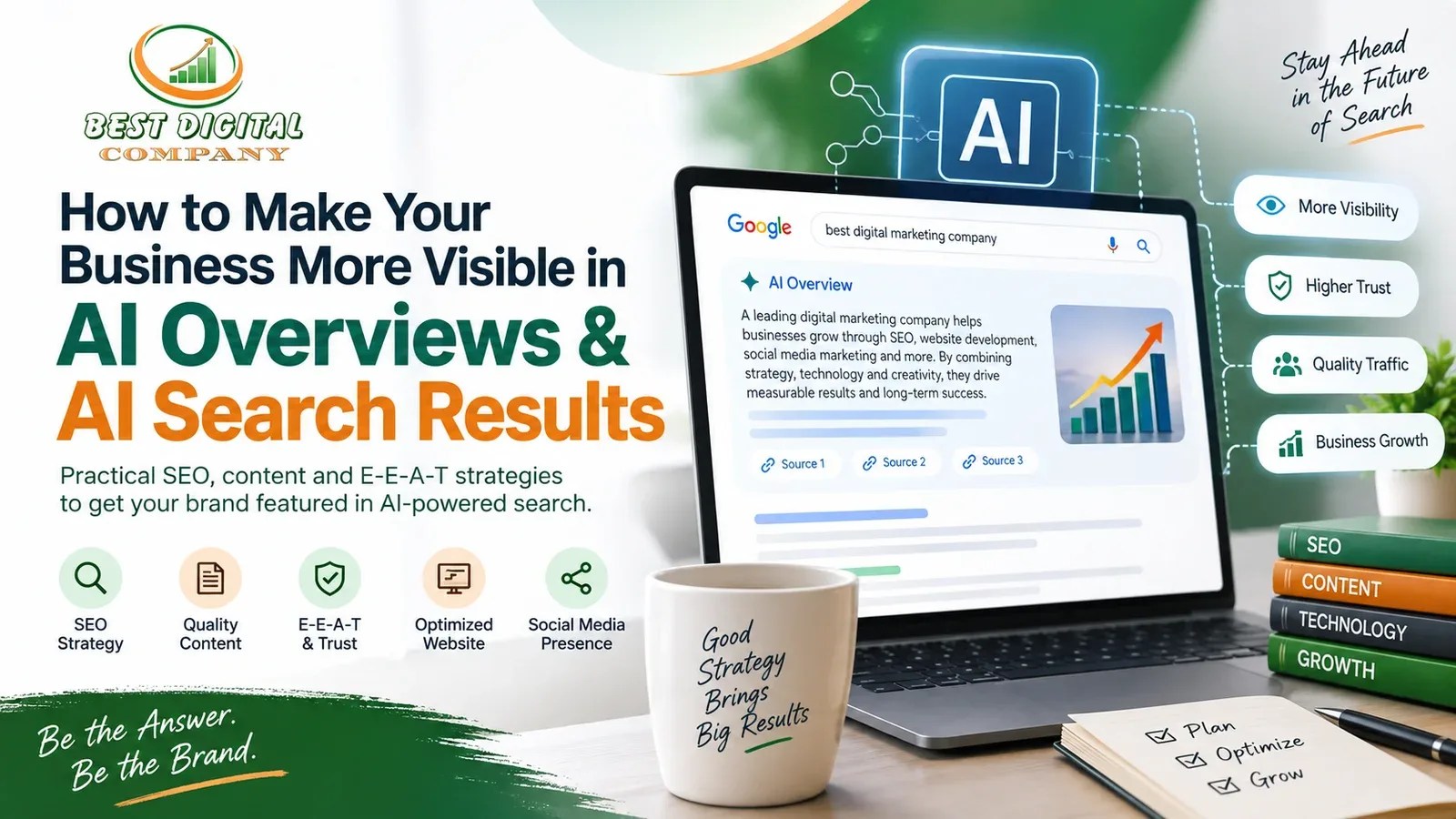
AI Overviews are the AI-generated summaries that now appear at the top of many search results. Instead of listing links for the user to click through, the search engine reads across multiple trusted sources, synthesizes the information, and presents a direct answer — often with a few source links attached.
This matters for three reasons:
- Reduced click-through rates. When a searcher gets their answer directly in the overview, they may never click through to a website at all. If your competitor is cited and you aren’t, they get the visibility and the trust, even if your content is just as good.
- New ranking signals. Being included in an AI Overview depends less on traditional keyword density and more on how clearly your content answers a specific question, how trustworthy your site appears, and how well your information is structured for machines to read.
- A shrinking window of opportunity. Early adopters who optimize now will have an advantage, since AI systems tend to favor sources they’ve already learned to trust over time.
In short, if your business isn’t showing up in AI-generated answers, you’re losing visibility at the exact moment a customer is deciding who to trust.
How AI Search Is Different from Traditional Search Results
Traditional search rewarded pages that matched a keyword closely and had strong backlink profiles. AI search still cares about relevance and authority, but it adds a layer of interpretation on top. The AI has to understand the intent behind a question, not just the words used, and then decide which sources are reliable enough to summarize.
A few practical differences worth understanding:
- Answers are extracted, not just linked. The AI pulls a sentence or paragraph out of your page and rewrites it in its own words. This means your content needs to contain clear, self-contained answers, not just vague marketing language.
- Multiple sources are blended. An AI Overview often draws from three, five, or even ten different pages to build one answer. Your goal isn’t to “win” the top spot outright — it’s to be one of the sources the AI trusts enough to include.
- Freshness and consistency matter more. AI models weigh how consistently a fact appears across multiple credible sources. If your business information is inconsistent across your website, directories, and social profiles, it becomes harder for AI systems to confidently cite you.
Understanding this shift is the foundation of any real AI Overviews optimization strategy — it’s not a trick or a shortcut, it’s a change in how you present expertise.
AI Overviews Optimization: The Core Principles You Need to Follow
Once you understand how AI-driven search works, the actual optimization process becomes much clearer. Here are the principles that consistently make a difference:
1. Answer the question directly, early, and clearly.
Every page should open with a clear, concise answer to the core question it targets, ideally within the first two or three sentences. Save the elaboration, examples, and context for after the direct answer.
2. Structure content for extraction.
Use descriptive subheadings, short paragraphs, numbered steps, and bullet points. AI systems parse structured content far more easily than long, unbroken blocks of text.
3. Cover the topic completely, not just the keyword.
AI Overviews tend to favor pages that thoroughly address a topic — including related questions, common objections, and practical next steps — over pages that only skim the surface to target a single phrase.
4. Keep facts accurate and consistent everywhere.
Your business name, services, pricing information, and claims should match across your website, Google Business Profile, social channels, and any directories you’re listed in.
5. Update content regularly.
Stale pages lose trust over time. Revisiting older posts, refreshing statistics, and adding new insights signals to AI systems (and human readers) that your information is current.
None of this replaces solid fundamentals — it builds on them. A technically sound, well-structured, genuinely useful website is still the backbone of visibility in AI-driven search results.
Building E-E-A-T to Earn a Place in AI Answers
Google has been public about the importance of Experience, Expertise, Authoritativeness, and Trustworthiness (E-E-A-T) for years, and this framework matters even more in an AI-driven search environment. AI systems are cautious about which sources they cite, because citing an unreliable source damages the credibility of the answer itself. That means your business needs to actively demonstrate why it should be trusted.
Practical ways to strengthen E-E-A-T on your site:
- Show real experience. Share case studies, client results, and behind-the-scenes insights that only someone who has actually done the work could write. Generic, recycled advice is easy for AI systems to deprioritize because it adds nothing new.
- Highlight expertise with author bios. Attach a real name, credentials, and a short bio to your blog content. Anonymous, unattributed content is far less likely to be treated as authoritative.
- Build authority through consistent publishing. A single great article won’t move the needle much. A steady stream of useful, well-researched content across your blog builds topical authority over time.
- Earn trust signals. Secure hosting (HTTPS), clear contact information, transparent pricing where possible, genuine customer reviews, and an easy-to-find About Us page all contribute to how trustworthy your site appears — both to human visitors and to AI crawlers evaluating your content.
E-E-A-T isn’t a checkbox exercise. It’s the difference between a website that reads like it was written to please an algorithm and one that reads like it was written by people who genuinely know what they’re talking about — which, not coincidentally, is exactly what both human readers and AI systems are looking for.
Content Structure Tips That Help AI Systems Understand Your Business
Beyond E-E-A-T, there are specific formatting choices that make your content easier for AI systems to read, summarize, and cite accurately.
- Use question-based subheadings. Phrasing an H2 or H3 as a question (e.g., “How much does website development cost?”) makes it far easier for an AI system to match your section to a user’s actual query.
- Front-load the answer, then explain. Don’t bury the useful information under three paragraphs of introduction. Say what the reader needs to know, then support it with detail.
- Use lists and tables where they genuinely help. Steps, comparisons, and pricing breakdowns are exactly the kind of content AI Overviews like to pull from.
- Add structured data (schema markup). FAQ schema, article schema, and organization schema give search engines explicit, machine-readable signals about what your content covers and who published it.
- Keep paragraphs short. Dense blocks of text are harder to parse and less likely to be extracted cleanly.
This kind of structural work is technical, but it’s also very much a content and writing discipline — which is why AI Overviews optimization sits at the intersection of SEO, content strategy, and web development.
The Role of SEO Services in AI Visibility
Traditional SEO services haven’t become irrelevant in the age of AI search — they’ve become the foundation it’s built on. AI Overviews still rely heavily on a site’s existing search performance, indexation, and topical relevance to decide which sources are worth summarizing.
A few SEO fundamentals that directly support AI visibility:
- Keyword and intent research to understand exactly what questions your audience is asking, not just what terms they type.
- On-page optimization, including title tags, meta descriptions, header structure, and internal linking, so both traditional and AI crawlers can understand your content hierarchy.
- Technical SEO health, such as fast page speed, mobile-friendliness, and clean indexing, since AI systems are far less likely to cite a site that’s difficult to crawl.
- Backlink building, because external validation from other trusted sites still signals authority to AI-driven ranking systems.
If your business hasn’t invested in solid SEO practices yet, AI Overviews optimization will be much harder to achieve, because you’d essentially be trying to build a second floor without a first one.
Why Website Development and Design Impact AI Overviews Optimization
It’s easy to think of AI visibility as purely a content problem, but the technical foundation of your website plays a huge role. A poorly built site — slow load times, broken navigation, missing metadata, non-responsive design — makes it harder for both search engines and AI crawlers to access and understand your content in the first place.
Good website development and design supports AI Overviews optimization by:
- Ensuring pages load quickly on mobile and desktop, since speed affects crawl efficiency and user experience alike.
- Providing clean, semantic HTML so headings, lists, and key information are properly tagged rather than styled with generic text.
- Making navigation and internal linking logical, so crawlers can find and connect related content easily.
- Supporting the structured data (schema) that helps AI systems understand what type of content each page contains.
A visually appealing site that’s technically weak underneath won’t perform well in AI search. The two need to work together.
Using Social Media Marketing to Support AI Search Visibility
While AI Overviews primarily draw from indexed web content, social signals still play a supporting role in building the kind of brand presence and consistency that AI systems (and human searchers) trust.
Social media marketing contributes to AI Overviews optimization in a few indirect but meaningful ways:
- Brand consistency. When your business name, services, and messaging are consistent across social platforms and your website, it reinforces the same facts AI systems are trying to verify.
- Content distribution. Sharing blog content on social channels increases the chances of engagement, mentions, and links — all of which feed back into your site’s authority signals.
- Real-time relevance. Active social profiles show that a business is operational, current, and engaged with its audience, which supports the “trustworthiness” side of E-E-A-T.
Social media won’t replace strong website content, but it amplifies it — and amplification matters when AI systems are weighing which sources deserve to be cited.
How Paid Campaigns Complement Your AI Visibility Strategy
Paid advertising and AI Overviews optimization serve different purposes, but they work well together. While organic AI visibility takes time to build, paid campaigns can drive immediate traffic and conversions while your long-term content and authority-building efforts take hold.
A well-run paid strategy can also indirectly support AI visibility by:
- Driving more visitors to your best-performing content, increasing engagement signals like time on page.
- Testing which headlines, offers, and messaging resonate most, insights you can then apply to the organic content you’re optimizing for AI Overviews.
- Keeping your brand visible and consistent across the search results page while your organic AI presence is still developing.
If you’re exploring how paid and organic strategies fit together for your business, our digital marketing packages are built to combine both.
Local Business Visibility in AI Search Results
For local businesses, AI Overviews optimization has an added layer: local intent. When someone searches for a service “near me” or in a specific city, AI-generated answers often pull from Google Business Profiles, local citations, and reviews, alongside website content.
To improve local AI visibility:
- Keep your Google Business Profile complete, accurate, and regularly updated with posts, photos, and correct hours.
- Maintain consistent name, address, and phone number (NAP) details across every directory and citation source.
- Encourage genuine customer reviews and respond to them — review content is frequently referenced in local AI-generated answers.
- Publish location-specific content that answers real questions your local customers are asking, rather than generic, copy-paste service pages.
Local businesses that get these basics right often see AI visibility improvements faster than larger, more generic competitors, simply because the local data ecosystem is smaller and easier to dominate with consistent, accurate information.
Measuring Success: Tracking Your AI Overviews Optimization Progress
Because AI Overviews are still a relatively new feature, measurement tools are evolving quickly. Here’s how to track progress in a practical way:
- Monitor impressions and click data in Google Search Console for queries where an AI Overview appears, watching for shifts in visibility even when clicks decline.
- Track brand mentions by periodically asking AI tools like ChatGPT, Gemini, or Perplexity questions relevant to your industry, and noting whether your business is mentioned.
- Watch engagement metrics, such as time on page and scroll depth, since these often correlate with the kind of content AI systems prefer to cite.
- Audit content consistency across your website, directories, and social profiles on a regular schedule, rather than only when something breaks.
Treat this as an ongoing process rather than a one-time project. AI search behavior will keep evolving, and your optimization approach needs to evolve with it.
Common Mistakes Businesses Make with AI Search Optimization
A few patterns show up repeatedly among businesses that struggle to gain AI visibility:
- Writing for algorithms instead of people. Keyword-stuffed, repetitive content might have worked years ago, but it actively hurts your chances now. AI systems are specifically designed to favor genuinely helpful, human-sounding writing.
- Ignoring technical fundamentals. No amount of great writing matters if your site is slow, poorly structured, or difficult to crawl.
- Inconsistent business information. Conflicting details across platforms make it harder for AI systems to confidently cite your business.
- Treating this as a one-time fix. AI Overviews optimization isn’t a project you complete once. It requires ongoing content updates, technical maintenance, and monitoring.
- Neglecting the basics of trust. Missing author information, no clear contact details, and thin “About” pages all quietly undermine your credibility in the eyes of both readers and AI systems.
Avoiding these mistakes is often just as valuable as actively optimizing, since a single trust or technical issue can undo months of good content work.
How Best Digital Company Can Help
Improving visibility in AI-driven search results touches nearly every part of digital marketing — content strategy, technical SEO, website performance, social presence, and paid campaigns all need to work together. That’s a lot to manage on your own, especially while running a business.
Our team works with businesses to build this kind of integrated visibility strategy, combining SEO services, website development, content creation, and social media marketing into one coordinated approach. If you’d like a clearer picture of where your business currently stands in AI search results and what it would take to improve it, get in touch with us and we’ll walk you through it.
Frequently Asked Questions
What is AI Overviews optimization?
AI Overviews optimization is the practice of structuring and writing website content so it’s more likely to be selected, summarized, and cited by AI-generated search answers, such as Google’s AI Overviews or other AI search assistants.
Is AI Overviews optimization different from regular SEO?
Not entirely. It builds on solid SEO fundamentals — technical health, relevant keywords, quality backlinks — but adds an emphasis on clear, extractable answers, strong E-E-A-T signals, and information consistency across the web.
Can small or local businesses realistically compete in AI search results?
Yes. AI systems favor accurate, well-structured, trustworthy content over sheer brand size. A local business with consistent, complete information and genuinely useful content can outperform larger competitors with weaker or inconsistent online presence.
How long does it take to see results from AI Overviews optimization?
It varies by industry and competition, but most businesses start noticing shifts in visibility within a few months of consistent content improvements, technical fixes, and authority-building work. Ongoing effort tends to compound over time.
Do I need to abandon traditional SEO to focus on AI search?
No. Traditional SEO and AI Overviews optimization aren’t competing strategies — they reinforce each other. A technically strong, well-optimized site is the foundation that makes AI visibility possible in the first place.
Does social media affect AI Overviews visibility?
Indirectly, yes. Social media supports brand consistency, distribution, and engagement, all of which contribute to the trust signals that AI systems weigh when deciding which sources to cite.
What’s the biggest mistake businesses make when trying to appear in AI Overviews?
Writing content that’s optimized for keywords rather than for genuinely answering a reader’s question. AI systems are built to prioritize clear, helpful, human-sounding content, so anything that reads as manipulative or thin tends to be filtered out.