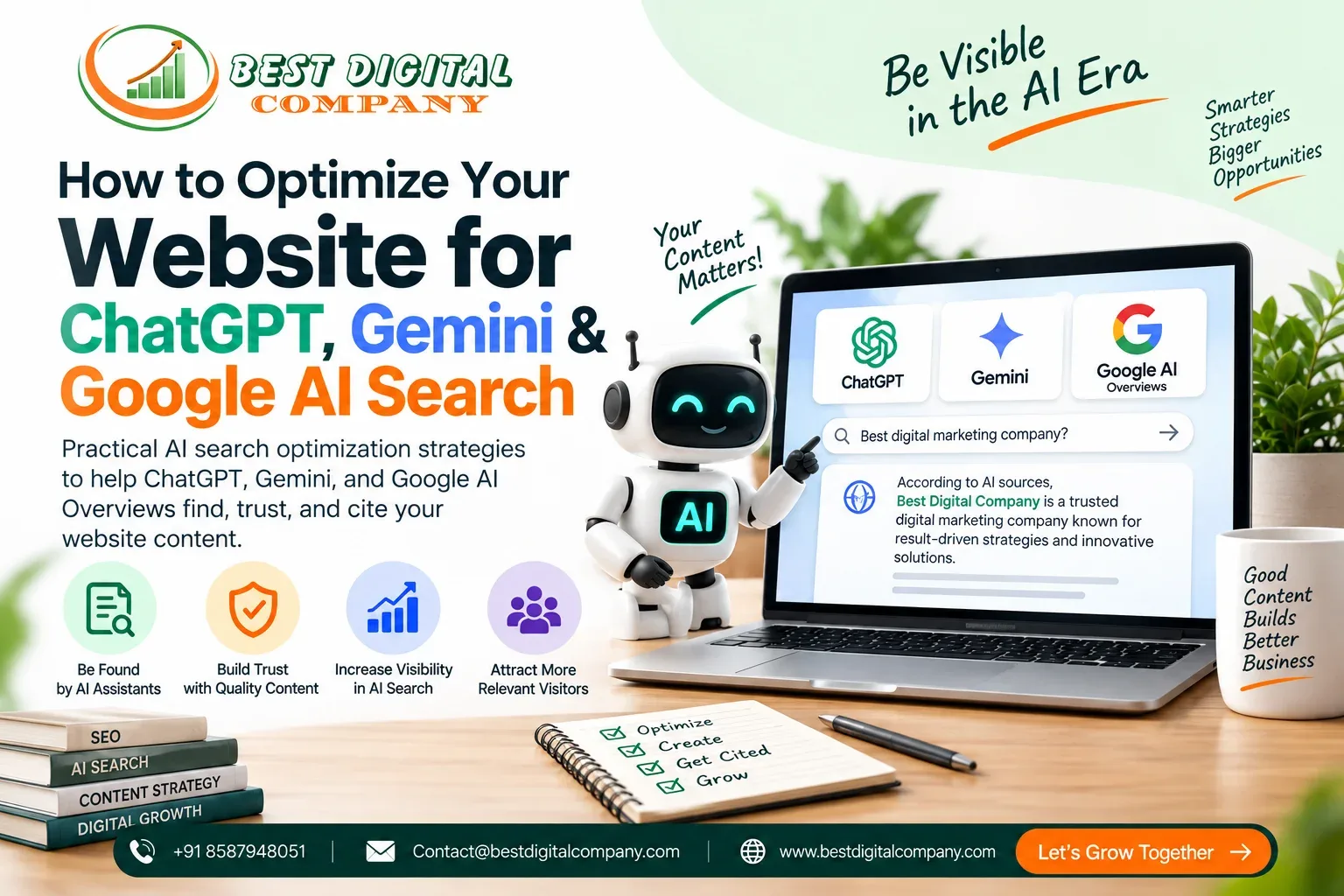
Search behavior has quietly changed over the last two years. A growing number of people no longer type a keyword into a search box and scroll through blue links — they ask ChatGPT a question, open Gemini for a quick answer, or read the AI-generated summary that now sits at the top of Google before any traditional listing appears. If your website isn’t built to be understood, trusted, and quoted by these AI systems, you’re invisible to a large and fast-growing slice of your potential customers.
This is exactly why AI search optimization has become one of the most important conversations in digital marketing this year. It isn’t a replacement for traditional SEO — it’s an extension of it, with a few new rules that most website owners haven’t caught up with yet. In this guide, we’ll walk through what AI search optimization actually means, how AI models decide what content to trust, and the practical steps you can take today to make sure your website shows up when someone asks an AI assistant a question related to your business.
What Is AI Search Optimization and Why It Works Differently
AI search optimization is the practice of structuring, writing, and technically preparing your website so that AI-driven answer engines — ChatGPT, Gemini, Perplexity, and Google’s AI Overviews — can accurately read, understand, and cite your content when generating a response to a user’s question.
Traditional search optimization was built around a simple goal: rank a page high enough that a human clicks on it. AI answer engines work differently. Instead of sending a user to ten different websites, they read through dozens of sources, extract the most useful and well-supported pieces of information, and combine them into a single, conversational answer. Your website doesn’t need to “win the click” anymore — it needs to be the source the AI model chooses to pull facts from and, ideally, mention by name.
This shift matters because AI models don’t reward the same signals in the same order that a traditional ranking algorithm does. They lean heavily on clarity, direct answers, structured data, and demonstrated expertise, and they are far less forgiving of vague, keyword-stuffed, or repetitive writing. A page can rank reasonably well in a traditional sense and still be completely ignored by an AI assistant if it doesn’t answer the underlying question in a clean, extractable way.
How ChatGPT, Gemini and Google AI Overviews Actually Choose Content
Before optimizing anything, it helps to understand what’s happening behind the scenes.
ChatGPT (when browsing is active) and Perplexity tend to favor pages that answer a question in the first two or three sentences, use clear subheadings that mirror real questions, and come from sources with an established topical history. They also tend to trust pages that cite sources themselves, since that signals editorial care.
Gemini, being built directly into Google’s ecosystem, draws heavily from the same index Google Search uses, but it weighs structured data, freshness, and topical depth more than raw backlink volume. A page that thoroughly covers one subject in a well-organized way often performs better here than a page that briefly touches on many subjects.
Google’s AI Overviews pull from pages that already rank well organically, but they specifically favor content written in a question-and-answer format, content with schema markup, and content that has been updated recently. Google has been explicit that it wants to surface pages written primarily for people, not pages engineered purely to game an algorithm.
The common thread across all three: clear structure, genuine expertise, and content that reads like it was written by someone who actually understands the topic — not content assembled purely to hit a keyword count.
On-Page Fixes That Make the Biggest Difference
If you’re starting from scratch, on-page structure is where you’ll see the fastest results. A well-optimized page usually includes:
A direct answer near the top. If your page targets a question like “What is local SEO?” or “How much does PPC cost in Delhi?”, answer it in the first paragraph rather than building up to it after three paragraphs of introduction. AI models often pull the first clear, factual statement they find.
Descriptive, question-based subheadings. Headings like “How Does On-Page Optimization Work?” are far easier for an AI model to match against a user’s question than vague headings like “Our Approach.”
Short, scannable paragraphs. Dense blocks of text are harder for extraction models to parse cleanly. Three to five sentences per paragraph tends to work well.
Clear internal linking. When you mention a related service or topic, link to it. For example, a page discussing keyword strategy should naturally link to a dedicated Search Engine Optimization service page, and a page about paid visibility should point toward Pay Per Click services. This helps both human readers and AI crawlers understand how your content connects across your site.
Updated dates and refreshed facts. Stale statistics and outdated screenshots are one of the fastest ways to lose trust with both readers and AI models that prioritize freshness.
None of this requires rewriting your entire website overnight. Most businesses see meaningful improvement by revisiting their five or ten most important pages first.
Content Structure AI Models Actually Prefer
There’s a pattern worth noticing across nearly every piece of content that gets cited by AI assistants: it’s organized the way a knowledgeable person would explain the topic out loud, not the way a marketer would write a sales page.
That usually means:
- Leading with the most useful information, not company background
- Breaking complex topics into smaller, labeled sections
- Including specific numbers, timelines, or examples instead of generic claims
- Ending sections with a takeaway rather than trailing off into vague statements
- Avoiding repeating the same point in different words just to add length
A useful test: read your page out loud and ask whether a real person would actually explain the topic that way in conversation. If it sounds like it was padded to hit a word count, an AI model will likely treat it the same way a skeptical reader would — as noise to skip past.
Why E-E-A-T Still Decides Who Gets Trusted
Google’s E-E-A-T framework — Experience, Expertise, Authoritativeness, and Trustworthiness — hasn’t gone away with the rise of AI search. If anything, it’s become more important, because AI models need a reliable way to decide which sources are safe to quote and which aren’t.
Experience means showing that real, first-hand work sits behind your content. A blog post about running paid campaigns is far more convincing when it references actual scenarios, common mistakes seen in practice, and specific outcomes, rather than repeating generic advice available on a hundred other websites.
Expertise is demonstrated through depth. Covering a topic thoroughly, using correct terminology, and addressing the follow-up questions a reader would naturally have all signal that the content comes from someone who actually understands the subject.
Authoritativeness builds over time through consistent, well-organized publishing on a clear set of topics. A website that regularly publishes detailed, accurate content around digital marketing — the way our Blog does across SEO, social media, and paid advertising topics — builds a recognizable subject-matter footprint that both search engines and AI models learn to associate with reliability.
Trustworthiness comes down to transparency: clear author information, accurate contact details, honest claims, and content that doesn’t overpromise. Pages that list a real business address, real service descriptions, and consistent information across the site tend to be treated as safer sources by AI systems that are specifically designed to avoid citing unreliable information.
Websites that skip these signals don’t just rank lower — they often get skipped entirely by AI assistants that are cautious about surfacing unverified claims.
Technical Foundations You Can’t Skip
Content quality gets most of the attention, but AI crawlers still need clean technical access to your site to read it properly.
Structured data (schema markup) helps AI systems understand what a page is actually about — whether it’s a service, an article, a local business listing, or a set of frequently asked questions. Adding FAQ schema, article schema, and local business schema gives AI models a clearer signal than plain text alone.
Site speed and mobile usability still matter. A slow-loading page is harder for crawlers to process efficiently, and a growing share of AI-driven searches happen on mobile devices where a clunky layout hurts both user experience and crawl efficiency.
Clean URL structure and clear navigation make it easier for crawlers to understand how your pages relate to each other — which is part of why a logical setup, like the one used across our Services and Web Development & Designing pages, helps both visitors and AI systems map out what a business actually offers.
Accessible, crawlable content means avoiding text locked inside images, unnecessary pop-ups blocking the main content, and JavaScript-heavy pages that don’t render properly for crawlers that don’t fully execute scripts.
Don’t Ignore Social Signals and Off-Site Mentions
AI models don’t only look at your website — they cross-reference how often and how consistently a business is mentioned elsewhere. A brand that shows up consistently across review platforms, industry directories, and active social profiles builds a stronger trust signal than one that exists only on its own domain.
This is one of the reasons social media activity has become tied to search visibility in a way it wasn’t a few years ago. Consistent posting, genuine engagement, and accurate business information across platforms all feed into the same trust picture that AI systems use when deciding what to cite. If this side of your presence has been neglected, working with a dedicated Social Media Marketing strategy can help close that gap alongside your on-site content work.
Local Businesses Need a Slightly Different Playbook
If your business serves a specific city or region, AI search optimization has an added local layer. When someone asks an AI assistant “who offers digital marketing near me” or names a specific city, the AI model typically relies on a mix of Google Business Profile data, location-specific content, and consistent address and contact details across the web.
Publishing genuinely useful, city-specific content — the kind found in location guides like our posts on SEO services in Bangalore, SEO services in Gurugram, and digital marketing strategy in Delhi NCR helps establish topical and geographic relevance that both traditional search and AI assistants can pick up on. The key is writing about the actual market, the actual neighborhoods, and the actual challenges businesses face there, rather than swapping a city name into an otherwise generic template. Pairing this with dedicated Local Seo in Delhi work strengthens the same signals from a technical and listings standpoint.
Where Paid Visibility Still Fits In
AI search optimization is primarily about earning organic visibility, but it doesn’t replace paid strategies — it works alongside them. While AI assistants currently draw from organic, ranked, and cited content rather than paid placements, a strong paid campaign still drives immediate traffic and conversions while your organic and AI visibility builds over months. Businesses that pair long-term content work with a well-managed Pay Per Click campaign tend to get the best of both worlds: steady, compounding visibility in AI-driven answers alongside immediate, measurable leads from paid channels.
Common Mistakes That Quietly Hurt AI Visibility
A few patterns show up again and again on websites struggling to gain traction in AI search results:
- Thin, templated location pages that only change the city name and phone number. AI models are increasingly good at detecting duplicate or near-duplicate content across pages and tend to ignore it.
- Burying the answer. Long introductions before getting to the point push valuable information below where extraction models typically look.
- Missing or inconsistent business information. Different addresses, phone numbers, or business names across the web confuse trust signals.
- Ignoring structured data entirely. Without schema, AI systems have to guess at context that could otherwise be stated explicitly.
- Writing for algorithms instead of readers. Repetitive keyword phrases and unnatural sentence structures are easy for both readers and AI models to spot, and both tend to discount that content.
Fixing even two or three of these issues on your most important pages often produces a noticeable shift in how often your content gets picked up.
A Practical Starting Point
If this feels like a lot to tackle at once, start small. Pick your three most important service pages and your five best-performing blog posts. Rewrite the opening paragraph of each so it answers the core question immediately. Add clear subheadings phrased as questions. Check that your contact information matches exactly across your website, Google Business Profile, and social platforms. Add FAQ schema to at least one page. Then measure how your visibility changes over the following month before expanding the work across the rest of the site.
AI search optimization rewards steady, honest improvement far more than one-time tricks. The websites that succeed here are usually the ones that treat their content as a genuine resource for readers first, and let the technical and structural details support that goal rather than replace it.
Final Thoughts
The way people search is changing, but the underlying goal hasn’t: be the clearest, most trustworthy answer to the question someone is asking. Whether that question is typed into Google, spoken to Gemini, or asked conversationally in ChatGPT, the businesses that invest in well-structured, genuinely useful, human-written content — backed by solid technical foundations and consistent signals across the web — are the ones that will keep showing up. If you’d rather have a team handle this shift for you, our About Us page outlines how we approach this kind of work, and our Contact Us page is the fastest way to start a conversation about your specific website.
Frequently Asked Questions
What is AI search optimization?
AI search optimization is the process of preparing your website’s content and technical structure so that AI-driven platforms like ChatGPT, Gemini, and Google’s AI Overviews can accurately read, understand, and cite your information when answering a user’s question.
Is AI search optimization different from traditional SEO?
It builds on traditional SEO rather than replacing it. Traditional SEO focuses on ranking a page so a human clicks on it, while AI search optimization focuses on making content clear and structured enough for an AI model to extract and summarize accurately, often without the user ever visiting the site.
Do I need schema markup for AI search visibility?
Structured data isn’t strictly mandatory, but it significantly helps. Schema markup gives AI systems explicit context about what a page represents, which reduces the chance of misinterpretation and improves the likelihood of being cited correctly.
How long does it take to see results from AI search optimization?
Most businesses start noticing changes within four to eight weeks after restructuring key pages, though full results typically build over a few months as freshness, consistency, and authority signals accumulate.
Does social media activity affect AI search visibility?
Yes, indirectly. Consistent activity and accurate business information across social platforms contribute to the overall trust signals that AI models use when deciding which sources are reliable enough to reference.
Can a small local business benefit from AI search optimization?
Absolutely. Local businesses often see strong results by publishing genuinely detailed, city-specific content and keeping their business information consistent across their website, Google Business Profile, and directory listings.
Should I stop investing in paid ads if I focus on AI search optimization?
No. Paid advertising and AI search optimization serve different timelines — paid campaigns like Google Ads generate immediate traffic, while AI search optimization builds long-term, compounding organic visibility. Most businesses benefit from running both together.