
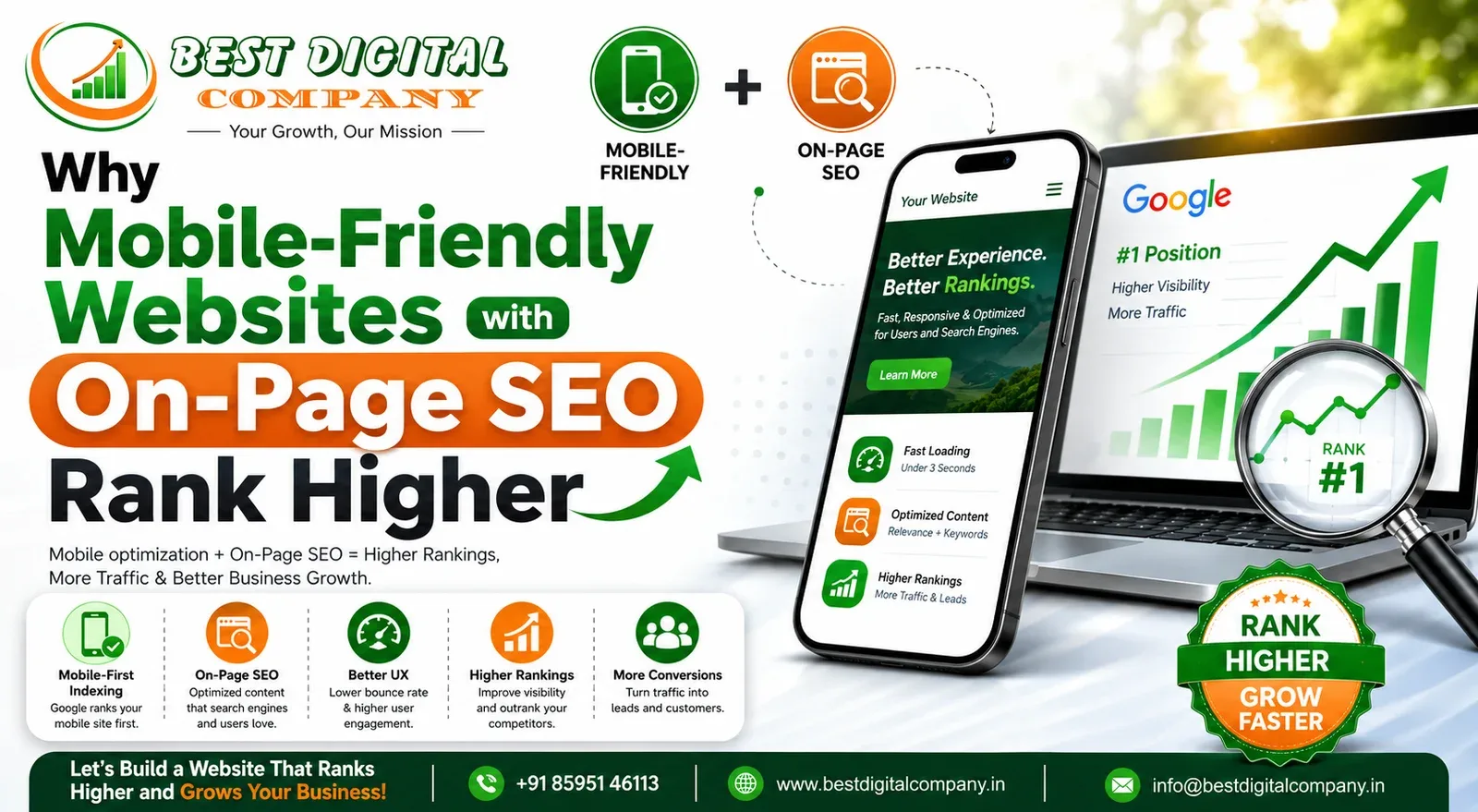
If you have been wondering why your competitor’s website consistently outranks yours despite having seemingly similar content, the answer likely lies in two powerful, interconnected pillars of modern search engine optimization: mobile-friendliness and on-page SEO.
In 2024, over 63% of all Google searches happen on mobile devices. Google responded to this shift by rolling out mobile-first indexing meaning Google now uses the mobile version of your website as the primary basis for ranking and indexing. If your site isn’t optimized for mobile, you are, quite simply, invisible to the majority of your potential customers.
At Best Digital Company, we’ve helped hundreds of businesses across India transform their online presence through strategic mobile optimization and on-page SEO. This guide breaks down exactly why these two forces work best together and what you can do about it.
What Is Mobile-First Indexing and Why It Matters
Google officially completed its switch to mobile-first indexing for all websites in 2023. This means Googlebot now crawls and evaluates your mobile site first your desktop version is secondary. The implications are profound:
- If your mobile site has less content than your desktop version, Google only sees that reduced content for ranking purposes.
- If your mobile pages load slowly, Core Web Vitals scores drop, directly hurting rankings.
- If navigation, text, or buttons aren’t optimized for touchscreens, user engagement metrics suffer and Google takes note.
The truth is, mobile-friendliness is no longer an enhancement, it is the baseline requirement for ranking on the first page of Google. Businesses that treat it as optional are leaving enormous revenue on the table, regardless of how strong their off-page authority might be.
On-Page SEO: The Foundation Google Builds Rankings On
On-page SEO refers to all the optimizations you make directly within your web pages to improve their relevance and usability for both users and search engines. Unlike off-page SEO (which involves backlinks and external signals), on-page SEO is entirely within your control.
Title Tags and Meta Descriptions
Your title tag is arguably the single most important on-page SEO element. It signals to Google and to users, what your page is about. An optimized title tag includes your primary keyword near the beginning, stays under 60 characters, and compels clicks. Similarly, your meta description (ideally 150–160 characters) should act as a mini-advertisement for your page, incorporating secondary keywords naturally.
Header Structure (H1–H6)
Proper use of header tags creates a logical hierarchy that helps Google understand your content structure. Your H1 should contain your primary keyword and appear exactly once. Subsequent H2 and H3 headings break content into scannable sections — which is especially critical for mobile readers who scroll through content quickly on small screens.
Keyword Placement and Semantic SEO
Modern on-page SEO goes beyond simply inserting keywords into text. Google’s natural language processing (NLP) now evaluates semantic relevance whether your content genuinely covers a topic comprehensively. This means incorporating related terms, answering user questions directly, and structuring content around search intent.
Image Optimization
Images are often the largest culprits behind slow mobile load times. Properly optimized images compressed to WebP format, with descriptive alt text containing relevant keywords improve both page speed scores and accessibility, both of which factor into rankings.
Why Mobile-Friendliness + On-Page SEO = Ranking Power
Neither mobile optimization nor on-page SEO works as effectively in isolation. Here’s why the combination is multiplicative, not additive:
Core Web Vitals Connect Both
Google’s Core Web Vitals measuring Largest Contentful Paint (LCP), Interaction to Next Paint (INP), and Cumulative Layout Shift (CLS) sit at the intersection of mobile performance and on-page optimization. A technically well-coded, mobile-responsive page that also has lean, properly structured on-page content will consistently outperform competitors on these metrics.
User Engagement Signals Amplify Rankings
When a user lands on a mobile-friendly page with clear on-page structure, readable font sizes, properly sized CTAs, and fast-loading images, they stay longer. Lower bounce rates, higher time-on-page, and more pages-per-session are behavioural signals that Google incorporates into its ranking algorithm. On-page SEO drives initial relevance; mobile UX drives sustained engagement.
The Mobile-First On-Page SEO Checklist:
- Responsive design that adapts fluidly to all screen sizes
- Page load time under 3 seconds on mobile (use PageSpeed Insights to check)
- Touch-friendly buttons with minimum 48×48px tap targets
- Font size no smaller than 16px on mobile viewports
- Primary keyword in H1, URL slug, title tag, and first 100 words
- Compressed WebP images with descriptive alt text
- Structured data markup (Schema.org) for rich results
- Internal links to relevant service pages with anchor-text variety
- No intrusive interstitials or pop-ups that block mobile content
- XML sitemap submitted to Google Search Console
Local SEO: Where Mobile and On-Page SEO Intersect Most Powerfully
One of the most striking examples of the mobile-SEO nexus is local search. When someone types “SEO services near me” or “digital marketing agency in Mumbai” on their phone, Google prioritizes businesses that are:
- Geographically relevant — with location-specific on-page content
- Mobile-optimized — because local searches are overwhelmingly performed on phones
- Fast to load — since mobile users on the go have zero patience for slow pages
For businesses looking to dominate local search across India’s major markets, our region-specific SEO services combine mobile-first technical optimization with hyper-local on-page content strategies:
- SEO Services in Mumbai → Dominate India’s commercial capital with targeted Mumbai SEO strategies built for mobile-first indexing.
- SEO Services in Punjab → Grow your business across Amritsar, Ludhiana, and Chandigarh with our Punjab-focused SEO solutions.
- SEO Services in Haryana → Rank higher across Gurugram, Faridabad, and Hisar with on-page and mobile SEO expertise in Haryana.
Technical On-Page Factors That Boost Mobile Rankings
Schema Markup for Mobile Rich Results
Structured data (Schema.org markup) helps Google understand your content in order to generate rich results star ratings, FAQs, breadcrumbs, and more directly in search results pages. On mobile, these rich results occupy significantly more screen real estate, dramatically increasing click-through rates even when you’re not in position one.
Accelerated Mobile Pages (AMP) vs. Core Web Vitals
While Google retired AMP as a ranking factor, the underlying principle holds: fast, clean mobile pages win. The modern equivalent is optimizing for Core Web Vitals through techniques like lazy loading images, eliminating render-blocking resources, and leveraging browser caching. These are all on-page technical decisions with direct ranking consequences.
Internal Linking Architecture
A strong internal linking structure distributes “link equity” across your site and helps Google discover and prioritize your most important pages. On mobile, clear internal navigation also keeps users exploring your site rather than bouncing back to search results. Every service page and blog post should strategically link to other relevant pages using varied, keyword-rich anchor text.
For example, a business seeking comprehensive SEO services in Mumbai benefits not only from local keyword targeting but from a mobile-optimized site structure that makes navigating between service pages seamless on any device. The same principle applies whether you’re looking for SEO services in Punjab or SEO services in Haryana, the combination of local on-page relevance and flawless mobile experience is what separates page-one businesses from the rest.
Content Strategy for Mobile-First On-Page SEO
Writing content for mobile readers isn’t about dumbing it down, it’s about structuring it differently. Mobile users scroll quickly and read in fragments. Here’s how top-ranking pages structure their content for mobile-first consumption:
- Inverted pyramid structure: Lead with your most important information. Mobile users decide within seconds whether to keep reading.
- Short paragraphs: No more than 3–4 lines on mobile. Long walls of text look especially overwhelming on a 6-inch screen.
- Scannable subheadings: Every H2 and H3 should be able to stand alone as a meaningful takeaway.
- Bulleted lists: Ideal for mobile reading – easy to skim, easy to process.
- Strategic keyword placement: Primary keywords in the first 100 words, in at least one H2, and in the conclusion but always naturally integrated.
The #1 Mistake Businesses Make with Mobile SEO: They separate mobile optimization and on-page SEO into different workstreams, treating them as distinct disciplines. The most successful sites integrate these strategies from the beginning: every content decision is made with mobile rendering in mind, and every mobile UX decision is made with ranking impact in mind.
How to Measure Mobile SEO Success
Google Search Console
GSC’s Mobile Usability report identifies specific pages with mobile errors. The Core Web Vitals report shows URL-level performance data for mobile vs. desktop separately. Monitor your mobile click-through rate (CTR) for target keywords, an increase indicates improving title tags and meta descriptions.
Google Analytics 4
Segment all traffic by device type. Compare bounce rates, session duration, and conversion rates between mobile and desktop users. A properly optimized mobile experience should show mobile bounce rates approaching (if not matching) desktop performance.
PageSpeed Insights
Run your core service and landing pages through PageSpeed Insights monthly. Aim for a mobile score above 80. Pay close attention to LCP (should be under 2.5s), INP (under 200ms), and CLS (under 0.1).
Frequently Asked Questions
How long does mobile-first on-page SEO take to show results?
Most businesses begin to see measurable improvements in mobile rankings within 3–6 months of implementing comprehensive mobile-first on-page SEO changes. Technical improvements (speed, mobile usability) often produce faster results than content-based changes. Consistency and regular updates are key to sustained ranking improvements.
Does my website need a separate mobile version?
No ,Google actually recommends against separate mobile URLs (m.website.com). The preferred approach is a single responsive website that adapts automatically to any screen size using CSS media queries. Responsive design is Google’s recommended configuration and avoids the complications of managing duplicate content across multiple URLs.
Is on-page SEO enough to rank without backlinks?
For highly competitive keywords, off-page signals (backlinks) remain important. However, for local and long-tail keywords, excellent on-page SEO combined with mobile optimization can absolutely achieve first-page rankings with minimal backlinks. We often see this with our clients seeking SEO services in Mumbai ,Punjab and Haryana or any other location in India or across India, local intent significantly reduces the backlink threshold for ranking.
What’s the most important on-page SEO element for mobile rankings?
Page speed is the single most impactful factor unique to mobile. However, it works in conjunction with title tags, header structure, and content quality. Think of it as a chain: page speed gets you through the door, on-page content quality keeps you in the room, and user engagement signals determine how high you rise.
How can Best Digital Company help with mobile SEO?
We offer end-to-end SEO services covering technical mobile audits, on-page optimization, content strategy, and local SEO, all integrated into a single cohesive strategy. Whether you need SEO in Mumbai, Punjab or Haryana, or any other location, our team delivers measurable ranking improvements.
Reach us at +91 8587948051 or Contact@bestdigitalcompany.com.
Conclusion: The Mobile-SEO Advantage Is Available to You
The evidence is overwhelming and the direction is clear: businesses that invest in mobile-friendly design and rigorous on-page SEO consistently outperform those that neglect either element. In India’s rapidly mobile-first digital landscape, this combination is especially powerful.
Whether you’re a local business in Punjab looking to capture regional search traffic, a growing brand in Haryana trying to dominate district-level SERPs, or an enterprise in Mumbai competing for high-value commercial keywords, the playbook is the same: optimize for mobile, perfect your on-page SEO, and measure relentlessly.
Ready to take your search rankings to the next level? Our team at Best Digital Company specializes in exactly this intersection.