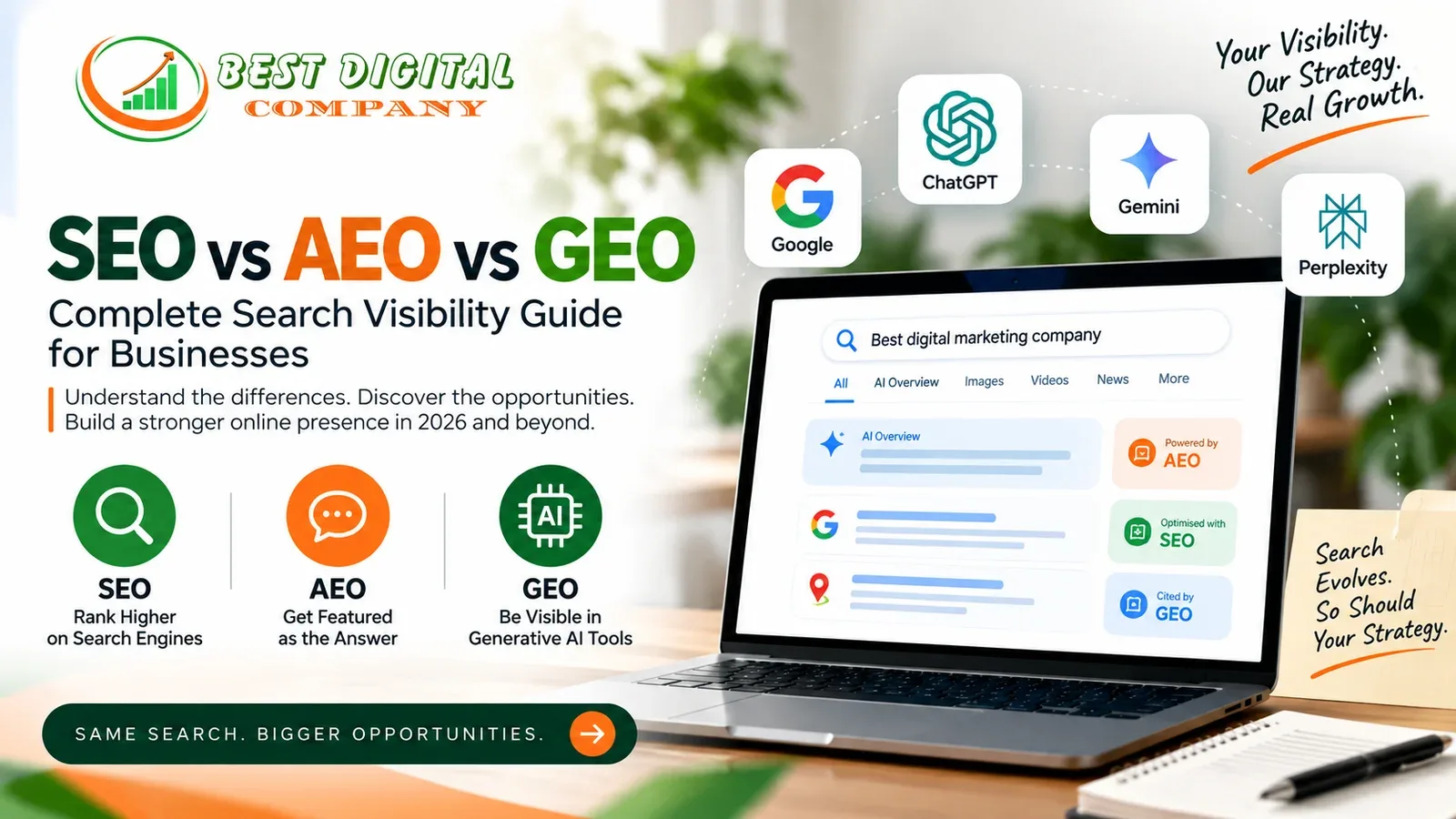
SEO vs AEO vs GEO: Complete Search Visibility Guide

SEO vs AEO vs GEO: Complete Search Visibility Guide for Businesses

If you run a business and someone on your marketing team recently asked, “Should we still be worried about SEO, or do we need AEO and GEO now too?” — you’re not alone. Search has quietly split into three overlapping disciplines, and most business owners haven’t been told what changed or why it matters to their revenue.

For almost twenty years, being found online meant one thing: rank high on Google’s results page. Today, that’s only part of the picture. People still type keywords into Google, but they also ask ChatGPT for recommendations, get instant answers from Google’s AI Overviews without clicking anything, and rely on Gemini or Perplexity to compare options before they ever visit a website. Each of these behaviors is served by a different discipline — SEO, AEO, and GEO.

This guide breaks down what SEO, AEO, and GEO actually mean, how they’re different, where they overlap, and how a business should combine all three to stay visible in 2026 and beyond. Whether you’re a founder, a marketing manager, or someone simply trying to make sense of the terminology before hiring an agency, this is meant to be the one page you need to read.

What Is SEO (Search Engine Optimization)?

SEO, or Search Engine Optimization, is the practice of improving a website so that search engines like Google and Bing understand it, trust it, and rank it higher for relevant queries. It covers technical site health, keyword-focused content, backlinks, page speed, mobile usability, and dozens of smaller signals that together decide where a page lands when someone searches.

SEO has always been about earning organic visibility without paying for every click. A well-optimized website keeps generating traffic long after the work is done, which is why it remains the foundation of almost every digital growth plan. If you’re unfamiliar with how this works in practice, our detailed breakdown of Search Engine Optimization covers the technical, on-page, and off-page pieces that go into a real SEO strategy, and our SEO services in Delhi page shows how this is applied for local businesses specifically.

SEO typically includes:

  • Keyword research – understanding what your audience is actually typing into search engines
  • On-page optimization – titles, headers, internal links, content structure, and image alt text
  • Technical SEO – site speed, mobile-friendliness, crawlability, and secure hosting
  • Off-page SEO – backlinks and brand mentions that signal authority to search engines
  • Local SEO – optimizing for “near me” searches and Google Business Profile visibility, something we cover in depth on our Local SEO in Delhi page

SEO isn’t going away. It’s still the backbone that AEO and GEO are built on top of — but it’s no longer the whole story.

What Is AEO (Answer Engine Optimization)?

AEO, or Answer Engine Optimization, is the practice of structuring content so it gets pulled directly into featured snippets, voice assistant answers, and the “answer box” style results that sit above traditional organic listings. Instead of optimizing purely to rank a page, AEO optimizes to become the answer itself.

Think about how often you ask a smart speaker a question, or how frequently a short answer box appears right at the top of Google before any website links show up. That box didn’t get there by accident — the content behind it was written in a format answer engines could easily lift: a direct question, followed by a clear, concise answer, often supported by a list or a short paragraph.

AEO leans heavily on:

  • Direct, well-structured answers to specific questions, usually in the first sentence or two
  • FAQ sections and schema markup that make it easy for algorithms to extract and display content
  • Conversational phrasing that matches how people actually speak and ask questions, especially through voice search
  • Clear headers that mirror real user questions

This is a discipline that’s still fairly new to most businesses, which is exactly why we put together a dedicated guide on what AEO is and how to get featured in AI search results. If your competitor’s content is showing up as the answer to a question and yours isn’t, AEO is usually the reason.

What Is GEO (Generative Engine Optimization)?

GEO, or Generative Engine Optimization, is the newest of the three, and it’s built specifically for how generative AI tools — ChatGPT, Gemini, Perplexity, Claude, and Google’s AI Overviews — pull together information to answer a question in a written, conversational response rather than a list of links.

Here’s the shift GEO responds to: when someone asks a generative AI tool “which digital marketing agency should I hire in Delhi,” the tool doesn’t hand back ten blue links. It reads across multiple sources, synthesizes an answer, and often names two or three businesses by name — sometimes without the user ever visiting a website at all. GEO is about making sure your business is one of the sources that gets cited, quoted, or recommended in that generated response.

GEO focuses on:

  • Topical authority – covering a subject thoroughly enough that AI models recognize your site as a credible source
  • Clear, factual, well-organized content – generative models favor content that’s easy to extract and summarize accurately
  • Brand mentions across the web – AI tools weigh how often and how consistently your business is referenced elsewhere, not just on your own site
  • Original data, expert opinions, and specificity – generic content is far less likely to be cited than content with real insight behind it

We’ve written a full comparison of GEO vs SEO and which one your business actually needs, along with a broader look at how AI search is changing SEO in 2026. Both are worth reading if you want to go deeper into how generative engines are reshaping discovery.

SEO vs AEO vs GEO: The Core Differences

It’s easier to understand these three disciplines side by side. Here’s how SEO, AEO, and GEO compare across the factors that matter most to a business owner deciding where to invest.

FactorSEOAEOGEO
Primary goalRank higher on traditional search resultsGet selected as a direct answer or featured snippetGet cited or recommended inside AI-generated responses
PlatformsGoogle, Bing organic listingsFeatured snippets, voice assistants, answer boxesChatGPT, Gemini, Perplexity, AI Overviews
Content styleKeyword-optimized, comprehensive pagesShort, direct answers to specific questionsWell-structured, factual, citation-worthy content
Success metricRankings, organic traffic, click-through rateSnippet ownership, voice search appearancesBrand mentions, citations, AI-driven referral traffic
User outcomeUser clicks through to your websiteUser gets the answer instantly, may or may not clickUser gets a recommendation and may never visit your site
Time horizonMedium to long term, compoundingMedium term, dependent on content structureEmerging, requires ongoing authority building

The biggest mental shift for most businesses is this: SEO earns clicks, but AEO and GEO increasingly earn visibility without a click. Your business can be “found” and even trusted by a potential customer before they ever land on your website — which changes how you should measure success and how you should write your content in the first place.

Where SEO, AEO, and GEO Overlap

None of these three exist in isolation, and treating them as separate projects is one of the most common mistakes businesses make. In reality, they share a foundation:

  • Quality content is non-negotiable across all three. Thin, generic pages don’t rank well in traditional search, don’t get pulled into answer boxes, and definitely don’t get cited by generative AI tools that are specifically trying to avoid low-value sources.
  • Site structure and technical health matter everywhere. A slow, poorly organized website hurts SEO rankings, makes it harder for answer engines to parse your content, and gives AI crawlers a worse experience overall.
  • Authority and trust signals carry weight in all three systems. Backlinks, consistent business information across the web, and genuine expertise influence how Google ranks you, how answer engines select you, and how generative models decide whether to cite you.
  • Search intent still drives everything. Whether someone types a query into Google, asks a voice assistant, or prompts ChatGPT, they’re trying to solve the same underlying problem. Content that genuinely answers the question performs better across every channel.

This overlap is good news. It means a business doesn’t need three completely separate strategies — it needs one strong content and authority foundation, adapted slightly for how each system consumes and surfaces information.

Why Businesses Can’t Rely on SEO Alone Anymore

A few years ago, ranking on page one of Google was the finish line. That’s no longer true, and the data backs this up: a growing share of searches now end without a single click, because the user’s question gets answered directly on the results page or inside an AI chat window.

This has real consequences for businesses that have only ever invested in traditional SEO:

  1. Zero-click searches are rising. If your content isn’t structured to appear in an answer box, you may be losing visibility even when you technically rank well.
  2. AI Overviews are becoming the default experience. Google now shows AI-generated summaries for a large portion of informational queries, and businesses that don’t optimize for this are invisible in that summary regardless of their traditional ranking. We break this down further in our guide on making your business visible in AI Overviews and AI search results.
  3. Generative AI is becoming a discovery channel, not just a chatbot. People are starting to ask ChatGPT and Gemini for recommendations the way they used to ask a friend or search Google — and if your business isn’t part of the data these tools were trained on or actively crawl, you simply won’t come up.
  4. Voice search continues to grow, and voice results almost always come from a single, well-structured answer rather than a list of ranked pages.

None of this means SEO has lost its value. It means SEO is now the foundation that AEO and GEO are built on, rather than the entire strategy on its own. For a practical look at adapting your existing site, our guide on optimizing your website for ChatGPT, Gemini, and Google AI search walks through the specific changes that help.

How to Build a Search Visibility Strategy That Covers SEO, AEO, and GEO

Bringing all three together doesn’t require a complete overhaul of your marketing. It requires a shift in how content is planned, written, and structured. Here’s a practical approach.

1. Start with genuinely useful, well-researched content

Every discipline rewards content that actually helps the reader. Vague, keyword-stuffed pages written purely to rank no longer perform well anywhere — not on Google, not in answer boxes, and definitely not in AI-generated responses that are built to filter out low-quality sources. Write for a real person with a real question first, then optimize.

2. Structure content around questions, not just keywords

Instead of building a page around a single keyword phrase, build it around the actual questions your customers ask. Use clear H2 and H3 headers phrased as questions, followed by direct, concise answers. This single change improves your odds across SEO, AEO, and GEO simultaneously.

3. Add FAQ sections with structured markup

FAQ sections aren’t just good for user experience — they’re one of the most effective tools for both AEO and GEO because they present information in a format that’s easy for machines to extract, summarize, and cite accurately.

4. Build topical authority, not just isolated pages

Publishing one article about a topic rarely earns you a citation in an AI-generated answer. Publishing a genuinely thorough cluster of content around a subject — the way we’ve approached search visibility topics on our own blog — builds the kind of depth that both search engines and generative AI models recognize as expertise.

5. Strengthen your presence beyond your own website

Generative engines and answer engines pull signals from across the web, not just from your homepage. Consistent business information, credible mentions, reviews, and social proof all feed into how trustworthy your business appears. This is where Social Media Marketing plays a bigger role than most businesses realize — an active, consistent social presence reinforces the same authority signals that AEO and GEO depend on.

6. Keep technical SEO healthy

None of this matters if your site is slow, poorly structured, or difficult to crawl. A clean technical foundation — the kind covered under proper Website Development & Designing makes it easier for every type of search and AI system to access and understand your content.

7. Use paid visibility to fill the gaps while organic strategies mature

AEO and GEO take time to build, especially the authority component. In the meantime, a well-targetedPay Per Click campaign keeps your business visible and generating leads while your organic and AI-search presence grows in the background.

Common Mistakes Businesses Make With SEO, AEO, and GEO

  • Treating them as competing strategies instead of complementary ones. You don’t choose SEO or AEO or GEO — you build one strong foundation that supports all three.
  • Ignoring structure in favor of length. A 3,000-word article with no clear headers, no direct answers, and no logical flow will underperform a well-organized 1,200-word page in both answer engines and generative AI results.
  • Forgetting to update existing content. Older pages written purely for traditional SEO often need restructuring — added FAQs, clearer headers, more direct answers — to compete in an AI-driven search environment.
  • Assuming rankings alone equal visibility. A page can rank on the first page and still be invisible in an AI Overview or a ChatGPT response if it isn’t structured for extraction.
  • Skipping measurement. Most businesses still only track clicks and rankings. Tracking brand mentions in AI tools, featured snippet ownership, and referral patterns from AI platforms is quickly becoming just as important.

Bringing It All Together

SEO, AEO, and GEO aren’t three separate battles for visibility — they’re three lenses on the same goal: being found, trusted, and chosen by the right people at the moment they’re looking for what you offer. SEO gets your website in front of search engines. AEO gets your content selected as the direct answer. GEO gets your business mentioned inside the AI-generated responses that a growing number of people now trust as their starting point for research and decisions.

Businesses that treat these as one connected strategy — built on genuinely useful content, solid technical foundations, and consistent authority across the web — are the ones who will stay visible no matter how people choose to search over the next few years.

If you’d like help auditing where your business currently stands across search engines and AI platforms, our team can walk you through a practical, prioritized plan. You can explore our full range of digital marketing services or get in touch with our team to start the conversation.

Frequently Asked Questions

What is the difference between SEO, AEO, and GEO?

SEO focuses on ranking your website higher on traditional search results through keywords, technical optimization, and backlinks. AEO focuses on getting your content selected as a direct answer in featured snippets and voice search. GEO focuses on getting your business cited or recommended inside AI-generated responses from tools like ChatGPT and Gemini.

Does a business need to choose between SEO, AEO, and GEO?

No. These three disciplines share the same foundation — quality content, technical health, and authority — and work best when combined into a single strategy rather than pursued separately.

Is SEO still worth investing in with the rise of AI search?

Yes. SEO remains the foundation that AEO and GEO are built on. Without solid on-page and technical SEO, it’s much harder for answer engines or generative AI tools to find, understand, and trust your content in the first place.

How long does it take to see results from AEO and GEO?

AEO can show results faster, sometimes within a few weeks, since it often involves restructuring existing content with clearer answers and FAQ sections. GEO typically takes longer because it depends on building broader topical authority and consistent mentions across the web, which compounds over several months.

Can small or local businesses benefit from AEO and GEO, or is this only for large companies?

Small and local businesses can benefit significantly, especially since many AI-driven searches are local in nature — such as “best digital marketing agency near me.” A focused strategy combining local SEO with clear, well-structured content often works well even on a limited budget.

How can I check if my business is showing up in AI search results?

Try asking tools like ChatGPT, Gemini, and Google’s AI Overviews the kinds of questions your customers would ask, and see whether your business appears in the response. If it doesn’t, that’s usually a sign your content needs better structure, more depth, or stronger authority signals across the web.
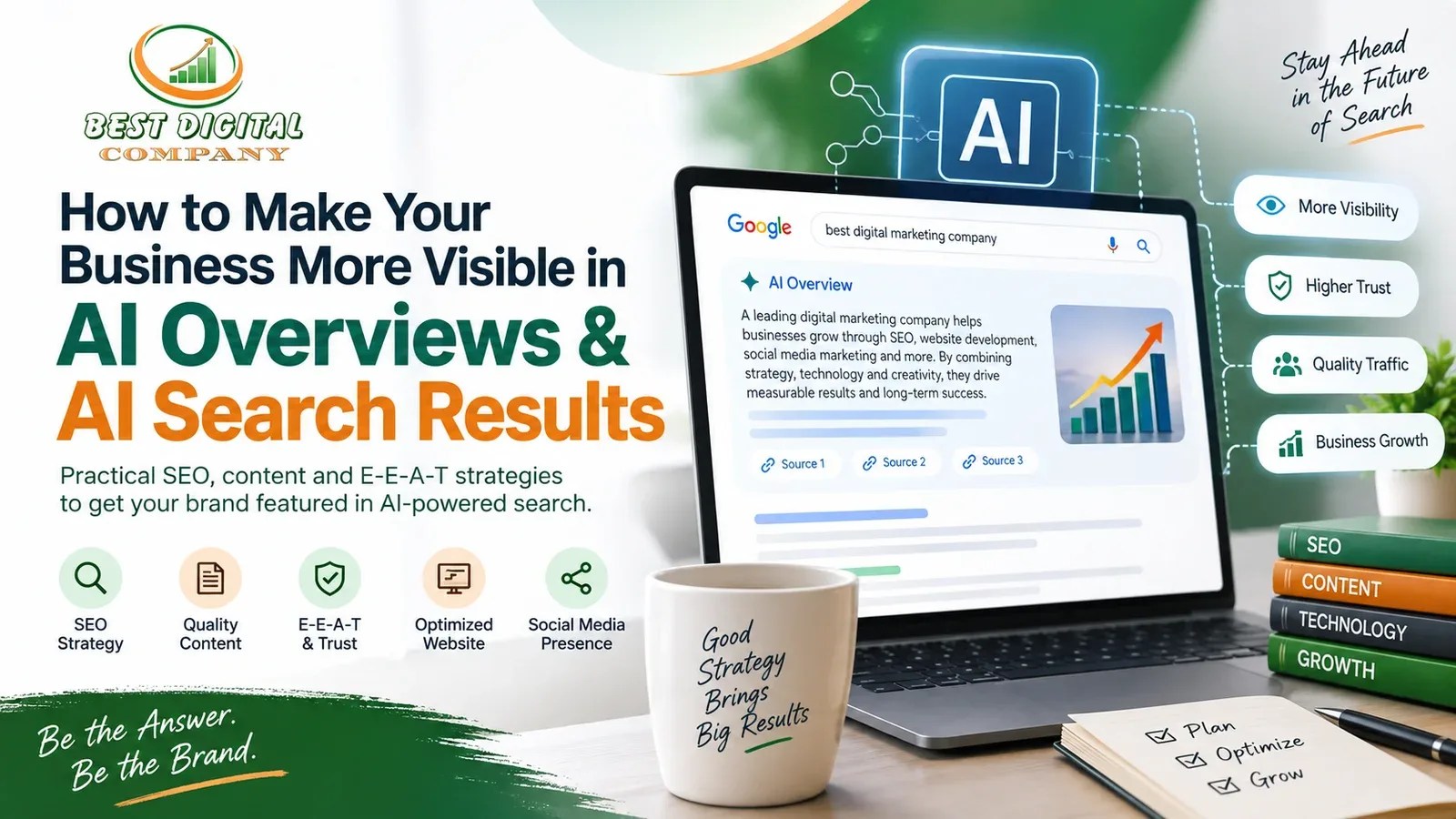
AI Overviews Optimization: Make Your Business Visible

How to Make Your Business More Visible in AI Overviews & AI Search Results

Search behavior has changed more in the last two years than it did in the previous decade. People no longer type a query and scroll through ten blue links. Instead, they read a short AI-generated summary at the top of the page, get their answer, and move on. If your business isn’t part of that summary, you’re invisible to a growing share of potential customers — even if you still rank well the old-fashioned way.

This shift is exactly why AI Overviews optimization has become one of the most important priorities for any business that wants to stay discoverable in 2026 and beyond. Whether you run a local service business, an e-commerce store, or a B2B company, the way you structure and present your content now directly affects whether Google’s AI, ChatGPT, Perplexity, or Copilot mentions your brand when someone asks a relevant question.

In this guide, we’ll break down what AI Overviews actually are, why they matter, and the practical steps you can take — from content structure to technical setup — to improve your chances of being featured. We’ll also look at how core digital marketing disciplines like SEO, website development, and social media marketing all play a role in this new search landscape.

What Are AI Overviews and Why They Matter for Your Business

AI Overviews are the AI-generated summaries that now appear at the top of many search results. Instead of listing links for the user to click through, the search engine reads across multiple trusted sources, synthesizes the information, and presents a direct answer — often with a few source links attached.

This matters for three reasons:

  1. Reduced click-through rates. When a searcher gets their answer directly in the overview, they may never click through to a website at all. If your competitor is cited and you aren’t, they get the visibility and the trust, even if your content is just as good.
  2. New ranking signals. Being included in an AI Overview depends less on traditional keyword density and more on how clearly your content answers a specific question, how trustworthy your site appears, and how well your information is structured for machines to read.
  3. A shrinking window of opportunity. Early adopters who optimize now will have an advantage, since AI systems tend to favor sources they’ve already learned to trust over time.

In short, if your business isn’t showing up in AI-generated answers, you’re losing visibility at the exact moment a customer is deciding who to trust.

How AI Search Is Different from Traditional Search Results

Traditional search rewarded pages that matched a keyword closely and had strong backlink profiles. AI search still cares about relevance and authority, but it adds a layer of interpretation on top. The AI has to understand the intent behind a question, not just the words used, and then decide which sources are reliable enough to summarize.

A few practical differences worth understanding:

  • Answers are extracted, not just linked. The AI pulls a sentence or paragraph out of your page and rewrites it in its own words. This means your content needs to contain clear, self-contained answers, not just vague marketing language.
  • Multiple sources are blended. An AI Overview often draws from three, five, or even ten different pages to build one answer. Your goal isn’t to “win” the top spot outright — it’s to be one of the sources the AI trusts enough to include.
  • Freshness and consistency matter more. AI models weigh how consistently a fact appears across multiple credible sources. If your business information is inconsistent across your website, directories, and social profiles, it becomes harder for AI systems to confidently cite you.

Understanding this shift is the foundation of any real AI Overviews optimization strategy — it’s not a trick or a shortcut, it’s a change in how you present expertise.

AI Overviews Optimization: The Core Principles You Need to Follow

Once you understand how AI-driven search works, the actual optimization process becomes much clearer. Here are the principles that consistently make a difference:

1. Answer the question directly, early, and clearly.

Every page should open with a clear, concise answer to the core question it targets, ideally within the first two or three sentences. Save the elaboration, examples, and context for after the direct answer.

2. Structure content for extraction.

Use descriptive subheadings, short paragraphs, numbered steps, and bullet points. AI systems parse structured content far more easily than long, unbroken blocks of text.

3. Cover the topic completely, not just the keyword.

AI Overviews tend to favor pages that thoroughly address a topic — including related questions, common objections, and practical next steps — over pages that only skim the surface to target a single phrase.

4. Keep facts accurate and consistent everywhere.

Your business name, services, pricing information, and claims should match across your website, Google Business Profile, social channels, and any directories you’re listed in.

5. Update content regularly.

Stale pages lose trust over time. Revisiting older posts, refreshing statistics, and adding new insights signals to AI systems (and human readers) that your information is current.

None of this replaces solid fundamentals — it builds on them. A technically sound, well-structured, genuinely useful website is still the backbone of visibility in AI-driven search results.

Building E-E-A-T to Earn a Place in AI Answers

Google has been public about the importance of Experience, Expertise, Authoritativeness, and Trustworthiness (E-E-A-T) for years, and this framework matters even more in an AI-driven search environment. AI systems are cautious about which sources they cite, because citing an unreliable source damages the credibility of the answer itself. That means your business needs to actively demonstrate why it should be trusted.

Practical ways to strengthen E-E-A-T on your site:

  • Show real experience. Share case studies, client results, and behind-the-scenes insights that only someone who has actually done the work could write. Generic, recycled advice is easy for AI systems to deprioritize because it adds nothing new.
  • Highlight expertise with author bios. Attach a real name, credentials, and a short bio to your blog content. Anonymous, unattributed content is far less likely to be treated as authoritative.
  • Build authority through consistent publishing. A single great article won’t move the needle much. A steady stream of useful, well-researched content across your blog builds topical authority over time.
  • Earn trust signals. Secure hosting (HTTPS), clear contact information, transparent pricing where possible, genuine customer reviews, and an easy-to-find About Us page all contribute to how trustworthy your site appears — both to human visitors and to AI crawlers evaluating your content.

E-E-A-T isn’t a checkbox exercise. It’s the difference between a website that reads like it was written to please an algorithm and one that reads like it was written by people who genuinely know what they’re talking about — which, not coincidentally, is exactly what both human readers and AI systems are looking for.

Content Structure Tips That Help AI Systems Understand Your Business

Beyond E-E-A-T, there are specific formatting choices that make your content easier for AI systems to read, summarize, and cite accurately.

  • Use question-based subheadings. Phrasing an H2 or H3 as a question (e.g., “How much does website development cost?”) makes it far easier for an AI system to match your section to a user’s actual query.
  • Front-load the answer, then explain. Don’t bury the useful information under three paragraphs of introduction. Say what the reader needs to know, then support it with detail.
  • Use lists and tables where they genuinely help. Steps, comparisons, and pricing breakdowns are exactly the kind of content AI Overviews like to pull from.
  • Add structured data (schema markup). FAQ schema, article schema, and organization schema give search engines explicit, machine-readable signals about what your content covers and who published it.
  • Keep paragraphs short. Dense blocks of text are harder to parse and less likely to be extracted cleanly.

This kind of structural work is technical, but it’s also very much a content and writing discipline — which is why AI Overviews optimization sits at the intersection of SEO, content strategy, and web development.

The Role of SEO Services in AI Visibility

Traditional SEO services haven’t become irrelevant in the age of AI search — they’ve become the foundation it’s built on. AI Overviews still rely heavily on a site’s existing search performance, indexation, and topical relevance to decide which sources are worth summarizing.

A few SEO fundamentals that directly support AI visibility:

  • Keyword and intent research to understand exactly what questions your audience is asking, not just what terms they type.
  • On-page optimization, including title tags, meta descriptions, header structure, and internal linking, so both traditional and AI crawlers can understand your content hierarchy.
  • Technical SEO health, such as fast page speed, mobile-friendliness, and clean indexing, since AI systems are far less likely to cite a site that’s difficult to crawl.
  • Backlink building, because external validation from other trusted sites still signals authority to AI-driven ranking systems.

If your business hasn’t invested in solid SEO practices yet, AI Overviews optimization will be much harder to achieve, because you’d essentially be trying to build a second floor without a first one.

Why Website Development and Design Impact AI Overviews Optimization

It’s easy to think of AI visibility as purely a content problem, but the technical foundation of your website plays a huge role. A poorly built site — slow load times, broken navigation, missing metadata, non-responsive design — makes it harder for both search engines and AI crawlers to access and understand your content in the first place.

Good website development and design supports AI Overviews optimization by:

  • Ensuring pages load quickly on mobile and desktop, since speed affects crawl efficiency and user experience alike.
  • Providing clean, semantic HTML so headings, lists, and key information are properly tagged rather than styled with generic text.
  • Making navigation and internal linking logical, so crawlers can find and connect related content easily.
  • Supporting the structured data (schema) that helps AI systems understand what type of content each page contains.

A visually appealing site that’s technically weak underneath won’t perform well in AI search. The two need to work together.

Using Social Media Marketing to Support AI Search Visibility

While AI Overviews primarily draw from indexed web content, social signals still play a supporting role in building the kind of brand presence and consistency that AI systems (and human searchers) trust.

Social media marketing contributes to AI Overviews optimization in a few indirect but meaningful ways:

  • Brand consistency. When your business name, services, and messaging are consistent across social platforms and your website, it reinforces the same facts AI systems are trying to verify.
  • Content distribution. Sharing blog content on social channels increases the chances of engagement, mentions, and links — all of which feed back into your site’s authority signals.
  • Real-time relevance. Active social profiles show that a business is operational, current, and engaged with its audience, which supports the “trustworthiness” side of E-E-A-T.

Social media won’t replace strong website content, but it amplifies it — and amplification matters when AI systems are weighing which sources deserve to be cited.

How Paid Campaigns Complement Your AI Visibility Strategy

Paid advertising and AI Overviews optimization serve different purposes, but they work well together. While organic AI visibility takes time to build, paid campaigns can drive immediate traffic and conversions while your long-term content and authority-building efforts take hold.

A well-run paid strategy can also indirectly support AI visibility by:

  • Driving more visitors to your best-performing content, increasing engagement signals like time on page.
  • Testing which headlines, offers, and messaging resonate most, insights you can then apply to the organic content you’re optimizing for AI Overviews.
  • Keeping your brand visible and consistent across the search results page while your organic AI presence is still developing.

If you’re exploring how paid and organic strategies fit together for your business, our digital marketing packages are built to combine both.

Local Business Visibility in AI Search Results

For local businesses, AI Overviews optimization has an added layer: local intent. When someone searches for a service “near me” or in a specific city, AI-generated answers often pull from Google Business Profiles, local citations, and reviews, alongside website content.

To improve local AI visibility:

  • Keep your Google Business Profile complete, accurate, and regularly updated with posts, photos, and correct hours.
  • Maintain consistent name, address, and phone number (NAP) details across every directory and citation source.
  • Encourage genuine customer reviews and respond to them — review content is frequently referenced in local AI-generated answers.
  • Publish location-specific content that answers real questions your local customers are asking, rather than generic, copy-paste service pages.

Local businesses that get these basics right often see AI visibility improvements faster than larger, more generic competitors, simply because the local data ecosystem is smaller and easier to dominate with consistent, accurate information.

Measuring Success: Tracking Your AI Overviews Optimization Progress

Because AI Overviews are still a relatively new feature, measurement tools are evolving quickly. Here’s how to track progress in a practical way:

  • Monitor impressions and click data in Google Search Console for queries where an AI Overview appears, watching for shifts in visibility even when clicks decline.
  • Track brand mentions by periodically asking AI tools like ChatGPT, Gemini, or Perplexity questions relevant to your industry, and noting whether your business is mentioned.
  • Watch engagement metrics, such as time on page and scroll depth, since these often correlate with the kind of content AI systems prefer to cite.
  • Audit content consistency across your website, directories, and social profiles on a regular schedule, rather than only when something breaks.

Treat this as an ongoing process rather than a one-time project. AI search behavior will keep evolving, and your optimization approach needs to evolve with it.

Common Mistakes Businesses Make with AI Search Optimization

A few patterns show up repeatedly among businesses that struggle to gain AI visibility:

  • Writing for algorithms instead of people. Keyword-stuffed, repetitive content might have worked years ago, but it actively hurts your chances now. AI systems are specifically designed to favor genuinely helpful, human-sounding writing.
  • Ignoring technical fundamentals. No amount of great writing matters if your site is slow, poorly structured, or difficult to crawl.
  • Inconsistent business information. Conflicting details across platforms make it harder for AI systems to confidently cite your business.
  • Treating this as a one-time fix. AI Overviews optimization isn’t a project you complete once. It requires ongoing content updates, technical maintenance, and monitoring.
  • Neglecting the basics of trust. Missing author information, no clear contact details, and thin “About” pages all quietly undermine your credibility in the eyes of both readers and AI systems.

Avoiding these mistakes is often just as valuable as actively optimizing, since a single trust or technical issue can undo months of good content work.

How Best Digital Company Can Help

Improving visibility in AI-driven search results touches nearly every part of digital marketing — content strategy, technical SEO, website performance, social presence, and paid campaigns all need to work together. That’s a lot to manage on your own, especially while running a business.

Our team works with businesses to build this kind of integrated visibility strategy, combining SEO services, website development, content creation, and social media marketing into one coordinated approach. If you’d like a clearer picture of where your business currently stands in AI search results and what it would take to improve it, get in touch with us and we’ll walk you through it.

Frequently Asked Questions

What is AI Overviews optimization?

AI Overviews optimization is the practice of structuring and writing website content so it’s more likely to be selected, summarized, and cited by AI-generated search answers, such as Google’s AI Overviews or other AI search assistants.

Is AI Overviews optimization different from regular SEO?

Not entirely. It builds on solid SEO fundamentals — technical health, relevant keywords, quality backlinks — but adds an emphasis on clear, extractable answers, strong E-E-A-T signals, and information consistency across the web.

Can small or local businesses realistically compete in AI search results?

Yes. AI systems favor accurate, well-structured, trustworthy content over sheer brand size. A local business with consistent, complete information and genuinely useful content can outperform larger competitors with weaker or inconsistent online presence.

How long does it take to see results from AI Overviews optimization?

It varies by industry and competition, but most businesses start noticing shifts in visibility within a few months of consistent content improvements, technical fixes, and authority-building work. Ongoing effort tends to compound over time.

Do I need to abandon traditional SEO to focus on AI search?

No. Traditional SEO and AI Overviews optimization aren’t competing strategies — they reinforce each other. A technically strong, well-optimized site is the foundation that makes AI visibility possible in the first place.

Does social media affect AI Overviews visibility?

Indirectly, yes. Social media supports brand consistency, distribution, and engagement, all of which contribute to the trust signals that AI systems weigh when deciding which sources to cite.

What’s the biggest mistake businesses make when trying to appear in AI Overviews?

Writing content that’s optimized for keywords rather than for genuinely answering a reader’s question. AI systems are built to prioritize clear, helpful, human-sounding content, so anything that reads as manipulative or thin tends to be filtered out.

GEO vs SEO: Key Differences & Which One Does Your Business Need?

GEO vs SEO: What Is the Difference and Which One Does Your Business Need?

If you have spent any time in a marketing meeting over the last year, you have probably heard someone bring up GEO and ask how it’s different from SEO. It’s a fair question. For almost two decades, ranking on Google meant one thing: search engine optimization. Now, with AI tools like ChatGPT, Google’s AI Overviews, and Perplexity answering questions directly, a new term has entered the conversation, and business owners want to know whether they should be worried, excited, or both.

At Best Digital Company, we work with clients across Delhi, Gurugram, Noida, and several other cities who are asking the exact same thing: is GEO replacing SEO, or do the two need to work together? This guide breaks down GEO vs SEO in plain language, explains what each one actually does, and helps you figure out which approach (or combination) makes sense for your business right now.

What Is SEO (Search Engine Optimization)?

Search engine optimization is the practice of improving a website so that it ranks higher in organic search results and earns clicks from people actively searching for something. It covers technical fixes like site speed and mobile usability, on-page work like keyword placement and content structure, and off-page work like backlinks and brand mentions.

SEO has always been built around one core idea: helping a search engine understand what your page is about and trusting it enough to show it to the right person. That trust doesn’t happen overnight. It’s built through consistent, well-structured content, a technically sound website, and signals that show real expertise behind what’s published. Businesses that invest in Search Engine Optimization over months and years usually see steady, compounding traffic rather than a quick spike that fades.

Local businesses have an added layer here too. A bakery in Karol Bagh or a clinic in Sector 62 doesn’t just need to rank nationally, it needs to show up when someone nearby searches “best bakery near me.” That’s where Local SEO in Delhi and city-specific strategies come in, something we’ve written about in detail for markets like Bangalore and Gurugram.

What Is GEO (Generative Engine Optimization)?

Generative Engine Optimization, or GEO, is the practice of optimizing content so it gets picked up, understood, and cited by AI-driven answer engines like ChatGPT, Google’s AI Overviews, Gemini, and Perplexity. Instead of aiming to be the blue link someone clicks on, GEO aims to be the source an AI model pulls from when it generates a written answer.

This is a genuinely different goal. A search engine sends a person to your website. A generative engine often answers the question itself, using your content as the basis for that answer, sometimes without sending any traffic your way at all. So why would a business care about GEO if it doesn’t guarantee a visit? Because visibility inside an AI-generated answer still builds brand recognition, and for many purchase decisions, being the name an AI tool mentions is becoming just as valuable as being the top organic result.

GEO tends to reward content that is clearly structured, directly answers a specific question, cites real data or first-hand experience, and is written by someone with demonstrable authority on the topic. In other words, GEO doesn’t throw out good writing practices, it actually raises the bar for clarity and originality.

GEO vs SEO: The Key Differences

Understanding GEO vs SEO side by side makes the distinction much clearer:

Destination: SEO sends users to your website through organic listings. GEO gets your content referenced or summarized inside an AI-generated answer, and the user may never leave the AI tool.

Success metric: SEO is measured through rankings, organic sessions, and click-through rate. GEO is measured through how often your brand or content gets cited, mentioned, or quoted by AI tools, which is harder to track but increasingly trackable through emerging analytics tools.

Content format: SEO favors comprehensive pages that satisfy an entire search intent, often with headers, internal links, and depth. GEO favors direct, quotable answers, clear definitions, and content that an AI model can lift a clean sentence or two from.

Trust signals: SEO leans on backlinks, domain authority, and technical health. GEO leans heavily on demonstrated expertise, original data, clear sourcing, and content that reads as genuinely written by a knowledgeable person rather than assembled for keyword coverage.

Time to results: SEO is a long game, often three to six months before meaningful ranking movement. GEO can shift faster since AI models retrain and re-index more frequently, but it’s also less predictable and less controllable.

Despite the differences, GEO and SEO aren’t in competition. Most of what makes a page eligible for AI citation, clear structure, accurate information, and genuine expertise, also happens to be what search engines reward. Think of GEO as SEO’s newer sibling rather than its replacement.

Why Google Is Pushing Human-Written, Genuinely Helpful Content

Here’s something worth understanding regardless of which acronym you’re chasing: search engines have been steadily raising the bar on what counts as trustworthy content. Thin, repetitive, or clearly automated pages get filtered out faster than they used to. Content that reads like it was written by someone who has actually done the work, made mistakes, and learned from client results tends to hold up far better over time.

This is exactly why Experience, Expertise, Authoritativeness, and Trustworthiness (often shortened to E-E-A-T) has become such a central idea in both SEO and GEO. AI models trained on web content are, in a sense, doing the same evaluation a careful reader would: does this page sound like it knows what it’s talking about, or does it sound like filler? Businesses that publish original insights, real case examples, and content written in a natural, human voice are the ones both traditional rankings and AI citations tend to favor.

Does Your Business Need GEO, SEO, or Both?

This is the question that actually matters, and the honest answer depends on your industry, your goals, and your current stage of growth.

If you are a local service business (a clinic, a salon, a real estate agent), SEO should still be your primary focus. Most of your customers are searching with clear local intent, “SEO service in Delhi” or “dentist near Lajpat Nagar,” and they want to click through, call, or visit. GEO visibility matters less here because the buying decision usually requires direct contact, not just an AI-generated summary.

If you are a B2B brand, SaaS company, or a business that sells to informed, research-heavy buyers, GEO deserves real attention alongside SEO. These buyers often start their research inside AI tools, asking things like “best CRM for small teams” or “how does generative engine optimization work.” Being the source an AI model references during that research phase can influence a shortlist long before a prospect ever visits your website.

If you are an established brand with strong existing SEO, layering in GEO is a natural next step rather than a pivot. Your existing content, backlinks, and authority already give you a head start, since AI models tend to draw from sources that already show up reliably in search results.

If you are a newer business still building foundational visibility, SEO should come first. GEO strategies work best on top of a site that already has decent structure, indexed pages, and some established trust. Trying to chase AI citations before your site is even properly indexed is putting the cart before the horse.

For most businesses we work with, the realistic answer is both, with SEO as the foundation and GEO layered on as an emerging channel worth testing.

Building a Combined SEO and GEO Strategy

A strategy that covers both GEO vs SEO effectively usually includes a few consistent elements.

Start with genuinely useful, well-researched content instead of keyword-stuffed pages. Answer the actual question a reader (or an AI model summarizing on their behalf) is asking, clearly and near the top of the page. Structure content with proper headers, FAQs, and scannable sections, since both search engines and AI crawlers rely on structure to understand context.

Technical health still matters enormously. A slow, poorly coded website hurts both traditional rankings and AI crawl access. This is one reason Website Development & Designing is treated as a foundational service rather than an afterthought, a site that loads fast and renders cleanly gives both search engines and AI crawlers a much easier job.

Paid visibility still has a role too. While Pay Per Click advertising doesn’t directly influence AI citations, it keeps traffic flowing while your organic and GEO efforts mature, something we’ve broken down further in our piece on PPC services generating faster leads.

Social presence shouldn’t be ignored either. AI models increasingly draw context from how a brand is discussed across the web, including social platforms. Investing in Social Media Marketing helps build the kind of brand signal that supports both search rankings and AI visibility over time, a point we’ve also covered in our guide on SMO services and business growth.

Finally, don’t underestimate the value of a properly structured SEO package that combines technical audits, content strategy, and authority building. A scattered approach, where content is published without a plan, rarely performs well under either SEO or GEO evaluation.

Common Mistakes Businesses Make with GEO vs SEO

A few patterns show up again and again when businesses try to tackle this on their own.

The first is treating GEO as a replacement for SEO rather than an addition. Dropping search engine optimization work entirely to chase AI citations is risky, since organic search still drives the majority of measurable website traffic for most industries.

The second is publishing generic, repetitive content across multiple pages just to “cover more keywords.” Both search engines and AI models are increasingly good at recognizing repeated ideas dressed up in different words, and this approach tends to hurt trust rather than build it.

The third is ignoring local intent. Businesses serving specific cities, whether that’s Delhi, Noida, or markets further away like Chennai or Lucknow, sometimes chase broad national keywords instead of the specific, local searches that actually convert.

The fourth is skipping expertise signals entirely, no author bio, no real data, no evidence that a human with actual knowledge wrote the piece. That’s exactly the kind of content both traditional rankings and AI answer engines are learning to deprioritize.

Final Thoughts

GEO and SEO aren’t rivals fighting for the same job, they’re two channels solving related but different problems. SEO gets your business found and clicked on. GEO gets your business mentioned and trusted inside AI-generated answers. The businesses that will come out ahead over the next few years are the ones that treat both as part of one connected visibility strategy, built on genuinely useful, human-written content rather than shortcuts.

If you are not sure where your business currently stands, or which of the two deserves more of your budget right now, that’s a conversation worth having with a team that works across both. Reach out to Best Digital Company and we’ll walk through your current visibility, your industry, and build a plan that fits where your business actually is today.

Frequently Asked Questions

What does GEO stand for in digital marketing?

GEO stands for Generative Engine Optimization, the practice of optimizing content so AI tools like ChatGPT, Gemini, and AI Overviews can understand, summarize, and cite it accurately.

Is GEO replacing SEO?

No. GEO is an additional layer of visibility, not a replacement. Most businesses still get the majority of their measurable traffic through traditional organic search, so SEO remains the foundation.

Can one piece of content work for both GEO and SEO?

Yes, in most cases. Well-structured, genuinely helpful content that clearly answers a question tends to perform well for both search rankings and AI citations, since the underlying principles overlap heavily.

How long does it take to see results from SEO compared to GEO?

SEO typically takes three to six months to show meaningful ranking movement. GEO results can appear faster since AI models update more frequently, but the results are less predictable and harder to measure consistently.

Does my small local business need to worry about GEO right now?

Not urgently. If most of your customers search with local intent and want to call or visit your business directly, a solid SEO and local SEO foundation should remain your priority, with GEO treated as something to monitor rather than chase immediately.

How do I know if my content is being cited by AI tools?

You can manually test relevant questions in tools like ChatGPT or Google’s AI Overviews to see if your brand or website gets referenced. Dedicated GEO tracking tools are also emerging, though the space is still maturing compared to established SEO analytics.

What’s the biggest overlap between GEO and SEO?

Both reward clear, well-structured, expert-written content over thin or repetitive pages. Investing in genuine expertise and originality benefits both channels at the same time.

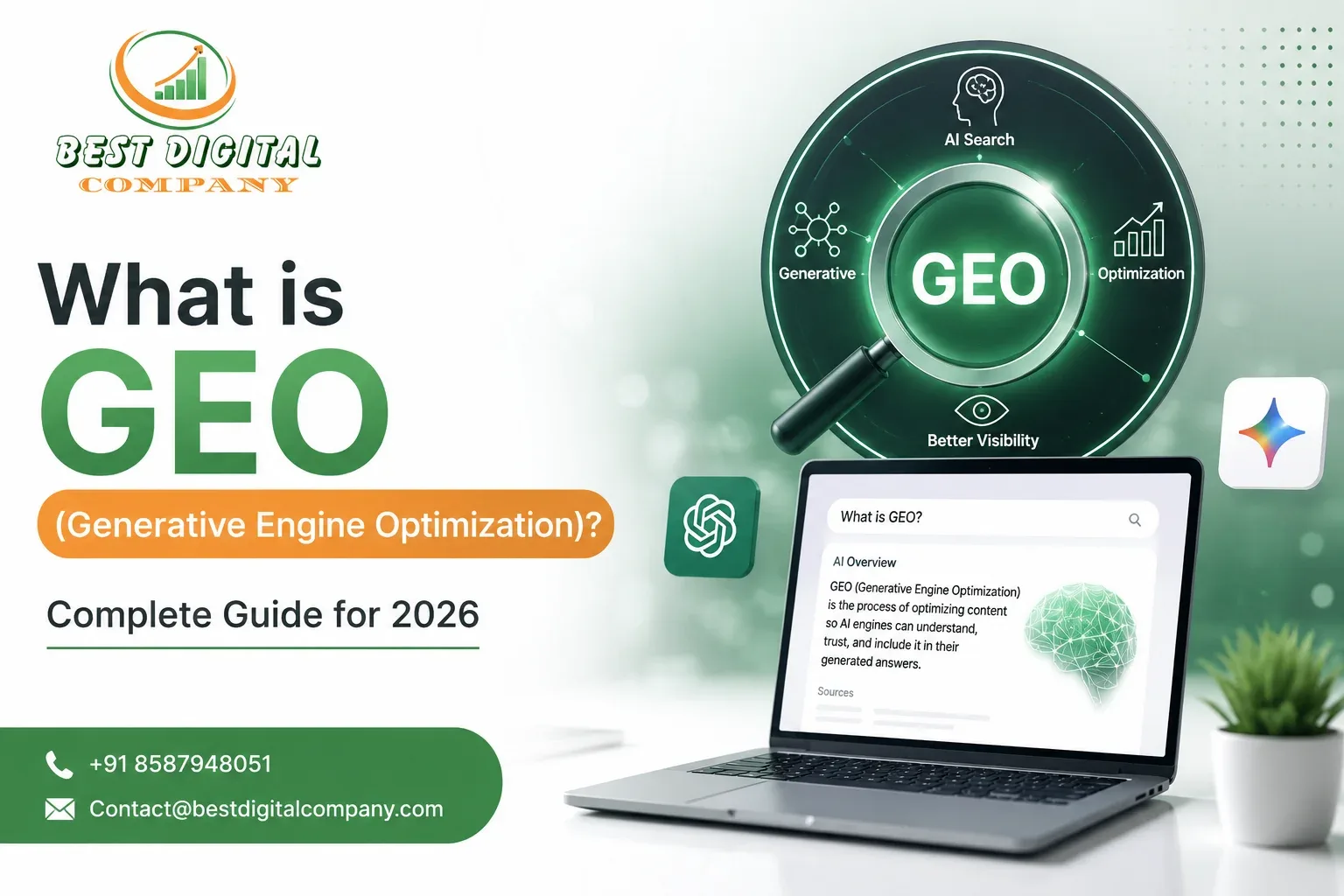
What is GEO? Generative Engine Optimization Guide 2026

What is GEO (Generative Engine Optimization)? Complete Guide for 2026

If you have noticed your website traffic behaving strangely this year, you are not imagining it. Fewer people are clicking through ten blue links anymore. Instead, they are typing a question into ChatGPT, Gemini, or Google’s AI Overviews and getting a complete answer without ever visiting a website. For business owners who have spent years building rankings the old-fashioned way, this shift feels unsettling. Where did the traffic go, and how do you get found in an answer that AI generates instead of a page it lists?

That is exactly what Generative Engine Optimization, or GEO, is built to solve.

In this guide, we will break down what GEO actually means, why it is different from the optimization work most agencies have done for the last decade, and how a business can realistically prepare for a search landscape where answers are generated, not just displayed. We will also look at how this connects to the fundamentals that already matter, like Search Engine Optimization, Website Development, and content structure, because GEO does not replace these disciplines. It builds on top of them.

What Exactly Is Generative Engine Optimization?

Generative Engine Optimization is the practice of structuring, writing, and promoting content so that AI-driven answer engines can understand it, trust it, and choose to cite or summarize it. Instead of optimizing purely to rank a page, GEO optimizes for a mention. It focuses on getting a brand’s information pulled into a generated response by tools like ChatGPT, Perplexity, Google’s AI Overviews, and Microsoft Copilot.

Think of it this way. Traditional search returns a list of links and lets the user decide which one to click. Generative search reads across many sources, synthesizes an answer, and often hands the user a finished response with a few citations attached. If your content is not one of those citations, you simply do not exist in that conversation, even if your website ranks well in traditional listings.

This does not mean classic optimization is dead. It means there is now a second, parallel goal sitting alongside it: making sure AI systems can find, parse, and trust your content well enough to quote it.

Why GEO Is Different from Traditional Search Engine Optimization

For years, ranking well meant chasing keywords, building backlinks, and optimizing page titles for click-through rate. Those levers still matter, but generative engines evaluate content differently in a few important ways.

They read for meaning, not just keywords. Large language models process entire passages and try to extract the most useful, accurate, and well-supported answer to a question. Keyword density has far less influence than clear, direct explanations.

They reward extractable structure. Content that answers a question in the first two or three sentences of a section, followed by supporting detail, gets pulled into summaries more easily than content that buries the answer under long introductions.

They weigh trust signals heavily. Author expertise, citations, consistency across the web, and real-world credibility carry more weight than they used to, because the AI is essentially vouching for your content when it repeats it to a user.

They pull from multiple sources at once. A generated answer might combine a sentence from your page, a statistic from a competitor, and a definition from a reference site. Being one of several sources is normal. The goal of GEO is to be a source the model trusts enough to include, not necessarily the only one.

This is why businesses that already invest in strong Search Engine Optimization tend to have a head start with GEO. Clean site structure, accurate information, and authoritative content are the foundation both systems are built on.

How AI Search Engines Actually Choose What to Cite

There is no single ranking formula the way there is with traditional search, but patterns have become clear over the last year as AI Overviews and chat-based assistants matured.

Generative engines tend to favor content that:

  • Directly answers a specific question within the first few lines
  • Comes from a source with demonstrated topical history, not a one-off post
  • Uses clear formatting like headers, short paragraphs, and lists that are easy to parse
  • Is corroborated by other credible sources saying something similar
  • Includes original data, case studies, or specifics rather than generic statements
  • Has been recently updated, since freshness signals still matter to AI crawlers

Notice that most of these overlap heavily with what makes content genuinely useful to a human reader. That overlap is intentional. AI models are trained to prefer content that resembles what a knowledgeable person would write, not content engineered purely to game a ranking system.

GEO vs SEO: Do You Need Both?

Yes, and treating them as competing strategies is one of the most common mistakes businesses make in 2026.

Search Engine Optimization still governs whether your website gets crawled, indexed, and ranked at all. Generative engines like Google’s AI Overviews are built on top of the same index that traditional search results come from. If your site has poor technical health, thin content, or weak authority, it is unlikely to be picked up by the generative layer either, because the underlying data was never surfaced to begin with.

GEO adds a second layer on top: making sure that once your content is discoverable, it is also usable and quotable by an AI system. A well-optimized page that ranks on page one can still be skipped over in a generated answer if it does not answer the question clearly enough. Conversely, a smaller site with tightly written, well-structured answers can sometimes get cited in an AI response even without ranking in the top three organic positions.

If your business is deciding where to start, our Search Engine Optimization services build the technical and content foundation first, since GEO cannot succeed on a site that search engines cannot properly read.

The Core Pillars of a Winning GEO Strategy

A practical GEO approach usually rests on four pillars.

1. Structural clarity. Content is broken into scannable sections with descriptive headings, so both readers and AI parsers can quickly locate the answer to a specific question.

2. Demonstrated expertise. The content reflects real experience, not a rewritten summary of what other pages already say. First-hand examples, data, and specific numbers signal that a human with actual knowledge produced the piece.

3. Consistent brand presence. AI models cross-reference information across multiple sources. A business that is mentioned consistently and accurately across its own website, directories, social profiles, and press coverage builds a stronger trust footprint than one that only exists in one place.

4. Technical accessibility. The website itself needs to be fast, mobile-friendly, and free of crawl barriers. This is where solid Website Development practices matter, because a slow or poorly coded site can quietly block both traditional and generative crawlers from reading your content properly.

Content Structure That AI Models Prefer

If you take away one practical habit from this guide, make it this: answer the question before you explain the context.

Most business blogs are still written the way articles were written a decade ago, starting with a broad introduction, some background, and only arriving at the actual answer three or four paragraphs in. Generative engines are far more likely to extract a clean, direct answer sitting near the top of a section.

A useful pattern looks like this:

  • State the direct answer in one or two sentences immediately under the heading
  • Follow with supporting explanation, data, or context
  • Use bullet points for lists of steps, features, or comparisons
  • Keep paragraphs short, ideally three to five sentences
  • Avoid repeating the same explanation in different words further down the page, since duplicated phrasing dilutes the clarity a model is trying to extract

This is also good practice for readers, not just algorithms. People skim. Giving them the answer immediately, then the depth afterward, respects their time whether they are human or an AI summarizing your page for someone else.

Why EEAT Matters More in the GEO Era

Google’s EEAT framework, which stands for Experience, Expertise, Authoritativeness, and Trustworthiness, has quietly become the backbone of generative citation decisions as well. This makes sense. If an AI system is going to repeat your claim to a user as if it were fact, it needs some basis for trusting that claim.

Experience shows up when content includes specifics that only someone who has actually done the work would know, like a particular tool setting, a real timeline, or a mistake learned from a live project.

Expertise is demonstrated through accurate, well-organized explanations that go beyond surface-level summaries.

Authoritativeness builds over time through consistent publishing on a topic, backlinks from credible sources, and recognition from other sites in the same industry.

Trustworthiness depends on transparency: clear authorship, accurate contact information, honest claims, and content that does not overpromise.

Businesses that have historically treated their blog as an afterthought are now finding that this is exactly the kind of content generative engines skip over. Thin, generic posts rarely get cited because they rarely say anything a model cannot already generate on its own. Original insight is what earns a citation.

Technical Foundations: Website Development and Site Health for GEO

None of the content strategy above matters if a website is technically difficult for a crawler to read. AI crawlers, much like traditional search bots, need clean HTML, reasonable load times, and a logical site structure to properly extract information.

Before investing heavily in GEO content, it’s worth auditing:

  • Page speed on both mobile and desktop
  • Whether content is rendered in a way crawlers can actually read, avoiding heavy reliance on JavaScript for core text
  • Clean heading hierarchy, using one H1 and logically nested H2s and H3s
  • Structured data markup, so machines can understand what type of content a page contains
  • Mobile responsiveness, since a large share of AI-assisted searches now happen on mobile devices

If your team went through a recent launch, revisiting our website launch checklist is a good way to confirm these basics are covered before layering GEO work on top. And if you are still comparing providers for this kind of technical work, our guide on choosing the best website development agency and SEO company walks through what actually separates a capable partner from an agency that just talks a good game.

The Role of Social Media Marketing in Generative Engine Optimization

Social platforms feed into the same trust ecosystem that generative engines draw from. When a brand is consistently discussed, tagged, and referenced across Instagram, LinkedIn, and other platforms, it builds a pattern of recognition that AI models can pick up on when assessing whether a source seems credible.

This does not mean social posts get cited directly very often. It means active, well-run Social Media Marketing contributes to the broader signal of a real, active, trusted business rather than a site that exists in isolation. Brands that show up consistently across channels tend to appear more frequently in generated answers about their industry, simply because there is more corroborating evidence tying their name to their expertise.

If your current social presence has looked quiet lately, it might be worth revisiting why. Our piece on SMO services and why brands are taking social seriously again covers exactly this shift, including why follower counts alone were never the real goal.

How Pay Per Click Fits Into a GEO-First Strategy

It is fair to ask whether paid advertising still matters when so much attention is going toward earning organic citations in AI answers. The honest answer is yes, though its role has shifted slightly.

Pay Per Click campaigns remain one of the fastest ways to generate visibility, leads, and data while GEO and organic strategies mature over months, not days. PPC also gives businesses immediate, measurable insight into which questions and phrases their actual customers are searching for, insight that can directly inform which topics deserve deeper, citation-worthy content.

In practice, a strong Pay Per Click campaign and a strong GEO content strategy support each other. Paid data tells you what people are asking. GEO content answers that question so clearly that AI systems want to repeat it. For businesses weighing where to allocate budget, our breakdown on choosing a PPC agency that actually grows your business is a useful starting point.

Internal Linking, Topical Authority, and GEO

One detail that often gets overlooked in GEO discussions is internal linking. When pages on a website reference and link to each other in a logical way, it signals topical depth. A single article about a topic looks like a guess. Ten interconnected articles covering the same subject from different angles look like genuine expertise, and that pattern of depth is something both traditional crawlers and generative models can detect.

A well-planned internal linking structure also helps distribute authority to the pages that matter most, rather than letting it dilute across dozens of disconnected posts. We covered this in detail in our guide on internal linking strategy for 2026, which explains how to stop link equity from quietly leaking away from your most important pages.

Step-by-Step GEO Checklist for 2026

If you are starting from scratch, here is a practical sequence to follow.

  1. Audit your existing content for pages that already rank reasonably well but read like generic summaries rather than original insight.
  2. Rewrite key pages so the direct answer appears within the first few sentences of each major section.
  3. Add real specifics, including data points, examples, and named experience, wherever a claim is made.
  4. Fix technical barriers on your site that might prevent crawlers from reading your content properly.
  5. Strengthen your author and brand presence with consistent information across your website, social profiles, and any directories your business is listed in.
  6. Build internal links between related articles so topical depth is obvious to anyone, human or machine, exploring your site.
  7. Monitor how your brand appears in AI-generated answers for your core topics, and adjust content where you notice gaps.
  8. Keep publishing consistently, since a single well-optimized page rarely outperforms a body of consistently strong content over time.

Common GEO Mistakes Businesses Make

A few patterns show up again and again with businesses that struggle to gain any traction in generated answers.

Writing for the algorithm instead of the reader. Content stuffed with keywords but light on real answers tends to get ignored by both traditional rankings and AI summaries.

Ignoring page speed and technical health. No amount of well-written content helps if a crawler cannot properly access it in the first place.

Publishing once and forgetting the page. Generative engines favor content that stays current. A three-year-old article with outdated statistics is less likely to be trusted than a recently reviewed one.

Treating GEO as separate from SEO. As covered earlier, these two disciplines share the same foundation. Neglecting one weakens the other.

Overlooking internal linking and site structure. A collection of disconnected blog posts signals less authority than a clearly organized content hub covering a topic from multiple angles.

How to Measure GEO Success

Measuring GEO is still evolving, since there is no universal dashboard equivalent to traditional ranking trackers yet. That said, a few practical indicators are worth tracking.

  • Manually searching your core topics in AI tools like ChatGPT, Gemini, and Copilot to see whether your brand or content is mentioned
  • Watching referral traffic from AI platforms in your analytics, which many tools now track separately
  • Tracking branded search volume, since being mentioned in an AI answer often drives people to search your business name directly afterward
  • Reviewing which pages earn backlinks and citations from other credible sites, since this remains a strong trust signal for both traditional and generative systems

Consistent tracking over several months gives a far clearer picture than a single snapshot, since AI answer patterns shift as models get updated.

Final Thoughts

Generative Engine Optimization is not a replacement for the fundamentals that have always mattered in digital marketing. It is an extension of them, shaped by the fact that a growing share of searches now end in a generated answer rather than a list of links. Businesses that already invest in clear writing, honest expertise, solid technical foundations, and a consistent brand presence across the web are naturally better positioned for this shift than those chasing shortcuts.

The businesses that will struggle most in the next few years are the ones treating their website and content as a box to check rather than a genuine resource. The ones that will do well are the ones willing to write like they actually know what they are talking about, because that is precisely the kind of content generative engines are built to recognize and repeat.

If you are unsure where your website currently stands with either traditional rankings or AI visibility, an audit is usually the fastest way to find out what is working and what needs attention first.


Frequently Asked Questions

What does GEO stand for in digital marketing?

GEO stands for Generative Engine Optimization. It refers to optimizing content so that AI-driven platforms like ChatGPT, Gemini, and Google’s AI Overviews can understand, trust, and cite it when generating answers for users.

Is GEO replacing traditional Search Engine Optimization?

No. GEO builds on top of solid Search Engine Optimization rather than replacing it. A technically sound, well-indexed website is still the foundation both traditional rankings and AI-generated answers rely on.

How is GEO different from regular content writing?

GEO content is structured so the direct answer to a question appears early, uses clear formatting, and includes real, specific detail rather than generic explanations. This makes it easier for AI systems to extract and quote accurately.

Does social media affect GEO?

Indirectly, yes. Consistent, active Social Media Marketing helps build a recognizable, trustworthy brand presence across the web, which contributes to the overall trust signals AI systems consider when choosing what to cite.

Should small businesses worry about GEO yet?

Yes, since AI-generated answers are already influencing a meaningful share of searches. Businesses that wait until this becomes mainstream will be starting from further behind than those who begin adjusting their content and site structure now.

Can Pay Per Click help while I build a GEO strategy?

Yes. Pay Per Click campaigns provide immediate visibility and useful data on what your audience is actually searching for, which can guide the topics your GEO content should prioritize.

How long does it take to see results from GEO efforts?

Similar to traditional optimization, GEO results build gradually over months rather than days, since AI systems rely on accumulated trust signals, consistent publishing, and technical health rather than one-time changes.

Do I need a developer to prepare my website for GEO?

In most cases, yes, at least for the technical audit. Clean Website Development practices, including fast load times and crawlable content, are necessary before content-level GEO work can have its full impact.