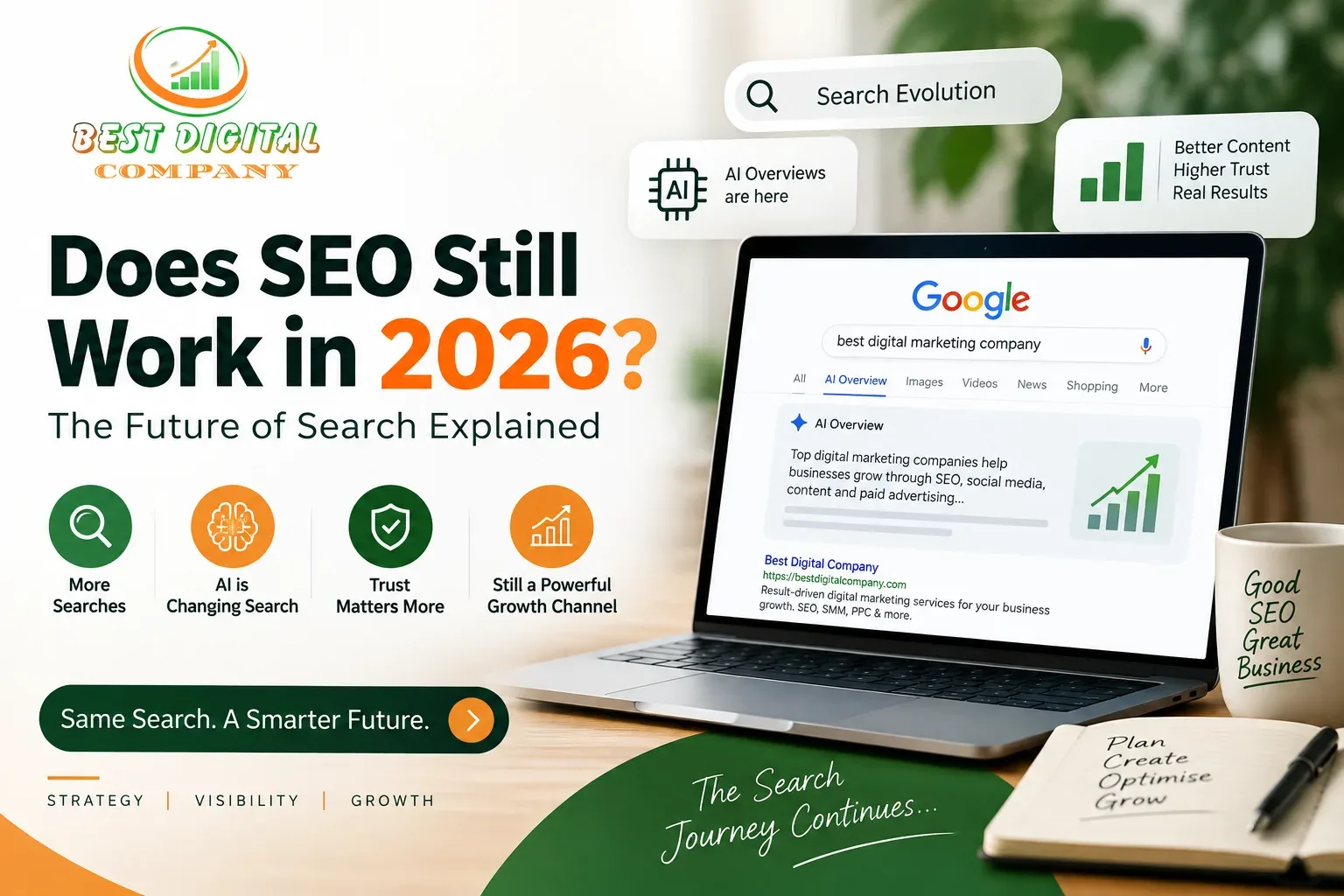
Every few years, someone declares SEO dead. It happened when social media exploded, again when voice assistants arrived, and now it’s happening because of AI chatbots and AI-generated answers sitting right at the top of the search results page. So it’s a fair question to ask in the middle of 2026: does SEO still work, or has the game actually moved on without it?
The short answer is that SEO in 2026 is not dead, but it has changed shape. Search behaviour has shifted, Google’s algorithms have gotten far better at understanding intent, and the businesses winning visibility today aren’t the ones stuffing keywords into blog posts. They’re the ones building genuinely useful, well-structured, trustworthy websites. If you run a business and you’re wondering whether it’s still worth investing in search visibility, this guide walks through exactly what has changed, what still matters, and how to build an approach to SEO in 2026 that actually holds up.
Why People Keep Asking If SEO Is Dead
The doubt isn’t coming from nowhere. Over the last two years, Google has rolled out AI-powered summaries that answer many queries directly on the results page, reducing the number of clicks that go to individual websites. Chatbots like ChatGPT and Gemini have become a starting point for research that used to begin with a Google search. Naturally, business owners started asking whether ranking on page one even matters anymore.
Here’s the part that gets missed in that panic: people are still typing (and speaking) billions of queries into Google every single day, and most commercial searches — the ones where someone wants to buy something, book a service, or find a local business — still lead to a list of websites, maps results, and organic listings. AI overviews have changed how informational queries get answered, but they haven’t replaced the need for a business to be found, evaluated, and chosen online. If anything, the businesses with strong SEO foundations are the ones AI tools pull their answers from in the first place.
Is SEO in 2026 Still Worth the Investment?
This is really the question underneath everything else, so let’s answer it directly: yes, SEO in 2026 is still one of the highest-return, most durable marketing channels available to a business — but only when it’s done the way search engines now expect.
The old playbook of publishing thin, keyword-stuffed pages and building a pile of low-quality backlinks stopped working years ago, and it’s even less effective now. What still works is a website that clearly demonstrates expertise, gets structured correctly for both traditional search and AI-driven answers, earns links because people genuinely want to reference it, and keeps loading fast and working properly on mobile. That’s a longer list of requirements than it used to be, which is exactly why SEO in 2026 rewards businesses that treat it as an ongoing discipline rather than a one-time project.
We’ve seen this play out first-hand while managing campaigns for clients across different cities — our recent work on digital marketing strategy for businesses in Delhi NCR is a good example of how SEO, social, and paid channels now have to work together rather than sit in separate silos.
How Google’s AI Overviews Changed the Search Results Page
The single biggest shift affecting SEO in 2026 is the way Google now answers questions directly within the search results page, using AI-generated summaries pulled from multiple sources. For simple, factual queries — “what time zone is Tokyo in,” “how many ounces in a cup” — this means fewer people click through to a website at all.
But there’s a nuance that gets lost in most of the doom-and-gloom takes: these AI summaries are built by pulling information from pages that already rank well and are structured clearly. A business with no organic visibility doesn’t suddenly get pulled into an AI summary — it has to already be recognised as a credible, relevant source. In practice, this means the fundamentals of SEO (clear content, proper headings, fast pages, credible signals) matter just as much as before. What’s changed is that ranking on page one is now a prerequisite for being cited by AI tools, not a separate goal.
For queries with commercial intent — anything close to “near me,” a service name, or a product comparison — actual website listings, reviews, and map results still dominate the page, which is exactly the kind of search where local and service-based businesses need to show up.
E-E-A-T: Why Trust Matters More Than Experience Ever Did
Google’s quality guidelines revolve around a framework it calls E-E-A-T: Experience, Expertise, Authoritativeness, and Trustworthiness. It’s not a ranking factor you can tick off with a plugin — it’s a lens Google’s systems and human quality raters use to judge whether content deserves to be shown to real people.
In 2026, this framework has become more important, not less, precisely because AI-generated content has made it easier than ever to produce large volumes of generic, low-effort articles. Google’s systems have gotten noticeably better at spotting content that reads like it was written to target a keyword rather than to genuinely help someone. The sites that keep ranking are the ones that show real experience — actual case studies, specific numbers, named authors, and details that couldn’t have been written by someone who’s never worked in the field.
Practically, this means:
- Experience: Writing from direct, hands-on knowledge rather than summarising what other articles already say.
- Expertise: Demonstrating a genuine understanding of the subject, not just surface-level familiarity.
- Authoritativeness: Being recognised by other credible sites and sources as a go-to reference in your field.
- Trustworthiness: Accurate information, transparent business details, secure browsing, and honest claims.
For a local business, this is where working with an established SEO service in Delhi or a similar specialist actually pays off — it’s far easier to build authority and trust signals with someone who understands how Google evaluates a business website than to guess at it alone.
Human-Written Content Is Winning Back the Search Results Page
There’s a reason Google keeps pushing content quality updates: the internet got flooded with AI-generated filler content almost overnight, and a lot of it was designed purely to rank rather than to inform anyone. Google’s response has been to reward content that reads like it was written by a person who actually knows the topic — content with opinions, specific examples, a clear point of view, and information that isn’t just a rehash of the ten articles already ranking above it.
This doesn’t mean AI tools have no place in content creation. Plenty of good writers use them for research or first drafts. What it means is that publishing content without a human editing, fact-checking, and adding real insight to it is a losing strategy for SEO in 2026. Search engines are specifically trying to identify and de-rank content that adds nothing new, repeats the same points in different words, or answers a question without actually answering it.
If you’re building out a content plan, the goal should be to answer the question a real person is asking, in a way only your business (with your specific experience) could write it — not to hit a word count or a keyword density target.
Local and Voice Search Are Reshaping SEO in 2026
Two search behaviours have grown fast enough to change how local businesses need to think about visibility this year: local search and voice/conversational search.
Local search — someone typing “digital marketing agency near me” or asking their phone the same thing out loud — depends heavily on a well-optimised Google Business Profile, consistent business information across the web, and genuine customer reviews. This is a different discipline from traditional SEO, and it’s why we treat it as its own workstream in our local SEO services in Delhi, separate from broader national campaigns.
Voice and conversational search — driven by smart speakers and AI assistants — tends to favour content written in a natural, question-and-answer style, because that’s closer to how people actually speak their queries. This is part of why FAQ sections, clear headings phrased as questions, and conversational writing have become genuinely useful SEO tactics rather than just a nice-to-have.
We’ve seen these patterns play out consistently across markets — the strategies we outlined for SEO services in Gurugram and for businesses comparing an SEO company in Gurugram versus an SEO agency in Gurgaon both come back to the same fundamentals: accurate local listings, review generation, and content that matches how people actually search in that city.
Technical SEO and Website Experience Still Decide Who Ranks
No amount of good content saves a website that loads slowly, breaks on mobile, or confuses search engines with a messy structure. Technical SEO has actually grown in importance in 2026, because Google now evaluates page experience — loading speed, visual stability, mobile usability, and secure connections — as a direct part of how it ranks pages.
This is also where structured data (schema markup) has become far more valuable than it used to be. Marking up your content correctly helps search engines and AI systems understand exactly what a page is about, who wrote it, what a product costs, or what a service includes — which increases the odds of being pulled into rich results or AI-generated answers.
A slow, outdated, or poorly structured website undermines every other SEO effort you make, which is why we always pair search strategy with proper website development and design rather than treating the two as separate projects. You can publish the best content in your industry, but if the site takes six seconds to load on a phone, most of that work goes to waste.
SEO in 2026 Doesn’t Work Alone Anymore
One thing that genuinely has changed is how isolated SEO can afford to be. A few years ago, a business could run SEO as a standalone channel and see steady results. In 2026, the businesses getting the best outcomes are combining organic search with paid advertising and social visibility, because each channel now reinforces the others.
Paid search fills the gap while organic rankings are still building, and it gives you fast data on which keywords actually convert. Our breakdown of how PPC and Google Ads can generate faster leads covers this in more detail — the short version is that PPC services and SEO complement each other rather than compete for budget.
Social signals also feed into how discoverable and trustworthy a brand appears, both to users and, indirectly, to search engines evaluating a brand’s overall footprint. We’ve written about this in our guide to how SMO supports business growth, and it’s a big part of why social media marketing now sits inside most integrated SEO strategies rather than off to the side.
Building a Future-Proof SEO Strategy in 2026
If you’re planning search visibility for the year ahead, here’s what an approach built for SEO in 2026 actually looks like in practice:
1. Start with real search intent, not just keywords. Before writing anything, understand what the person searching actually wants — information, a comparison, or a business to hire. Content that matches intent gets rewarded; content that just repeats a keyword phrase doesn’t.
2. Invest in original, experience-backed content. Case studies, original data, and specific examples from your own work carry far more weight than generic advice that could apply to any business anywhere.
3. Fix the technical foundation first. Page speed, mobile usability, and clean site structure aren’t optional extras — they’re the baseline Google expects before it even evaluates your content quality.
4. Build genuine authority signals. Earn links and mentions from credible sources in your industry rather than chasing volume through low-quality directories.
5. Treat local presence as its own project. If you serve a specific city or region, your Google Business Profile, reviews, and local content need dedicated attention — this is exactly the kind of work covered instructured SEO packages built around measurable local outcomes.
6. Track what actually moves the needle. Rankings alone don’t pay the bills — traffic, leads, and conversions do. A strategy built for 2026 needs to track the full path from a search to an actual customer.
Common Mistakes Businesses Still Make With SEO in 2026
Even with all this shift toward quality and trust, a lot of businesses keep repeating the same mistakes:
- Treating SEO as a one-time task. A website optimised once and left untouched for a year will lose ground to competitors who keep publishing and refining.
- Publishing content no one asked for. Articles written to hit a keyword rather than answer a real question tend to underperform, no matter how well they’re optimised technically.
- Ignoring page experience. A beautifully written page on a slow, cluttered website still struggles to rank or convert.
- Skipping local optimisation. Businesses that serve a specific city but never invest in local search lose a huge share of nearby, ready-to-buy customers to competitors who do.
- Expecting overnight results. SEO in 2026 still takes months to show its full impact — it rewards patience and consistency over quick fixes.
We’ve walked through a lot of these patterns while comparing options for business owners, including in our look at choosing between an SEO expert and a freelancer in Bangalore and our guide on what to ask before hiring an SEO agency in Lucknow the mistakes are strikingly consistent across cities and industries.
So, Does SEO Still Work in 2026?
Yes — but it works differently than it did even three years ago. Search engines have gotten better at rewarding genuine expertise and penalising shortcuts, AI-generated answers have raised the bar for what “ranking” actually means, and local, technical, and content strategies now have to work together instead of separately. Businesses that adapt to these shifts, rather than trying to relive 2019-era SEO tactics, are still seeing strong, sustainable growth from organic search.
The businesses struggling with SEO in 2026 usually aren’t struggling because the channel stopped working — they’re struggling because they haven’t adjusted their approach to match how search actually functions today. Whether you’re just getting started or trying to recover lost visibility, teams that understand search engine optimisation at this level of detail can usually get things back on track faster than trying to guess at it in-house.
Frequently Asked Questions About SEO in 2026
Is SEO still relevant in 2026, or has AI search replaced it?
SEO is still very relevant in 2026. AI-generated answers on the search results page have changed how some queries get answered, but they pull their information from well-ranked, trustworthy websites — so strong SEO is now a requirement for being included in AI answers, not a separate, outdated channel.
How long does it take to see results from SEO in 2026?
Most businesses start seeing meaningful movement in three to six months, with stronger, compounding results after nine to twelve months of consistent work. Highly competitive industries or cities can take longer, which is one reason pairing SEO with paid search often makes sense in the early stages.
What matters most for SEO in 2026: content, backlinks, or technical setup?
All three matter, but they’re no longer separate checkboxes. Content needs to demonstrate real experience and answer intent clearly, backlinks need to come from genuinely credible sources, and the technical foundation (speed, mobile experience, structured data) has to be solid enough for search engines to trust and understand the site in the first place.
Does AI-generated content hurt SEO rankings?
Content that is purely AI-generated, unedited, and adds nothing new tends to underperform, because search engines are specifically trying to identify and reduce visibility for generic, low-effort content. AI tools used for research or drafting are fine, but the published result needs human review, fact-checking, and genuine expertise added on top.
Is local SEO different from regular SEO in 2026?
Yes. Local SEO focuses on your Google Business Profile, reviews, local citations, and location-specific content, while broader SEO focuses on the wider website. Businesses that serve a specific city or region typically need both working together for full visibility.
Should a small business still invest in SEO in 2026, or focus on paid ads instead?
Both channels serve different purposes, and most businesses benefit from combining them. Paid ads deliver faster, immediate visibility, while SEO builds a lasting asset that keeps generating traffic without an ongoing cost per click. A small business with a limited budget often gets the best return by using paid search to generate quick leads while SEO builds up in the background.