
A few months ago, a clinic owner from East Delhi called us with a complaint that sounded strange at first. His Google Business Profile had more than 200 reviews and sat comfortably in the map results for his area. His website, built by a cousin years ago, had four pages and a contact form that no longer sent emails. “Phone calls are fine,” he said, “but nobody books online. Which one is actually broken?”
Neither was broken, exactly. They were doing different jobs, and only one of them was being looked after.
That is the real question behind Google Business Profile vs website. Business owners usually frame it as a contest, as if you must pick a winner and abandon the other. This guide explains what each one does, how Google treats them, which deserves your time first, and how to run both without doubling your workload.
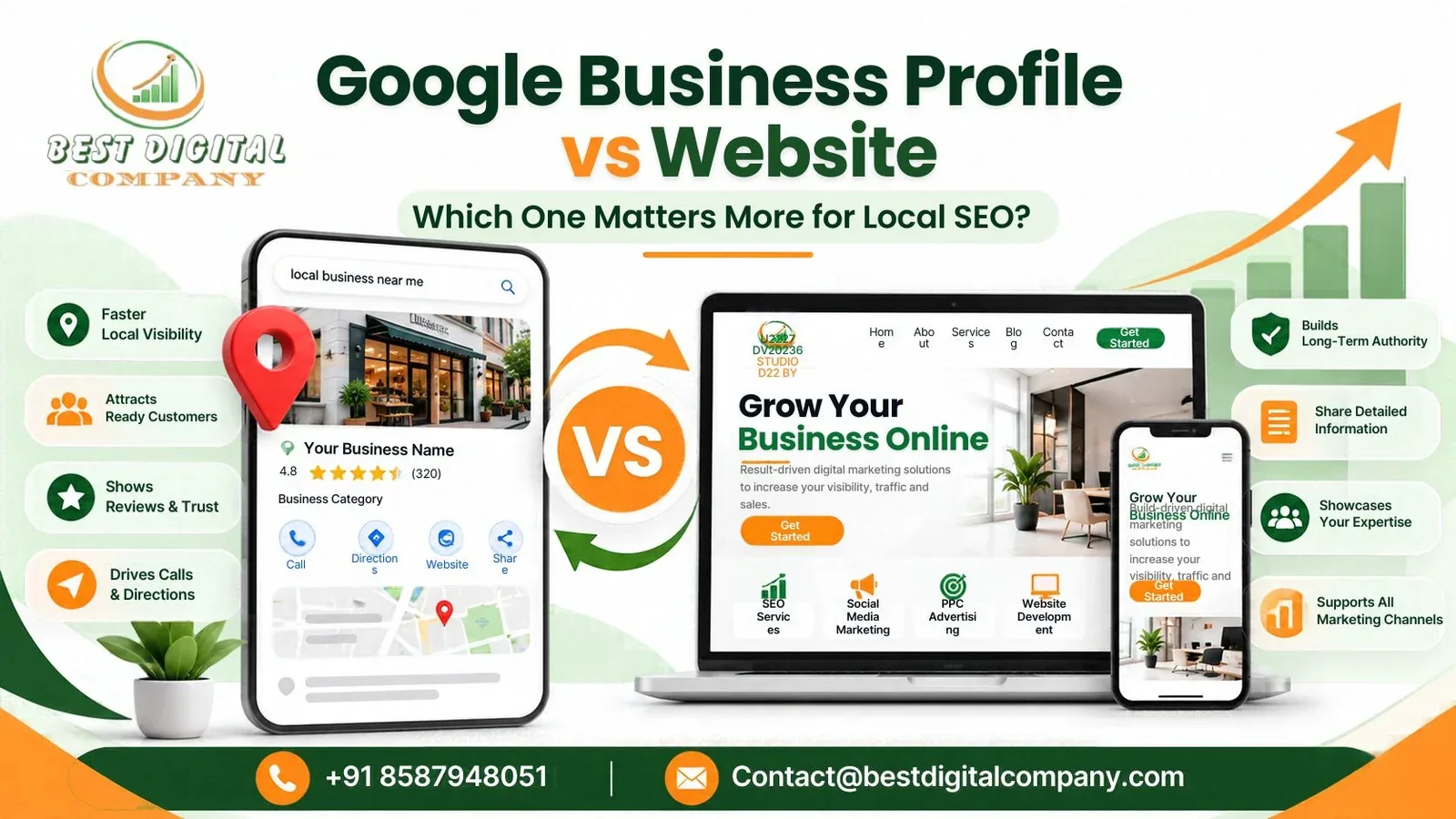
Google Business Profile vs Website: The Short Answer
For businesses that serve customers in a specific area, a Google Business Profile usually brings faster local visibility, while a website builds long-term authority and gives you full control. Neither replaces the other.
If you are starting from zero and need calls within weeks, set up and complete your profile first. If you already have a profile and your growth has stalled, the website is almost always the missing piece.
Think of it this way. Your profile is your shopfront window on a busy street. Your website is the shop itself, where people decide whether to trust you and buy. A great window with an empty shop loses customers at the door. A great shop on a hidden lane never gets found.
What a Google Business Profile Actually Does for Local SEO
Your profile is the free listing that appears when someone searches for a service near them or looks up your business by name. It feeds the map results, the local panel on the right side of the page, and a good share of “near me” searches.
Google has said for years that local ranking rests on three ideas: relevance, distance, and prominence. Your profile influences all three.
- Relevance comes from your primary category, secondary categories, services list, and business description. Choosing “Dentist” when you are really an orthodontist quietly costs you visibility.
- Distance is mostly out of your hands. It reflects how far the searcher is from your address, which is why a precise, verified location matters.
- Prominence reflects how well known you appear. Reviews, review replies, photos, and mentions around the web all feed into it.
What a profile does best is capture people who are ready to act. Someone searching for a chemist, a car repair shop, or a coaching centre at 9 p.m. wants an address, opening hours, a phone number, and a quick sense of whether others were happy. The profile delivers all four in a single glance.
Where it falls short is depth. You cannot explain your process on a profile, publish a detailed comparison, show a full price range, or build an argument for why you are the right choice. You also do not own it. Google can suspend a profile, merge it with a duplicate, or change how listings look, and you get limited say in any of it.
What Your Website Does That a Profile Cannot
A website is the only online property you fully control. That sounds like a slogan, but it has practical consequences.
First, it answers the questions that decide a purchase. How much does a root canal cost? How long does a kitchen renovation take? Do you serve Ghaziabad as well as Delhi? A profile gives you a few lines; a website gives you room to explain properly.
Second, it ranks for searches a profile cannot touch. A person typing “how to choose a physiotherapist after knee surgery” is not looking at a map. They are reading. Your site can answer that, earn their trust, and be remembered when they are ready to book.
Third, it is where proof lives. Case studies, certifications, doctor or founder bios, detailed testimonials, before-and-after work, and press mentions all belong on a site. This is also where Google looks for signals of experience, expertise, authoritativeness, and trustworthiness. A profile with 200 reviews is helpful. A site that shows who you are, what you have done, and how to verify it is stronger.
Finally, the website is the destination for nearly everything else you do. Ads, social posts, directory listings, and email all point to it. If it is slow, confusing, or outdated, every other channel leaks.
How Google Uses Both to Rank Local Businesses
Google does not treat these as separate worlds. It cross-checks them.
The website link on your profile tells Google which page represents your business. Google reads that page to confirm your services, your location, and your name match what the profile claims. When the two agree, confidence rises. When your profile says you offer “bridal makeup” and your site never mentions it, the mismatch weakens both.
The reverse also holds. Strong organic rankings for your website can support your local prominence, because Google treats a business that appears across many searches as better known. And a well-optimised profile sends real visitors, calls, and direction requests, which are the kind of everyday engagement that points to a genuine, active business.
This is why we tell clients to stop asking which one “ranks higher” and start asking whether the two tell the same story.
Local SEO in Delhi: Where the Two Work Together
Delhi is a good place to see this play out, because the competition is dense. In areas like Laxmi Nagar, Lajpat Nagar, or Karol Bagh, dozens of businesses sell almost identical services within a few hundred metres of each other. Distance alone cannot separate them.
In our experience with local businesses across the city, the ones who pull ahead tend to do a handful of unglamorous things consistently:
- They keep their name, address, and phone number identical everywhere, down to the way “Gali No. 15” or “Block C” is written.
- They create a separate page on their website for each main service and each area they actually serve, rather than one vague “Services” page.
- They ask for reviews after every job and reply to each one, including the unhappy ones.
- They add real photos of their premises and team, not stock images.
If you want a closer look at how this works for businesses in the capital, our page on local SEO in Delhi explains how we handle both the profile side and the on-site side together. And if you operate across the wider region, our breakdown of the digital marketing agency in Delhi NCR approach shows how SEO, social, and ads can share one plan instead of three.
Which One Matters More at Different Stages of a Business
The honest answer depends on where you are right now.
You are brand new or have no online presence. Start with the profile. Verification, correct categories, hours, services, and a handful of genuine reviews can make you findable within weeks. Put up a simple but accurate website at the same time, even five pages, so the profile has somewhere credible to send people.
You are established but flat. Your profile probably looks fine and your site is the bottleneck. Thin service pages, no location content, slow loading, and no proof of expertise are common culprits. This is where most of the long-term gain sits.
You serve customers beyond one neighbourhood. A profile is tied to a physical location or a defined service area, so it only goes so far. Your website is what lets you compete for searches in other localities, other cities, or across a whole region.
You are a purely online or appointment-based business. If customers never visit you, a website carries most of the weight. A profile may still help for brand searches, but it will not drive discovery the way it does for a shop.
You are in a high-trust field such as healthcare, legal, finance, or education. Here the website matters more than usual. Google holds this kind of content to a higher standard, and visitors want to see credentials, named professionals, and clear, accurate information before they act.
SEO Services in Delhi: Why the Website Side Needs Real Work
Optimising a profile is something an owner can largely do alone in an afternoon. Optimising a website takes longer, and that is where professional SEO services in Delhi tend to earn their keep.
The work typically covers a few areas:
- Page-level relevance. Each service gets its own page with a clear purpose, written for a specific search intent, not a keyword-stuffed paragraph on the home page.
- Technical health. Mobile speed, clean structure, working links, and pages that Google can crawl and understand without fuss.
- Local signals on the site. Embedded map, consistent contact details, location pages, and structured data that spells out your business details in a form search engines read easily.
- Authority. Mentions and links from relevant local sources, industry directories, and associations.
- Content that shows real experience. Answers written by someone who has done the work, not recycled summaries.
If you are comparing providers, our SEO packages lay out what is included at each level, so you can match the scope to your stage. For a broader view of how we approach organic growth, see our search engine optimization page.
Website Development: Fixing the Pages Your Profile Sends People To
Here is something we see often. A business invests in a polished profile, gets a steady stream of clicks to its site, and then loses most of those visitors in the first five seconds.
The cause is rarely dramatic. It is usually a slow page, a phone number that cannot be tapped, a layout that breaks on smaller screens, or a form buried three scrolls down. Since most local searches happen on phones, those small frictions decide whether the call happens.
Good website development for a local business does not have to be elaborate. It needs:
- A home page that states what you do and where within a few seconds
- Individual service pages with prices or ranges where possible
- A contact page with a tap-to-call number, address, hours, and a map
- Genuine photos, team details, and proof of your work
- Fast loading on average mobile connections
If your current site falls short, our web development packages are a straightforward starting point. And if you are in the Delhi NCR region and weighing local agencies, our guide to a digital marketing company in Noida shows what to look for when comparing providers.
Pay Per Click and Social Media Marketing: Where They Fit In
Organic and map visibility build slowly. If you need enquiries this month, paid search can fill the gap while the longer-term work catches up.
Here the profile and the website play different roles again. Google Ads can pull in details from your profile, such as your address and phone number, which makes your ads more useful for nearby searchers. The landing page, though, is part of your website, and a weak one wastes the click you paid for. That is why we see pay per click and site quality as linked problems, not separate ones. Our piece on PPC services in Delhi walks through how local campaigns are usually structured and where budgets leak.
Social platforms behave differently. People rarely find a plumber through Instagram, but they often check a business’s social pages before trusting it. Active, honest social media marketing reinforces your reputation and gives your profile and website fresh material to share. For Delhi-specific tactics, our article on SMO services in Delhi covers how local businesses use social channels to support enquiries.
AI Overviews, GEO and AEO: Why the Profile vs Website Debate Is Changing
Search looks different from how it did even two years ago. Many people now read an AI-generated summary at the top of the page, or ask a chatbot for a recommendation, before they ever see a list of links.
This changes the profile-versus-website question in a useful way. AI systems draw on many sources to decide which businesses to mention. Your profile data, your reviews, your website content, and mentions elsewhere on the web all feed that picture. A business with a complete profile but a thin website gives these systems very little to work with. A business with strong, specific, well-organised website content gives them plenty.
If this is new territory, three of our earlier articles go deeper. Start with how to improve your visibility in AI Overviews, then read our explanation of what AEO is and how it works. If you are wondering whether this replaces traditional optimisation, our comparison of GEO vs SEO answers that directly. For the practical side, here is how to optimise your website for ChatGPT and Gemini.
The takeaway is simple. Whatever the format of search becomes, clear, accurate, consistent information across your profile and your website remains the foundation.
A Practical 30-Day Plan to Strengthen Both
You do not need a large budget to make real progress. Here is a realistic month.
Week 1: Audit and fix the basics. Claim and verify your profile if you have not. Check your primary category, hours, phone number, and service list. Make sure the name, address, and number match your website exactly.
Week 2: Build out the profile. Add real photos of your premises, team, and work. Write a clear business description in plain language. List each service you offer. Start a simple routine for asking happy customers for reviews.
Week 3: Improve the website pages that matter. Pick your top three services and give each a proper page: what it is, who it is for, how it works, rough pricing, and a clear next step. Add a contact section with a map and tap-to-call number.
Week 4: Connect and measure. Link your profile to the most relevant page, not always the home page. Add tracking so you can see calls, direction requests, and website visits separately. Review what happened and decide where to focus next month.
Then repeat. Local visibility tends to reward steady effort more than one-time pushes.
Common Mistakes That Hold Local Businesses Back
A few patterns come up again and again when we review businesses.
- Treating the profile as “set and forget.” Outdated hours, closed-down services, and unanswered reviews quietly erode trust.
- Using a keyword-stuffed business name. Adding “Best Cheap AC Repair Delhi” to your name violates Google’s guidelines and can lead to suspension.
- Pointing the profile to a weak home page. If your most relevant page for a service is deeper in the site, link there.
- Buying reviews or asking friends to leave glowing ones. Google detects patterns, and customers can tell. Real, imperfect reviews carry more weight.
- Ignoring the website because “calls are fine.” Calls today do not protect you from a competitor who invests in a stronger site next year.
- Using different contact details in different places. Inconsistent information confuses both Google and customers.
Frequently Asked Questions
Is Google Business Profile or a website more important for local SEO?
For quick local visibility, the profile usually has more immediate impact because it feeds map results directly. For long-term growth, authority, and control, the website matters more. Most businesses need both, and the stronger one depends on your stage.
Can I rank on Google without a website if I have a Google Business Profile?
Yes, you can appear in local map results with only a profile, and many small businesses do. However, you will be limited to a narrow set of searches, and you will depend entirely on a listing you do not own. A website widens your reach and gives you stability.
Does my website affect my Google Business Profile ranking?
Indirectly, yes. Google compares the details on your site with your profile and uses your website’s content and reputation to understand your business better. A website that clearly supports your profile’s categories and services helps.
Should my profile link to my home page or a service page?
It depends. If you offer one main service, the home page works. If you offer several, link to the page that best represents your core offering, and make sure it loads quickly and includes your contact details.
How often should I update my Google Business Profile?
Check it at least once a month. Update holiday hours promptly, add new photos regularly, respond to reviews as they come in, and revise your services whenever they change.
Do reviews matter more than website content?
They do different jobs. Reviews strongly influence local prominence and customer confidence. Website content helps Google understand what you do and lets you rank for informational searches. Neither makes up for the absence of the other.
How long does it take to see results from local SEO?
Profile improvements can show changes within a few weeks. Website-based gains typically take several months, depending on competition, your starting point, and how consistently you publish and improve content. Anyone promising overnight results should be treated with caution.
Is it worth hiring an agency, or can I manage this myself?
Plenty of owners manage their profile well on their own. The website side, including technical fixes, content planning, and link building, is where outside expertise tends to save time and avoid costly mistakes. The right choice depends on your time, budget, and comfort with the work.
Will AI search tools make Google Business Profile or websites irrelevant?
Unlikely. AI-driven results still rely on trusted, structured information from profiles, websites, and reviews. Keeping both accurate and complete improves your chances of being mentioned.
Final Thoughts: Treat Them as One System
Google Business Profile vs website is a useful question only until you hear the answer. They are two halves of the same job. The profile gets you noticed at the moment of need; the website earns the trust that turns attention into customers.
If you had to pick one place to spend your next hour, look at which half is weaker today and fix that first. For most established businesses, that turns out to be the website. For brand-new ones, it is the profile.
If you would like a second pair of eyes on yours, the Best Digital Company team can review your profile and site together and tell you plainly where the gaps are. You can reach us through our contact page or call +91 8587948051.

Add a Comment