

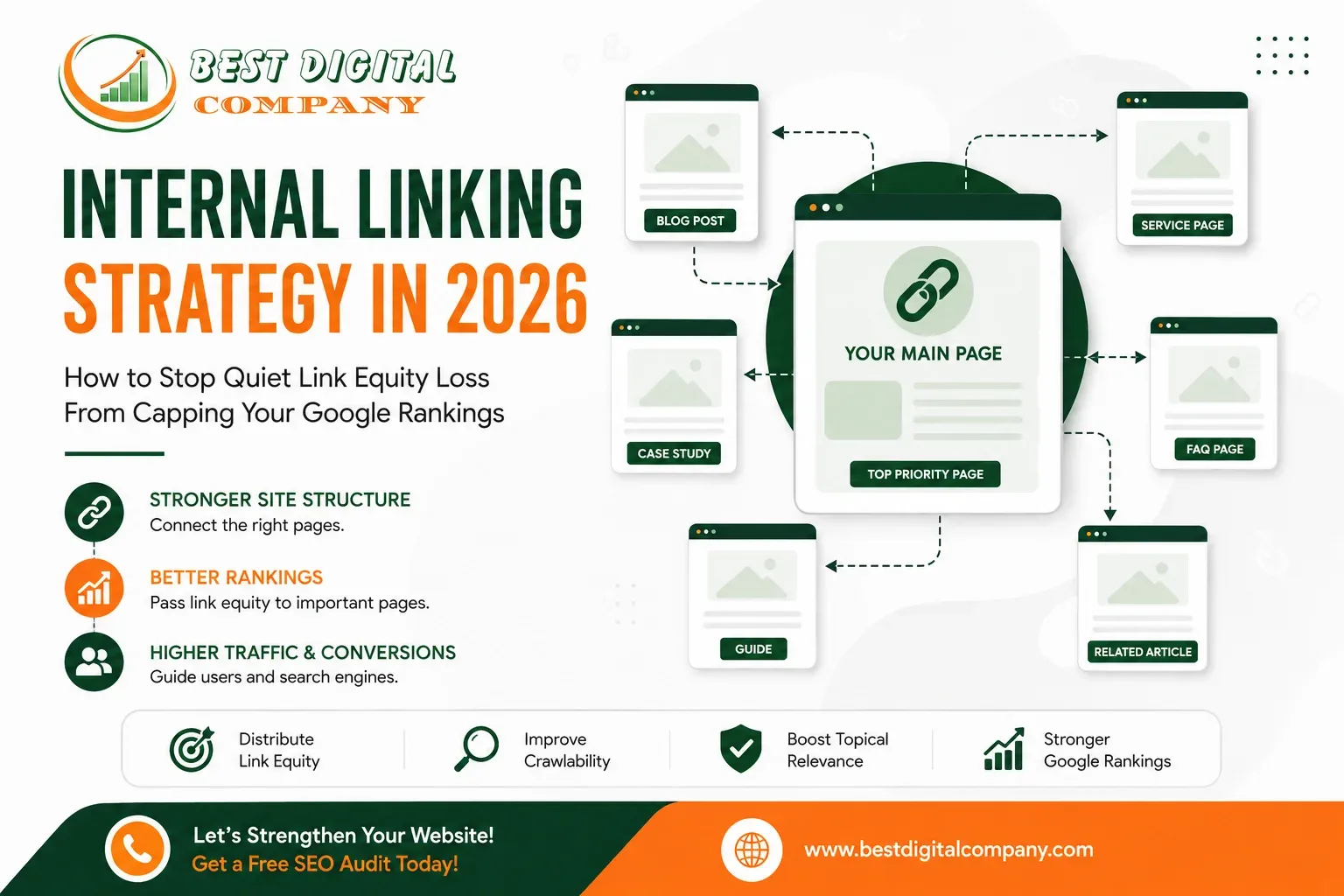
Not every page deserves equal water pressure. Your homepage, primary service pages, and best-converting content should sit at the top of that flow. The problem is that most sites do the opposite by default: new blog posts link to the newest blog posts, while the commercial pages that actually drive revenue get steadily cut off from new internal signals. Over time, search engines start treating the freshest content as the most important content simply because it’s the only thing still receiving internal support.
Internal Link Decay: A Three-Year Snapshot
This is the slow-moving problem most audits uncover, and it rarely trips any alarm in standard SEO tools.
Year one –
Ten blog posts go live, each linking to the core service page. The structure is clean and easy to follow.
Year two –
Fifty more posts publish. Writers link to whatever was published most recently, since that’s top of mind. Nobody circles back to update the original ten. The service page’s share of internal links starts shrinking relative to the rest of the site.
Year three –
Another hundred posts arrive. The earliest content is now several pages deep in the blog archive. Authority that should be concentrating on commercial pages is instead scattered across dozens of low-priority articles.
Nothing breaks. No crawl error appears. The site simply becomes structurally weaker, one publishing cycle at a time.
Nine Reasons Internal Link Value Erodes
Publishing without revisiting older content.
Most editorial calendars are built entirely around new output, with no recurring step for strengthening what’s already live.
Site redesigns.
Navigation, footers, and category pages often get rebuilt for aesthetics or usability, and the SEO impact on internal link flow is an afterthought rather than a planning input.
Unclustered content.
Without topic clusters, related articles compete against each other for the same keywords instead of reinforcing one clear cornerstone page.
Internal links that still point at redirected URLs.
Redirects technically work, but every hop adds friction. Pointing links directly at the final URL is cleaner for both crawlers and users.
Orphan pages.
A page with zero internal links pointing to it is nearly invisible to both visitors and crawlers, regardless of how good the content is.
Pagination soaking up authority.
On large blogs or ecommerce catalogs, deep paginated archives can absorb more internal link equity than the priority pages they’re meant to support.
Generic anchor text.
“Click here” and “learn more” tell search engines almost nothing about the destination page; descriptive, specific anchor text does real work.
An overgrown footprint of low-value URLs.
Tag archives, author pages, and duplicate filtered URLs quietly consume crawl budget and link equity without returning much ranking value.
Treating publication as the finish line.
Content that’s never revisited gradually falls out of the internal link graph, even if the information in it is still accurate.
How This Shows Up in Your Rankings
Weak internal linking rarely produces a dramatic ranking drop that’s part of why it goes unnoticed. Instead, you tend to see a plateau: important pages stop gaining ground, new content takes longer to index, organic traffic becomes inconsistent without an obvious cause, and conversion pages see fewer visits even as overall traffic looks stable.
The instinct in this situation is usually to buy more backlinks. In our experience, restructuring internal links first is the faster, cheaper fix you’re reallocating authority you already have rather than trying to acquire more from scratch.
Signs Worth Checking on Your Own Site
A few patterns we look for during audits: older posts that haven’t been touched in over a year, service or product pages with very few internal links pointing to them, redirect chains scattered through the site, valuable pages buried more than three clicks from the homepage, and new articles that never reference your cornerstone content. Any one of these is common; several together usually points to a structural problem worth fixing.
Frequently Asked Questions
What is an internal linking strategy?
It’s the deliberate process of connecting related pages on your site with relevant hyperlinks, so both visitors and search engines can navigate your content efficiently and understand which pages matter most.
Why do internal links matter for SEO?
They help search engines discover new pages, understand how topics relate, and decide which pages deserve the most visibility while also improving on-site navigation and engagement for real visitors.
What exactly is internal link decay?
It’s the gradual loss of internal link support to important pages as a site grows and publishes new content without maintaining older pages, which weakens authority distribution over time.
How often should internal links be audited?
Every three to six months is a reasonable cadence for most sites frequent enough to catch orphan pages and redirect chains before they accumulate.
How many internal links should one blog post include?
There’s no fixed quota. Aim for links that genuinely help the reader, which in practice tends to land somewhere between five and fifteen for a thorough article.
Do internal links directly improve rankings?
Not on their own but they materially improve how search engines crawl, understand, and prioritize your content, which supports rankings when paired with solid content and technical SEO.
What’s an orphan page, and does it need fixing?
It’s a page with no internal links pointing to it, making it hard for crawlers and users to find regardless of content quality. Linking it from relevant pages is usually a quick, high-value fix.
How does Best Digital Company approach this?
We run structural audits to map orphan pages, redirect chains, and weak linking patterns, then build a prioritized plan to redirect internal authority toward the pages that actually drive business results as part of our broader SEO Services in Delhi and beyond.
This article reflects audit methodology used at Best Digital Company as of 2026. For a site-specific internal linking audit, reach out to our team.
By Naveen Kumar,
Senior SEO Strategist at Best Digital Company
8+ years auditing enterprise and small-business websites across India, the UK, and the US.

Add a Comment