

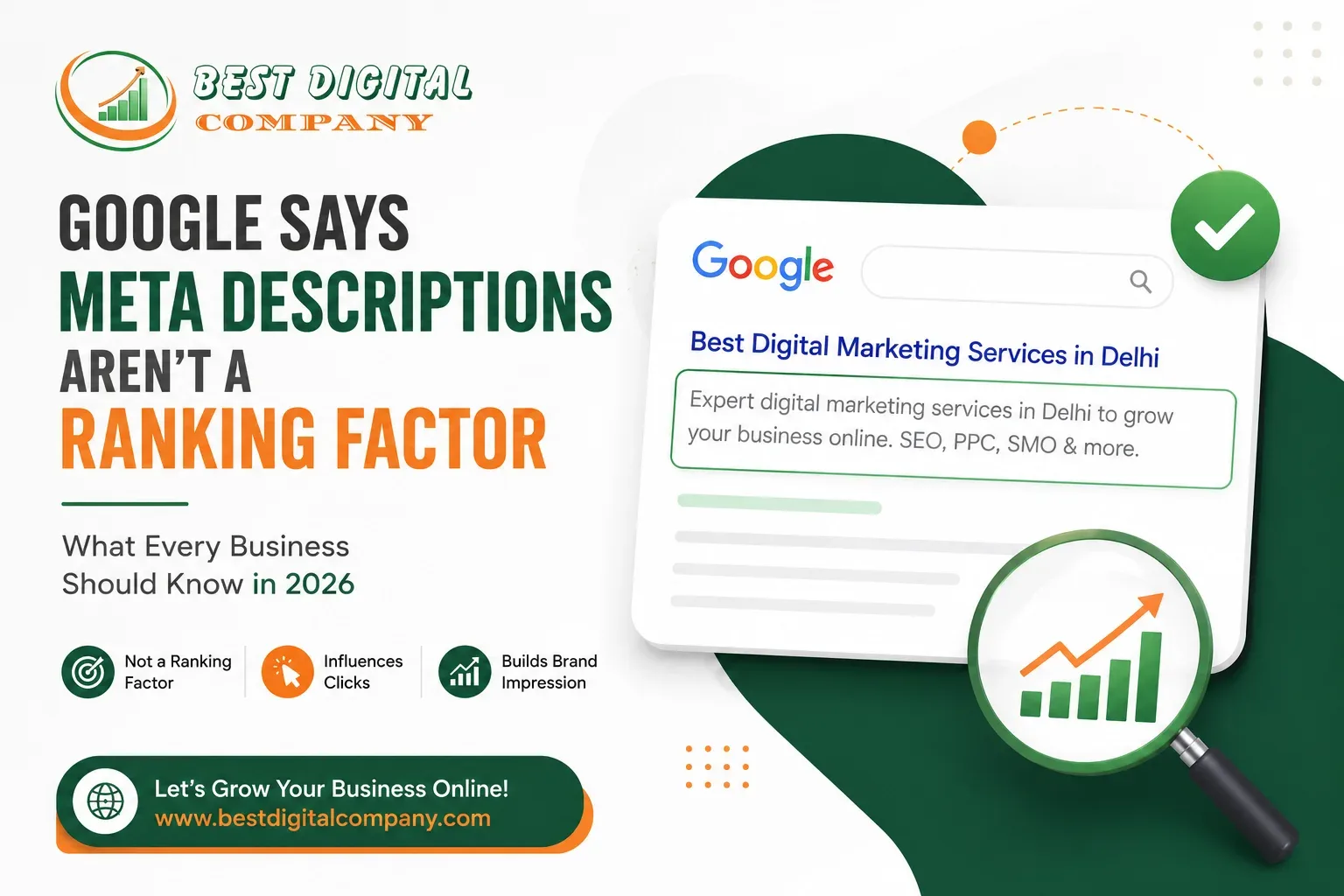
For years, digital marketers have debated one question repeatedly:
“Do meta descriptions improve Google rankings?”
Many business owners still believe that writing the perfect meta description can push a webpage to the top of Google Search.
The reality in 2026 is different.
Google has clarified that meta descriptions are not a ranking factor. A webpage won’t rank higher simply because it has a perfectly written description. Likewise, a page won’t be penalized for not having one.
That statement surprises many website owners, especially those who spend hours optimizing every page.
However, here’s where many people misunderstand Google’s message.
Just because something doesn’t directly influence rankings doesn’t mean it has no value.
A well-written meta description can influence how users perceive your business before they even visit your website. It helps communicate relevance, improves click appeal, and creates a stronger first impression.
Think of it like a storefront window.
A beautiful display doesn’t change the location of your shop, but it absolutely affects how many people decide to walk inside.
The same principle applies to your website.
Whether you run an ecommerce store, a healthcare website, a law firm, or offer SEO Services in Delhi, your meta descriptions are often the first marketing message potential customers see.
In this guide, we’ll explain exactly what changed, why Google made this clarification, and how businesses should approach meta descriptions moving forward.
What Is a Meta Description?
A meta description is a short summary placed in the HTML of a webpage.
Its purpose is simple:
It explains what visitors can expect after clicking your page.
Although users don’t usually see the meta description while browsing your website, search engines may display it beneath your page title in search results when it accurately reflects the page content.
For example, imagine someone searches for:
“Best SEO Company in Delhi”
A strong meta description might briefly explain the services offered, the industries served, and why the page is relevant.
Instead of showing random snippets from your content, Google may choose to display your description if it believes it provides the best answer for that search.
Do Meta Descriptions Affect Google Rankings?
The short answer is:
No.
Google has consistently stated that meta descriptions are not a direct ranking factor.
Adding keywords inside your description won’t magically improve your position.
Writing a longer description won’t increase authority.
Using AI-generated descriptions won’t boost rankings either.
Ranking depends on dozens of other signals, including:
- Helpful content
- Search intent satisfaction
- Website quality
- User experience
- Page speed
- Expertise
- Trustworthiness
- Internal linking
- Relevant backlinks
- Technical SEO
This is why many pages without custom meta descriptions still rank on the first page.
Google evaluates the quality of the page not whether you’ve written 155 characters inside a meta tag.
Why Google Doesn’t Require Meta Descriptions
Google’s mission has always been straightforward:
Show users the information that best answers their questions.
Sometimes, the description written by the website owner does exactly that.
Other times, it doesn’t.
Suppose a user searches:
affordable SEO audit for restaurants
If your meta description talks generally about digital marketing, but one section on your page specifically discusses restaurant SEO audits, Google may display that section instead.
Its goal is relevance.
This is why Google sometimes generates its own snippets instead of showing the description you’ve written.
Many website owners mistakenly think this means their work was wasted.
Not at all.
Google simply chooses whichever text it believes best answers the specific search query.
Why Businesses Should Still Write Meta Descriptions
Here’s where many marketers stop paying attention.
They hear:
“Meta descriptions don’t affect rankings.”
Then conclude:
“There’s no reason to write them.”
That’s a mistake.
Meta descriptions still offer several important benefits.
1. Better Brand Communication
Your description introduces your business before users visit your website.
A clear message helps people understand what you offer.
Instead of leaving Google to assemble random sentences from your page, you can provide a concise summary that reflects your brand voice.
2. Higher Click Potential
Imagine two pages ranking side by side.
One has a vague snippet.
The other clearly explains:
- what the page covers
- who it’s for
- why it’s valuable
Most users naturally gravitate toward the clearer option.
Although clicks don’t guarantee better rankings, compelling descriptions can improve how often users choose your page over competing results.
3. Better User Expectations
Nothing frustrates visitors more than clicking a page expecting one thing and finding another.
A good description sets accurate expectations.
That means visitors arrive knowing what they’ll find.
This often leads to a better browsing experience.
4. Stronger Marketing Message
Businesses spend thousands on branding.
Yet many ignore one of the first messages customers encounter.
A carefully written description lets you communicate professionalism, expertise, and value before users even visit your website.
What Happens If You Don’t Write One?
Nothing catastrophic.
Google may simply generate one automatically.
Sometimes, that generated snippet looks great.
Other times, it may:
- start mid-sentence
- cut off important information
- combine unrelated sections
- display navigation text
- show content that isn’t your primary selling point
For informational blogs, this may be acceptable.
For service pages, product pages, or landing pages, it’s usually better to provide your own description.
Why This Matters More for Service Businesses
Imagine you own a digital marketing agency.
Your service pages compete against dozens or even hundreds of similar businesses.
If someone searches for SEO Services in Delhi, PPC Services in Delhi, or SMO Services in Delhi, your meta description becomes one of the first opportunities to explain what makes your business different.
Instead of relying on automatically generated snippets, you can highlight your expertise, the industries you serve, or the value clients can expect. This doesn’t guarantee a higher ranking, but it can encourage more qualified visitors to click through.
The same principle applies whether you offer web development, local SEO, Google Ads management, or social media marketing. A concise, relevant description helps users quickly understand whether your page matches what they’re looking for.
Frequently Asked Questions (FAQs)
1. Do meta descriptions improve Google rankings?
No. Google has confirmed that meta descriptions are not a direct ranking factor. However, a well-written meta description can encourage more users to click your page by clearly explaining what it offers. This makes them valuable for user experience, branding, and improving the relevance of your search listing.
2. Does Google always use the meta description I write?
No. Google may rewrite or replace your meta description if it believes another section of your page better matches the user’s search query. Writing a clear, relevant description still increases the chances that Google will use it for important searches.
3. Should every page on my website have a meta description?
Not necessarily. Google recommends prioritizing your most important pages, such as the homepage, service pages, product pages, and high-traffic blog posts. If your website has thousands of pages, focus on creating unique descriptions for the pages that matter most.
4. What is the ideal length of a meta description?
A meta description should generally be between 140 and 160 characters. Keep it concise, informative, and relevant to the page content. Avoid keyword stuffing, and write naturally so users immediately understand what they will find after clicking your page.
5. Can duplicate meta descriptions affect SEO?
Duplicate meta descriptions usually don’t cause ranking penalties, but they can reduce clarity for search engines and users. Writing unique descriptions for important pages helps differentiate your content and improves the overall user experience when multiple pages appear in search results.
6. Should I include keywords in my meta description?
Yes, but naturally. Including your primary keyword can help users quickly identify that your page matches their search intent. Focus on writing for people first rather than forcing keywords, as readability and relevance are more important than keyword repetition.
7. Are AI-generated meta descriptions good for SEO?
AI-generated meta descriptions can save time, but they should always be reviewed by a human. Ensure they accurately summarize the page, reflect your brand voice, and provide useful information. Generic or misleading descriptions may reduce user trust and click-through rates.
8. Why are meta descriptions still important if they don’t affect rankings?
Meta descriptions influence how your page appears in search results. They help communicate your content, attract qualified visitors, and strengthen your brand message. Even without directly affecting rankings, they remain an important part of an effective on-page SEO strategy.

Add a Comment