

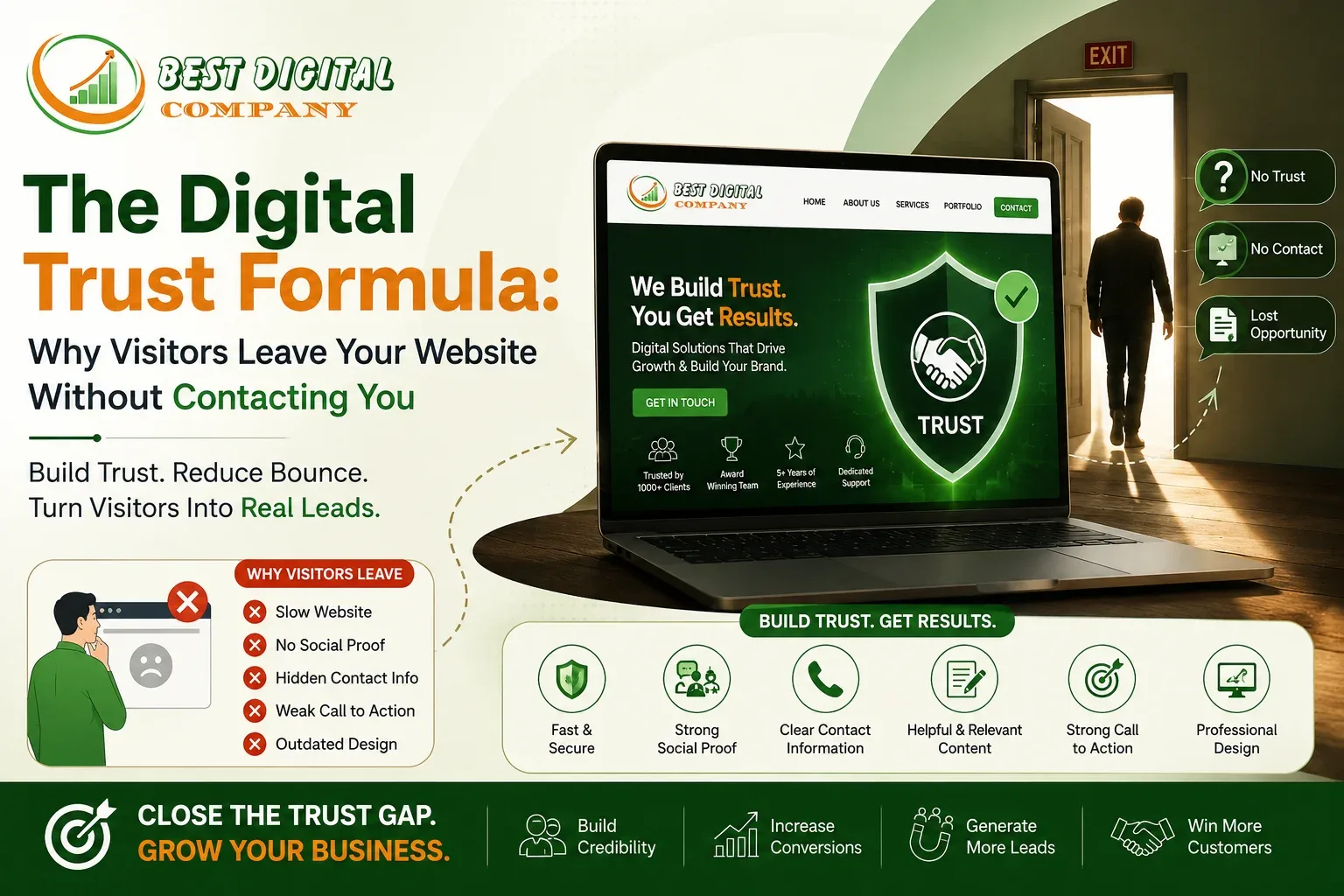
The Quiet Crisis Costing Businesses Every Day
Imagine opening your shop every morning, watching hundreds of people walk in, browse your shelves, and walk right back out without saying a word. No questions. No inquiry. No purchase. That is exactly what happens on most business websites, and owners have no idea it is happening to them.
You are investing in Google Ads, social media marketing, and SEO. People are clicking. Traffic dashboards look healthy. But the phone does not ring. The contact form sits untouched. Leads are not coming.
The problem is almost never the quality of your service. Most of the time, it is something far more invisible: digital distrust. Visitors arrive on your website, sense something is off, and make a split-second decision to leave.
This blog breaks down exactly why that happens and more importantly, gives you the formula to fix it for good.
Key Statistics:
- 94% of first impressions are based on website design
- 0.05 seconds is all it takes for a visitor to form an opinion about your site
- 75% of users judge credibility by visual design alone
- 88% of users won’t return after a bad website experience
What Is the Digital Trust Gap?
The digital trust gap is the invisible distance between what your website says about you and what a visitor actually believes about you. It does not matter how good your offer is: if your website fails to close this gap, the visitor will leave and find a competitor whose website makes them feel safe enough to reach out.
“People do not buy the best product or service. They buy the one they trust the most. Your website is your trust machine and right now, it may be broken.”
Think about the last time you searched for a service online. You opened three or four websites, stayed on one for a while, and bounced off the others almost immediately. What made you stay? It probably was not the price. It was a feeling a sense of reliability, professionalism, and familiarity that made you willing to share your details.
Your website needs to manufacture thatfeeling, deliberately and strategically. That is what the Digital Trust Formula is all about.
7 Reasons Visitors Leave Without Contacting You
Let’s get specific. Here are the most common reasons real businesses lose real leads from their websites every single day.
1. Your Website Loads Too Slowly
Speed is trust. A website that takes more than three seconds to load is a website that most visitors will abandon. According to Google, a one-second delay in page load time can reduce conversions by up to 7%. Every extra second is not just an inconvenience. it is a silent signal that your business may not be reliable or professional. Google’s Core Web Vitals now directly factor page speed into your search rankings, making this a double penalty: you lose visitors and you lose visibility.
Quick check: Test your website speed at Google PageSpeed Insights right now. If your score is below 70 on mobile, you are actively losing leads every hour your site stays that way.
2. Your Website Looks Outdated or Unprofessional
Humans are visual creatures. When a visitor lands on a cluttered, visually inconsistent, or old-looking website, their brain immediately categorises it as untrustworthy often in under a second. We associate visual quality with business quality. If your website looks like it was built in 2012, the unspoken message to your visitor is: “This business does not care about its image.” That thought immediately translates to: “Will they care about me?”
3. There Are No Social Proof Signals
Humans are social creatures. We make decisions based on what others think and do. If your website has no customer reviews, no testimonials, no case studies, no recognisable client logos visitors have nothing to anchor their trust to. They are being asked to make a leap of faith, and in a crowded digital marketplace, most people simply refuse to jump.
Businesses that display genuine client testimonials with names, photos, and specific outcomes see dramatically higher contact rates than those without any social proof at all.
4. Your Contact Information Is Hidden or Hard to Find
This is shockingly common. A potential customer is interested, they want to call you and they cannot find your phone number in under five seconds. So they leave. Your phone number, email address, and physical address (if applicable) should be visible at the top of every page, in the footer, and on a dedicated contact page. If a visitor has to “hunt” for your contact details, they will simply stop hunting and go to your competitor instead.
5. Your Content Does Not Address Real Customer Questions
Visitors arrive at your website with specific questions in their minds. “Can they handle my type of project?” “How much does it cost?” “How long will it take?” “Who are the people behind this business?” If your website fails to answer these questions ,if it is full of vague, generic statements like “We provide world-class solutions” visitors feel unheard and unsatisfied. They leave to find a website that speaks directly to their situation.
6. Your Call to Action Is Weak or Confusing
Every page on your website should tell the visitor exactly what to do next. A weak call to action or worse, no call to action at all leaves visitors in a state of passive browsing. They scroll, they read, they admire your work, and then they close the tab because nothing compelled them to take the next step. Strong calls to action are specific, urgent, and benefit-driven. “Get a Free Website Audit Today” outperforms “Contact Us” every single time.
7. Your Website Is Not Mobile-Friendly
In India, over 75% of internet users browse primarily on mobile devices. If your website does not render correctly on a smartphone, if text is too small, buttons are too close together, or images break the layout mobile visitors will leave immediately. A bad mobile experience is not just inconvenient; it is a credibility killer. Google also ranks mobile-friendly websites significantly higher in search results, meaning a broken mobile experience is costing you both leads and visibility simultaneously.
The Digital Trust Formula Explained
After working with businesses across industries, a clear pattern emerges in what separates high-converting websites from those that bleed traffic without results. We call it the Digital Trust Formula:
Digital Trust = Speed + Visual Authority + Social Proof + Clear Communication + Easy Access
Each of these five elements works together. Remove any one of them, and the entire trust structure weakens. Here is what each one means:
Speed — Your site must load in under 3 seconds on mobile and desktop. Every millisecond of delay costs you trust and rankings. Optimise images, use fast hosting, and implement caching.
Visual Authority — Professional, modern design signals that you are a legitimate, active business. Consistent brand colours, high-quality images, readable fonts, and clean layouts create the psychological perception of reliability.
Social Proof — Testimonials, Google ratings, case studies, client logos, and project outcomes give visitors external validation that your business delivers what it promises. This is the most underused trust signal on most SME websites.
Clear Communication — Speak directly to your customer’s problem. Avoid jargon. Answer their questions before they ask. Tell them who you are, what you do, who you serve, and what happens when they contact you.
Easy Access — Phone numbers, WhatsApp links, email addresses, and contact forms should be visible everywhere and friction-free. The easier you make it to reach you, the higher your conversion rate will be.
Your Trust Audit Checklist
Use this checklist to audit your own website right now. Be brutally honest — your leads depend on it.
You should have these:
✅ Website loads in under 3 seconds on mobile (test with Google PageSpeed Insights)
✅ Phone number and email are visible on the homepage above the fold
✅ At least 5 genuine customer testimonials displayed with names and outcomes
✅ Website design looks modern and consistent — updated within the last 3 years
✅ Every page has a clear, specific call to action
✅ The site is fully responsive and works perfectly on smartphones
✅ An SSL certificate is installed (https:// appears in the URL)
Warning signs — fix these immediately:
- ❌ Relying solely on “Contact Us” without explaining what happens next
- ❌ Using only generic stock photography that doesn’t represent your actual business
- ❌ Having no Google My Business listing linked or visible on the website
- ❌ Hiding your pricing or service details completely — vagueness breeds mistrust
How to Fix It: Step-by-Step
Knowing what is wrong is only half the battle. Here is a practical roadmap to rebuild digital trust on your website, regardless of whether you are a new business or an established brand.
Step 1 — Conduct a Technical Health Check
Run your website through Google PageSpeed Insights and GTmetrix. Fix image sizes, enable compression, and upgrade to a faster hosting plan if needed. Aim for a performance score above 80 on mobile. This is non-negotiable in 2026.
Step 2 — Redesign or Refresh Your Visual Identity
If your website is more than three years old, it is time for a professional refresh. Focus on consistent brand colours, clean typography, high-quality images of your actual work or team, and plenty of white space. A professional website redesign is an investment with direct, measurable returns in lead generation.
Step 3 — Collect and Display Social Proof Actively
Email your best customers and ask for a short review or testimonial. Add it to your homepage, your service pages, and your about page. Embed your Google reviews directly. Display the number of clients served, years in business, or projects completed. Social proof should be impossible to miss.
Step 4 — Rewrite Your Content to Speak to Real Pain Points
Stop writing about yourself. Start writing about your customer. Replace “We are a leading digital marketing company” with “Struggling to get leads from your website? Here’s how we fix that.” Address specific problems, ask rhetorical questions your customers actually ask, and provide genuine value before asking for a contact.
Step 5 — Make Contacting You Effortless
Add a WhatsApp chat button. Put your phone number in the top navigation bar. Add a short contact form to every service page not just the contact page. The goal is to reduce the number of clicks it takes a visitor to reach you to exactly one, from anywhere on your website.
Step 6 — Invest in SEO and Ongoing Content Marketing
Trust is also built over time through visibility. A business that consistently appears in Google search results for relevant queries builds passive authority. Publishing helpful, expert blog content like this one signals to both Google and your visitors that you are an active, knowledgeable business worth trusting.
Frequently Asked Questions (FAQ)
Why do people visit my website but never fill in the contact form?
The most common reasons are a lack of trust signals (no testimonials, no reviews, no visible contact information), a weak or unclear call to action, or a contact form that feels like too much effort. Simplify your form to just name, phone, and one question. Add a trust statement next to the form :
For example, “We reply within 2 hours. No spam, ever.” and watch your submission rate improve significantly.
How long does it take to see results after improving website trust signals?
Many improvements particularly adding social proof, simplifying navigation, and adding clear contact buttons show results within days to weeks, depending on your traffic volume. Technical improvements like page speed upgrades can show an impact on bounce rate almost immediately. SEO-related trust building, such as content marketing and backlink acquisition, typically takes 3 to 6 months to show significant ranking improvements, but the compounding effect is worth every effort.
Does website design really matter for lead generation, or is it just about looks?
Design is not about aesthetics, it is about psychology. A clean, professional design communicates competence, stability, and attention to detail. It tells visitors, before they read a single word, that you are a business that takes quality seriously. Research consistently shows that 75% of consumers judge a company’s credibility based on its website design. So while design is visual, its impact is very much functional and measurable in your lead numbers.
What is the single most impactful thing I can do today to improve my website’s conversion rate?
Add genuine customer testimonials to your homepage today. If you do not have any written ones, screenshot positive WhatsApp messages or Google reviews and add them with the customer’s permission. Social proof is the single fastest trust-builder you can implement without a redesign or technical changes. Pair this with a clearly visible phone number and a simple contact form, and you will likely see an uplift in enquiries within the first week.
How important is mobile optimisation for businesses in India?
Critically important. India has over 750 million smartphone internet users, and the vast majority of web searches especially for local businesses happen on mobile devices. If your website is not fully responsive, you are effectively invisible to this audience. Google’s mobile-first indexing means a poor mobile experience also directly suppresses your search rankings. A mobile-optimised website is not a luxury in the Indian market. it is the baseline requirement for digital credibility.
What is an SSL certificate and why does it affect visitor trust?
An SSL certificate is a digital credential that encrypts the connection between your website and your visitor’s browser, indicated by the padlock icon and “https://” in the URL. Without it, browsers like Chrome display a “Not Secure” warning to visitors. This is an instant trust-killer most visitors will leave immediately upon seeing this warning. SSL certificates are now available for free through providers like Let’s Encrypt, and most reputable hosting companies include them automatically. There is no excuse for operating without one.
Should I show pricing on my website or keep it off?
This depends on your industry, but as a general rule: hiding pricing entirely creates friction and distrust. Visitors assume the worst usually that you are too expensive. If exact pricing varies by project, consider displaying a “starting from” figure or a price range, and explain what influences the final cost. Transparency around pricing is a powerful trust signal. Even saying “Pricing is customised to your needs contact us for a free quote within 24 hours” is better than complete silence on the subject.
How does SEO relate to website trust?
SEO and trust are deeply interconnected. Google’s ranking algorithm increasingly rewards websites that demonstrate E-E-A-T: Experience, Expertise, Authoritativeness, and Trustworthiness. A website that ranks on page one of Google already carries an implied endorsement visitors assume that if Google is showing it, it must be credible. Additionally, SEO best practices: fast loading speeds, mobile optimisation, clear content structure, quality backlinks overlap significantly with trust-building best practices. Investing in good SEO is, in many ways, investing in your website’s trust infrastructure.
Can a digital marketing agency really help improve my website’s lead generation?
Absolutely if you choose the right one. A good digital marketing agency will not just run ads; they will look at your entire digital ecosystem: how your website performs technically, how it communicates trust to visitors, how well it ranks for relevant search terms, and how effectively it converts visitors into leads. Look for an agency that starts with an audit of your current website, talks about conversion rate alongside traffic, and provides transparent, measurable reporting. At Best Digital Company, we approach every client engagement with this holistic lens.
Is Your Website Losing Leads Right Now?
Get a free, no-obligation website trust audit from our team. We will identify exactly what is stopping visitors from contacting you and show you how to fix it.
Contact Us: https://bestdigitalcompany.com/contact-us/

Add a Comment