

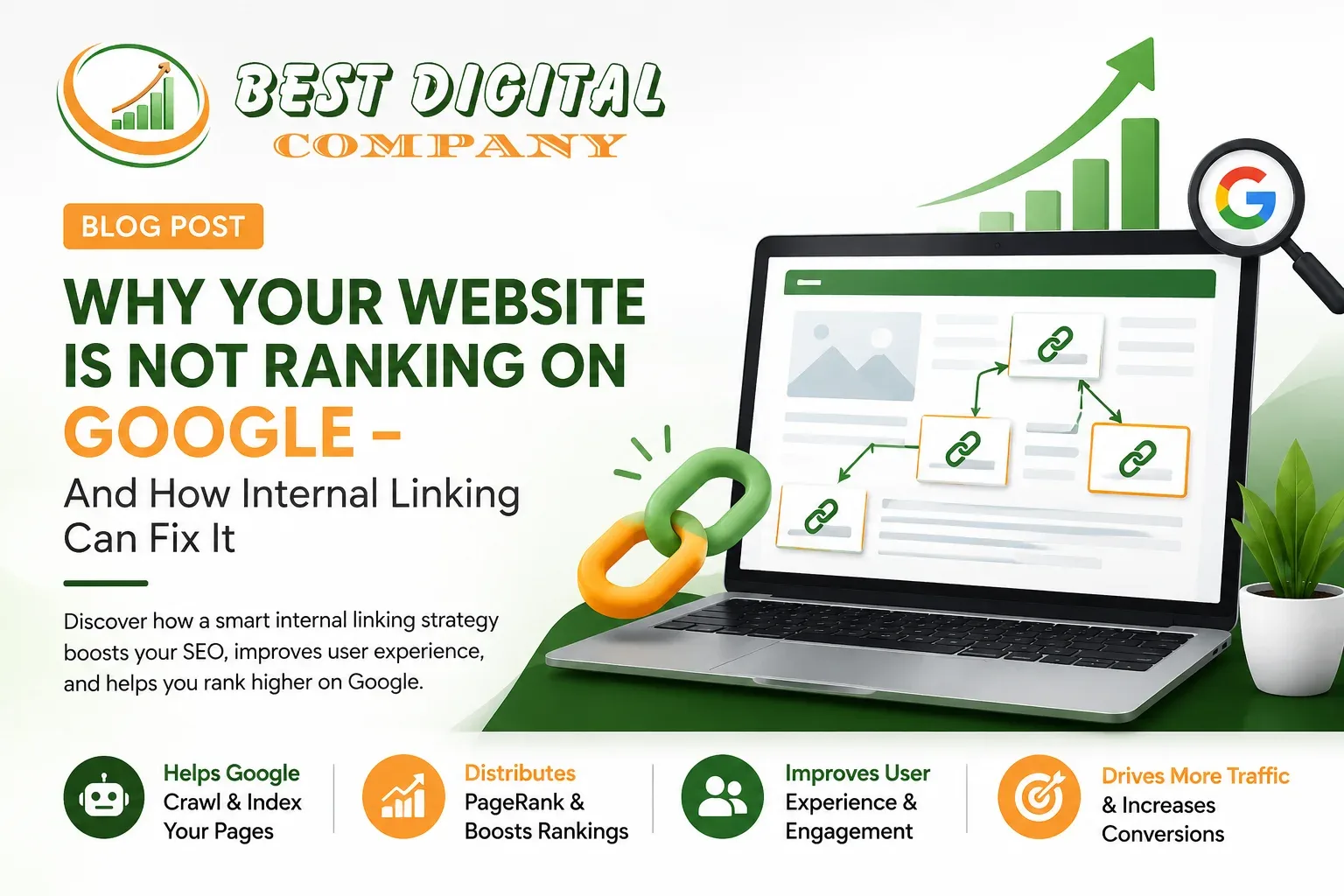
Every week, businesses invest thousands into content, technical audits, and paid backlinks, yet their SEO rankings refuse to budge. Traffic trickles in but never floods. Conversions stay modest. Sound familiar?
Here is something most agencies won’t tell you upfront: internal linking is one of the highest-impact, lowest-cost SEO levers you have and most websites use it wrong, or barely at all.
In this guide, we break down exactly what internal linking is, why it directly affects your Google rankings in 2026, and how to build a winning internal link structure that sends the right signals to search engines and users alike.
What Is Internal Linking And Why Does It Matter?
An internal link is a hyperlink that points from one page on your website to another page on the same domain. Simple enough. But the strategic placement of these links is what separates websites that dominate the first page from those that never crack the top 10.
Internal links serve three critical purposes simultaneously:
They guide Googlebot. Search engine crawlers discover new pages by following links. Without a proper internal link structure, many of your pages will never be crawled ,let alone indexed.
They distribute PageRank (link equity). Every time a page earns a backlink, that authority can be passed inward. Internal links are the pipes through which this equity flows to your most important pages.
They shape user experience. Smart internal linking keeps visitors engaged, reduces bounce rates, and guides users toward conversion pages ,all of which are positive behavioural signals that Google actively measures.
If your SEO strategy doesn’t include a deliberate internal linking plan, you are essentially building a maze with no signposts bad for visitors, worse for Google.
Did you know? Google’s John Mueller has publicly confirmed that internal links are “very important” for helping Google understand your site structure and which pages you consider most valuable. Ignoring them means leaving real ranking power on the table.
The Most Common Internal Linking Mistakes That Kill SEO
Before we dive into the fixes, let’s identify the patterns that are actively harming your rankings right now.
1. Orphan Pages
An orphan page has no internal links pointing to it. Googlebot will rarely find it, and even if it does, the page receives no link equity. These pages are effectively invisible to search engines. Run a crawl audit, you may be shocked at how many orphan pages your site has.
2. Over-Relying on Navigation Links
Your header and footer navigation links count, but they carry far less contextual weight than in-content links. If every page is only linked from the nav menu, Google sees a flat, undifferentiated hierarchy with no prioritisation of your important pages.
3. Generic Anchor Text
Linking with phrases like “click here” or “read more” tells Google absolutely nothing about the destination page’s topic. Keyword-rich, descriptive anchor text helps Google understand relevance and directly boosts the ranking potential of the target page.
4. Broken Internal Links
Linking to pages that return a 404 error wastes your crawl budget and passes no equity. Regular audits are essential especially after site migrations, page deletions, or URL restructuring.
5. Ignoring Deep Pages
The deeper a page sits within your site’s structure more than 3 clicks from the homepage the less authority it typically receives and the less often it gets crawled. Flattening your architecture through strategic internal links solves this entirely.
How Google Reads Your Internal Link Structure in 2026
Google’s crawling and ranking systems have grown dramatically more sophisticated. In 2026, here’s what Googlebot prioritises when evaluating your internal link structure:
- Topical clusters: Google rewards sites that organise content into tightly linked topic clusters pillar pages surrounded by cluster pages. Internal links signal which pages belong together thematically.
- Contextual relevance: Links embedded naturally within body content carry significantly more weight than those in sidebars, footers, or boilerplate sections.
- Anchor text diversity: A natural mix of exact-match, partial-match, and branded anchors looks organic and avoids over-optimisation signals.
- Link depth and crawl prioritisation: Pages linked from the homepage or high-authority pages get crawled more frequently and receive more distributed equity.
- E-E-A-T reinforcement: Linking between topically authoritative pages signals genuine expertise and depth an increasingly critical ranking factor under Google’s Helpful Content guidelines.
Pro Tip: Think of your website as a spider’s web. Every page is a node. The strength of the web depends on how many threads connect each node. The more contextually relevant internal links pointing to a page, the stronger its position in Google’s index.
Building a Winning Internal Link Strategy: Step by Step
Here is a practical, actionable framework our team at Best Digital Company uses for clients across India whether they need SEO Services in Mumbai, are growing businesses seeking SEO Services in Punjab, or enterprises scaling with SEO Services in Haryana.
Step 1: Audit Your Current Internal Links
Use a crawl tool -Screaming Frog, Ahrefs Site Audit, or Google Search Console, to map all existing internal links. Identify orphan pages, broken links, redirect chains, and pages with too few inbound internal links. This becomes your baseline for everything that follows.
Step 2: Define Your Site Architecture & Priority Pages
Decide which pages are your most strategically important, typically your commercial service pages and high-converting landing pages. These are your “pillar” pages. Every other relevant page on your site should have a pathway linking toward them. For example, every blog post about SEO should link contextually to your core SEO services page.
Step 3: Build Topical Clusters
Group your content into topic silos. A pillar page covers a broad topic broadly; cluster pages go deep on specific sub-topics, all linking back to the pillar and to each other where relevant. This structure builds topical authority and signals to Google that your site genuinely covers the subject comprehensively.
Step 4: Use Descriptive, Keyword-Rich Anchor Text
When linking to your PPC advertising services, use anchor text like “Google Ads management” or “pay-per-click campaign services” not “learn more.” Be descriptive, be natural, and vary your anchors consistently across multiple linking pages.
Step 5: Link New Content to Existing Pages Immediately
Every time you publish a new blog post or landing page, add contextual internal links from it to 3–5 relevant existing pages, and go back and add links from existing pages to the new one. This two-way linking accelerates indexation and distributes equity from day one.
Step 6: Monitor, Measure & Iterate
Set up tracking in Google Search Console and Google Analytics 4 to monitor which pages gain ranking improvements after internal link updates. Crawl your site quarterly. SEO is an ongoing, evolving system not a one-time fix.
How Best Digital Company Handles Internal Linking for Clients
Our approach to internal linking is never just technical, it is strategic and content-driven at every level. When a client comes to us with stagnant rankings, internal link architecture is always among the first areas we investigate, and frequently one of the fastest wins available.
We integrate deliberate internal linking strategy across all our services:
- Search Engine Optimization (SEO) — full site architecture mapping, link equity analysis, and cluster-building
- Social Media Marketing (SMM) —driving engaged traffic that lands on well-linked, high-converting pages
- Pay-Per-Click Advertising (ADS) — ensuring ad landing pages are supported by strong internal link authority
- Web Development — building sites from the ground up with SEO-friendly architecture and logical navigation hierarchies
We also offer tailored packages designed for different business sizes and goals. Whether you need a comprehensive SEO Package, a focused SMO Package, or a complete Web Development Package our strategies always include internal linking architecture as a core deliverable, not an afterthought.
Internal Linking Best Practices
Google’s recent algorithm updates particularly around Helpful Content and E-E-A-T have raised the bar significantly. Here is what matters most right now:
- Quality over quantity. Five highly relevant internal links beat fifty random ones. Every link should serve the reader and reinforce topical relevance.
- Aim for no more than 100 links per page as a general guideline. Beyond this, each individual link carries less distributed equity.
- Always use follow links internally. There is almost never a valid reason to nofollow an internal link. You want equity to flow freely within your own domain.
- Fix all redirect chains. If internal links pass through multiple redirects before reaching the destination, equity is significantly diluted. Always link directly to the final canonical URL.
- Prioritise contextual placement. Links appearing in the first 100–200 words of a page carry slightly more weight in Google’s evaluation. Lead with your most important contextual links.
- Mobile-first consideration. Ensure internal links are tap-friendly with adequate spacing on mobile. Poor UX signals high bounce rates, low dwell time directly impact your rankings.
Internal Linking for Local SEO: A Powerful Combination
If your business targets customers in specific cities or regions across India, internal linking becomes even more powerful. By creating dedicated location pages and linking to them from blog posts, service pages, and the homepage, you send strong geo-relevance signals to Google.
For example, a digital agency targeting clients across India might build a cluster of city-specific service pages like our SEO Services in Mumbai, SEO Services in Punjab, and SEO Services in Haryana and then systematically link to each from relevant blog content, the main services hub page, and the homepage footer.
This creates a geographic authority cluster that tells Google precisely where you operate, which local searches you should rank for, and how committed your local presence genuinely is.
Frequently Asked Questions
How many internal links per page is ideal?
There is no single perfect number, but a practical guideline for most sites is 3–10 contextual internal links per standard blog post or landing page. The links should feel natural and genuinely serve the reader’s journey. Avoid stuffing links purely for SEO, Google’s systems are sophisticated enough to detect and discount over-optimised patterns. Quality of placement matters far more than raw volume.
Does anchor text really make a difference for internal links?
Absolutely and it is one of the most underestimated factors in on-page SEO. Descriptive, keyword-relevant anchor text helps Google understand the topic of the destination page and reinforces its relevance for specific search queries. Using “click here” or “read more” misses this opportunity entirely. Use natural, varied, descriptive anchors consistently for measurable improvements in target page rankings.
Should I update old blog posts to add internal links?
Yes and this is one of the most cost-effective SEO actions you can take right now. Revisiting existing content and adding contextual links to strategically important pages distributes your existing authority and can produce meaningful ranking improvements within weeks, without creating a single new piece of content. Many of our clients see quick wins from this alone.
Can internal linking replace backlinks?
No and you wouldn’t want it to. Backlinks from authoritative external sites remain one of Google’s most powerful ranking signals. However, internal links amplify the value of the backlinks you already have by distributing that authority precisely to the pages that need it most. Think of them as complementary forces working together, not alternatives to each other.
How soon will I see results after fixing internal links?
Results typically begin to appear within 4–12 weeks, depending on how frequently Google crawls your site. After updating your internal link structure, you can request re-crawling of updated pages in Google Search Console to accelerate the process. Sites with stronger existing domain authority tend to see improvements on the faster end of this window.
What tools should I use to audit internal links?
The most commonly used tools are Screaming Frog SEO Spider (excellent for small to mid-size sites), Ahrefs Site Audit, Semrush Site Audit, and Google Search Console’s Coverage and Links reports. For most businesses, starting with Google Search Console (free) and one premium crawl tool gives you everything you need to identify and fix internal linking issues systematically.
Is internal linking part of on-page SEO or technical SEO?
It sits at the intersection of both. The strategy and anchor text selection is on-page SEO; the crawlability, redirect chains, and site architecture aspects are technical SEO. This is precisely why internal linking is so valuable fixing it delivers improvements across both disciplines simultaneously, making it one of the highest-ROI SEO activities available to any website.
Ready to Fix Your SEO From the Inside Out?
Internal linking is not a minor detail ,it is the structural backbone of a high-performing website. If your rankings have plateaued despite producing good content and earning backlinks, there is a strong chance your internal link architecture is the missing piece.
At Best Digital Company, we specialise in building SEO strategies that actually move the needle combining technical excellence, content strategy, and smart internal linking into a single, unified approach.
📞 Call us: +91 8587948051
✉️ Email us: Contact@bestdigitalcompany.com
🌐 Visit: bestdigitalcompany.com

Add a Comment