

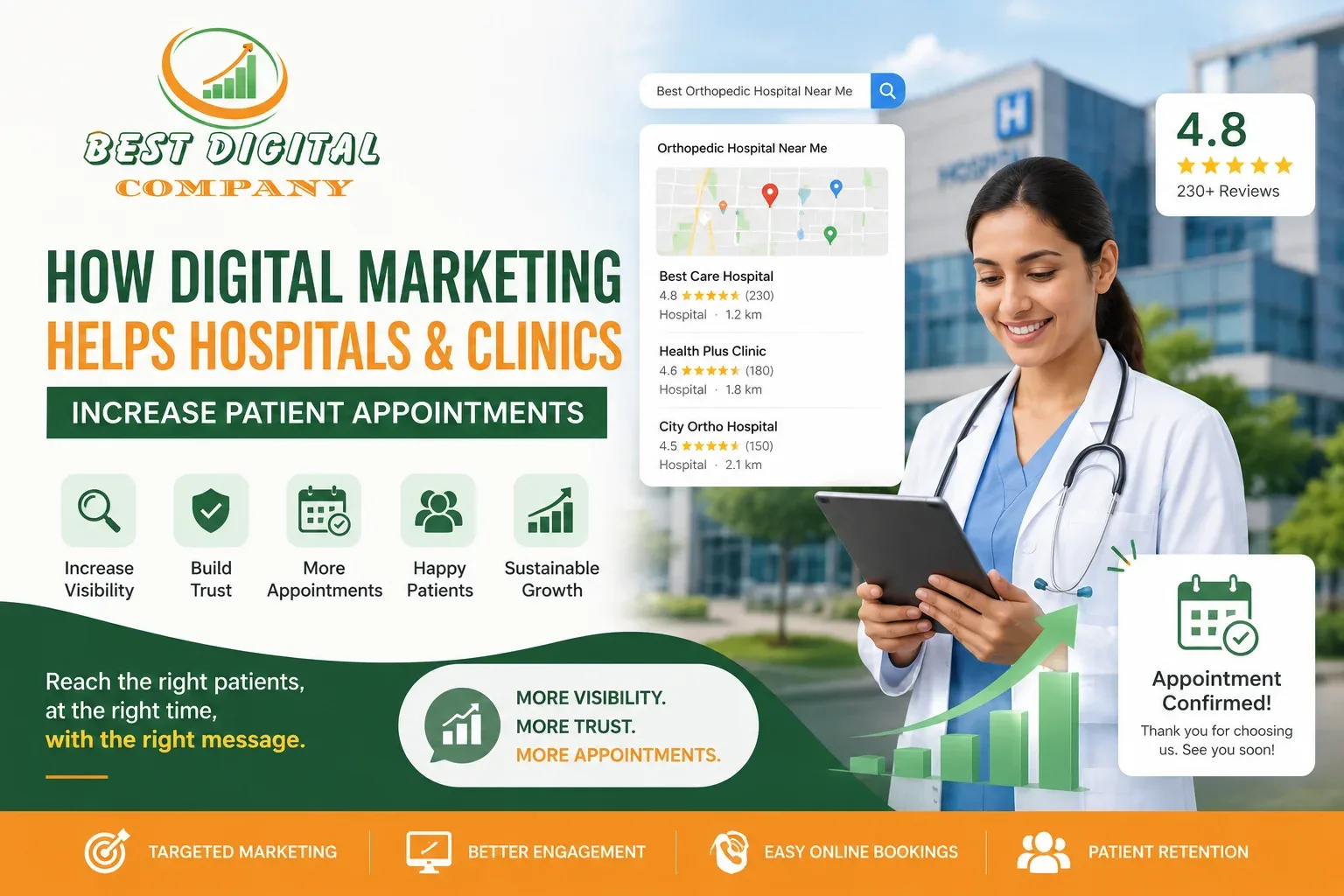
Think about the last time someone in your family needed a specialist. Chances are, the very first thing they did was open Google. They typed something like “best cardiologist near me” or “paediatric clinic open on Sunday in [city]” and they chose one of the first three results they saw.
That moment that search, is where healthcare decisions are made today. And if your hospital or clinic isn’t showing up there, your competitor’s is.
Digital marketing for hospitals is no longer a nice-to-have. It’s the single most powerful tool you have to reach patients at exactly the moment they need you, build trust before they walk through your door, and keep them coming back. This guide breaks down every channel that matters and shows you how to use each one to genuinely increase patient appointments.
Why Digital Marketing Is Important for Hospitals and Clinics
A decade ago, hospitals relied on word-of-mouth, newspaper ads, and hoardings near busy intersections. That model still has some value, but it’s shrinking fast. The patient journey has moved online from the first symptom search to reading doctor reviews to booking an appointment through a website or app.
What makes healthcare digital marketing different from other industries is the emotional weight behind every search. A person looking for an oncologist or a paediatric emergency clinic isn’t idly browsing ,they’re scared, in a hurry, or both. The practice that shows up with the right information, a credible presence, and an easy path to booking gets that patient. The one that doesn’t, doesn’t.
Here’s what a well-executed digital marketing strategy actually does for a healthcare business:
- Increases visibility so patients find you first on Google, Maps, and healthcare directories.
- Builds trust through online reviews, expert content, and a professional website — before a patient ever meets a doctor.
- Reduces no-shows with automated reminder systems tied to online booking flows.
- Fills appointment slots with targeted Google Ads and local SEO that reach patients who are actively searching right now.
- Retains existing patients through email, WhatsApp, and social media follow-ups that keep your clinic top-of-mind.
“The hospital that shows up on page one of Google isn’t necessarily the best hospital in your city – but in a patient’s mind, it might as well be.”
SEO Strategies That Increase Patient Appointments
Search Engine Optimisation for hospitals is about one thing: showing up when patients are searching for what you offer. But SEO for hospitals is nuanced, it requires a blend of technical precision, high-quality medical content, and the kind of trustworthiness that Google’s algorithms are specifically designed to measure in healthcare (what Google calls E-E-A-T: Experience, Expertise, Authoritativeness, Trustworthiness).
Keyword Strategy That Actually Reflects Patient Intent
Patients don’t search the way doctors talk. They type “knee pain doctor” not “orthopaedic surgeon for chondromalacia.” Your keyword strategy must include both clinical terms and everyday patient language. Longer, intent-rich phrases like “best gynaecologist for PCOD in Delhi” typically convert far better than broad terms because they capture patients who already know what they need.
Content That Answers Real Medical Questions
Google’s algorithm for healthcare sites prioritises content written by, attributed to, or reviewed by qualified medical professionals. A library of well-written condition pages, symptom guides, and procedure explainers does two things simultaneously: it ranks on Google for long-tail searches, and it establishes your doctors as authoritative, trustworthy voices in their field. This is some of the highest-ROI content a hospital can produce.
Technical SEO: The Foundation You Can’t Skip
Speed, mobile-friendliness, structured data markup, and clean site architecture aren’t glamorous but they’re the difference between a page that Google crawls and ranks versus one that disappears into obscurity. Healthcare websites with slow load times lose patients before a word is read.
SEO Checklist for Healthcare Websites:
- Target condition-specific and symptom-based keywords alongside service keywords
- Attribute medical content to named, credentialed doctors (with their photo and bio)
- Add structured data markup (MedicalOrganization, Physician, FAQPage schema)
- Ensure your site loads in under 2.5 seconds on mobile
- Create individual pages for each speciality, doctor, and location
- Publish a blog with regular, patient-focused health content
- Build high-quality backlinks from health directories and local news sites
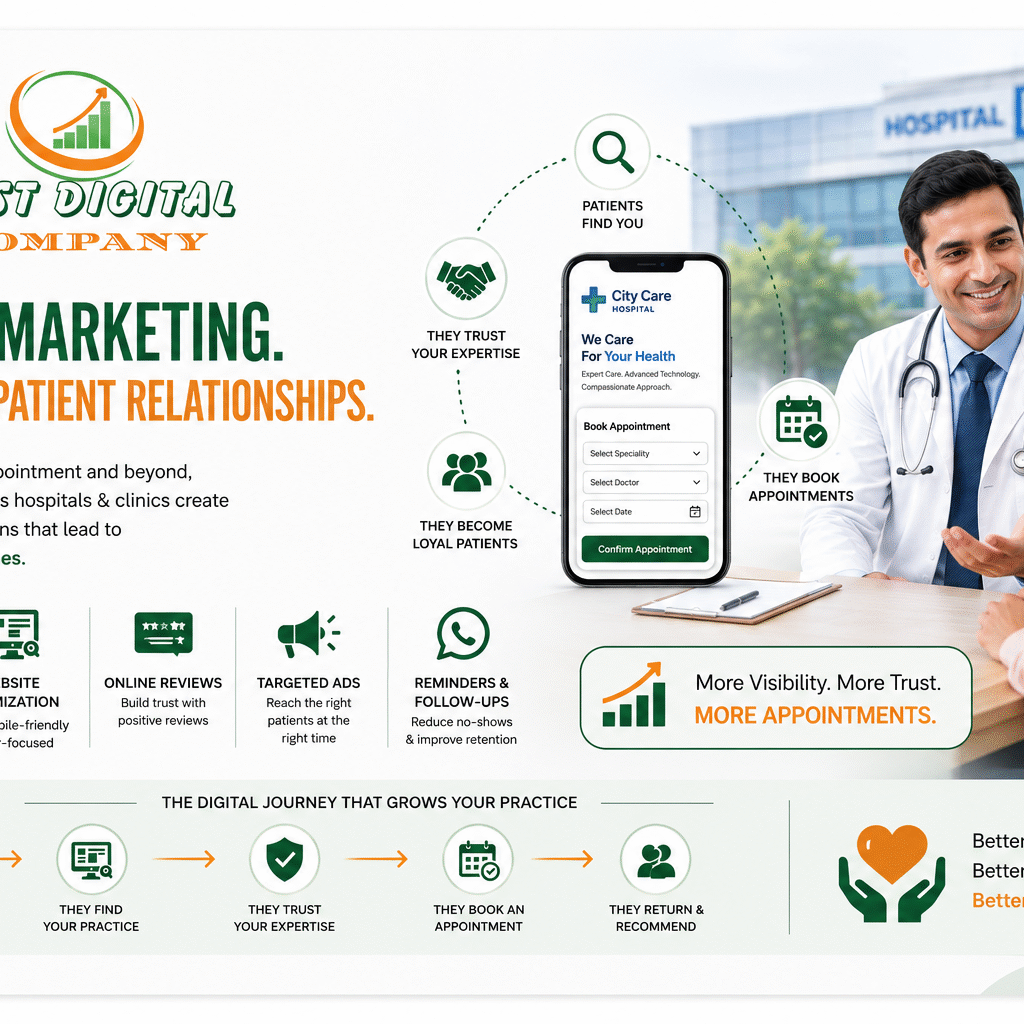
How Local SEO Helps Hospitals Rank on Google
If someone in your city searches “dermatologist near me” and your clinic doesn’t appear in Google’s local 3-pack (that map with three highlighted listings), you’ve lost that patient to a competitor. Local SEO for clinics is arguably the most impactful digital marketing lever for healthcare businesses especially for multi-specialty hospitals and single-location clinics.
Google Business Profile: Your Most Valuable Free Asset
Your Google Business Profile is the first thing most local patients see. It shows your address, opening hours, phone number, photos, appointment link, and crucially your star rating and reviews. An optimised, actively managed profile dramatically improves your chances of appearing in the local pack for high-intent searches like “orthopaedic hospital near me” or “best ENT specialist in [area].”
NAP Consistency Across All Directories
Name, Address, and Phone number must be identical across every place they appear online your website, Practo, JustDial, Sulekha, Google, Facebook, and health directories. Even small inconsistencies confuse Google’s local ranking algorithm and hurt your visibility.
Local Content and Geo-Targeted Landing Pages
Hospitals serving multiple areas should create individual landing pages for each location or neighbourhood, each optimised for area-specific searches. A page titled “Cardiology Hospital in Ghaziabad” will outrank a generic services page for patients searching in that specific area.
“Local SEO is the closest thing to a guaranteed patient pipeline. When someone in your city searches for a doctor and you show up first with good reviews and easy booking , the conversion almost takes care of itself.”
Benefits of Google Ads for Healthcare Businesses
Google Ads for hospitals is the fastest way to reach patients who are actively searching right now, today for exactly the services you offer. Unlike SEO, which builds momentum over months, a well-structured ad campaign can put your hospital at the top of Google within 24 hours of launch. For new clinics, clinics launching a new speciality, or those trying to fill specific appointment slots quickly, it’s invaluable.
Search Ads for High-Intent Patients
A patient typing “LASIK surgery consultation Noida” or “diabetologist appointment tomorrow” is at the bottom of the decision funnel. They’re not researching they’re ready to book. A precise search ad campaign targeting these high-intent queries delivers patients with the highest likelihood of converting into actual appointments.
Remarketing to Visitors Who Didn’t Book
Not everyone books on their first visit to your website. Healthcare decisions often take time. Remarketing campaigns keep your hospital visible to those visitors as they continue browsing a gentle, persistent reminder that guides them back when they’re ready to act.
Performance Max and Local Service Ads
Google’s Performance Max campaigns allow hospitals to reach patients across Search, YouTube, Gmail, and the Display Network from a single campaign. Local Service Ads, where available, show your clinic with a “Google Screened” badge significantly increasing trust and click-through rates.
Social Media Marketing for Clinics and Doctors
Social media is where your hospital builds relationships before patients need you and maintains them long after a visit. For healthcare providers, platforms like Instagram, Facebook, and YouTube serve a dual purpose: patient education and reputation building. Done well, they turn your doctors into trusted community figures.
The most effective social content for healthcare falls into a few clear categories:
- Health education posts – simple, visual explanations of conditions, preventive care tips, and myth-busting content. These get shared, expanding your reach organically.
- Doctor introduction videos – short clips where your doctors speak directly to patients. Nothing builds trust faster than seeing and hearing the person who might treat you.
- Patient success stories – with consent, sharing real patient journeys is powerfully persuasive and deeply human.
- Live Q&A sessions – weekly or monthly Instagram or YouTube Live sessions where doctors answer public health questions position your hospital as a generous, accessible resource.
Paid social campaigns on Facebook and Instagram are also remarkably cost-effective for promoting specific services, seasonal health camps, or new specialty launches particularly for reaching local audiences in a defined geographic radius around your hospital.
Online Reputation Management for Hospitals
Ninety-four percent of patients read online reviews before choosing a healthcare provider. A single bad review left unaddressed can cost you dozens of potential patients. Online reputation management for hospitals isn’t about hiding negative feedback, it’s about actively building a review profile strong enough that the occasional criticism is clearly an outlier, not a pattern.
Building a Review Culture Inside Your Hospital
The best way to generate good reviews is to systematically ask for them. After every appointment, a simple SMS or WhatsApp follow-up , “We hope your visit went well. If you’d like to share your experience on Google, it helps other patients find us” with a direct link can dramatically increase your review volume. Staff training matters too: the front desk and nursing team often have the biggest impact on the patient experience, and on whether a patient feels moved to leave feedback.
Responding to Reviews – Both Good and Bad
Every review deserves a response. Thank positive reviewers personally , it shows you read and appreciate feedback. For negative reviews, respond calmly, acknowledge the concern, and invite the patient to reach out directly to resolve it. Never be defensive. A graceful response to a critical review often impresses prospective patients more than the review itself upsets them.
Monitoring Your Brand Across the Web
Reputation management goes beyond Google. Monitor Practo, Lybrate, Healthgrades, Facebook, and any forum or social platform where patients discuss local healthcare. Setting up Google Alerts for your hospital’s name ensures nothing flies under the radar.
How Healthcare Websites Convert Visitors Into Patients
Traffic without conversion is just noise. Your hospital’s website can rank on page one and still fail to generate appointments if the user experience is poor, trust signals are absent, or booking requires too many steps. A high-converting healthcare website is designed around one goal: making it as easy as possible for a concerned patient to take the next step.
The Elements That Actually Drive Bookings
- A visible, prominent “Book Appointment” button – above the fold on every page, in your site’s header, and after every doctor’s profile.
- Doctor profiles that feel human – professional photos, warm bios in plain language, clear listing of conditions treated, and qualifications that are real without being intimidating.
- Trust indicators – accreditations, years of experience, number of procedures performed, and patient testimonials are conversion gold.
- Click-to-call functionality on mobile – never make a mobile visitor copy-paste a phone number. One tap should initiate the call.
- Live chat or WhatsApp integration – patients often have a quick question before they commit to booking. A chat widget that connects them to a human converts a hesitant visitor into a confirmed appointment.
- Fast, mobile-first design – if your website takes more than 3 seconds to load on a phone, more than half your visitors are already gone.
Best Digital Marketing Channels for Hospitals
The landscape of healthcare marketing services keeps evolving new platforms, new patient behaviours, new algorithm updates. But heading into the second half of 2026, the following channels deliver the strongest, most reliable return for hospitals and clinics.
1. Google Search (SEO + Paid Ads)
Still the dominant acquisition channel for healthcare. A combined strategy organic SEO for long-term visibility and Google Ads for immediate, targeted reach covers both the patient who’s in research mode and the one who’s ready to book today. Non-negotiable for any hospital serious about growth.
2. Google Maps / Local Search
For walk-in patients and local appointment seekers, appearing in Google’s local 3-pack is often more valuable than a position-one organic ranking. Local SEO is the engine behind this, but it requires consistent, ongoing attention not a one-time setup.
3. YouTube
Healthcare is one of the most-searched categories on YouTube. Patients research procedures, watch doctor explainer videos, and read comments before making decisions. A hospital YouTube channel with well-produced, educational content can become a significant, compounding source of new patient enquiries.
The Bottom Line: Patients Are Online – Are You?
The hospitals and clinics that will lead their markets through the rest of this decade aren’t just the ones with the best doctors and the most advanced equipment though those things matter enormously. They’re the ones that make themselves findable, trustworthy, and easy to choose in the moments that count.
Every day your hospital runs without a serious digital marketing strategy is a day your competitor is showing up where you aren’t. The gap is only going to widen.
Whether you’re a single-specialty clinic looking to fill your appointment book or a multi-department hospital aiming to dominate your city’s search results, the strategies in this guide, SEO for hospitals, local SEO, Google Ads, reputation management, social media, and website conversion optimisation form the complete playbook you need.
The team at Best Digital Company specialises in healthcare digital marketing. We understand the compliance requirements, the patient psychology, and the channel mix that actually moves the needle for medical businesses. Let’s talk about how we can help your hospital grow.
📞 +91 8587948051
✉ Contact@bestdigitalcompany.com
🌐 bestdigitalcompany.com
Published by Best Digital Company | Healthcare Digital Marketing Specialists

Add a Comment